Join us on a literary world trip!
Add this book to bookshelf
Grey
Write a new comment Default profile 50px
Grey
Subscribe to read the full book or read the first pages for free!
All characters reduced
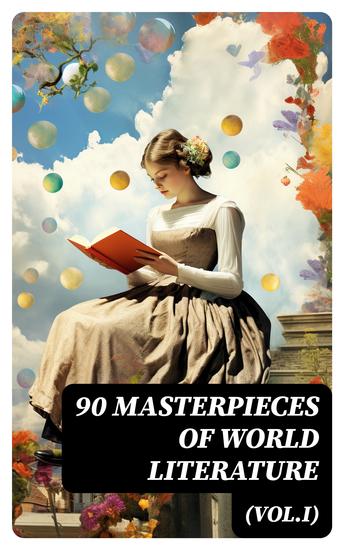
90 Masterpieces of World Literature (VolI) - Novels Poetry Plays Short Stories Essays Psychology & Philosophy - cover

90 Masterpieces of World Literature (VolI) - Novels Poetry Plays Short Stories Essays Psychology & Philosophy

Edgar Allan Poe, George Eliot, Benito Pérez Galdós, William Shakespeare, Juan Valera, Charles Dickens, Lewis Carroll, Mark Twain, Louisa May Alcott, Jane Austen, Oscar Wilde, Herman Melville, Alexandre Dumas, Joseph Conrad, Charlotte Brontë, Daniel Defoe, Henry David Thoreau, L. Frank Baum, Emily Brontë, Washington Irving, Walt Whitman, Henry James, Hans Christian Andersen, D. H. Lawrence, Anthony Trollope, Giovanni Boccaccio, Guy de Maupassant, Sigmund Freud, Marcus Aurelius, Frederick Douglass, Stephen Crane, William Makepeace Thackeray, Anne Brontë, Robert Louis Stevenson, John Keats, Anton Chekhov, Marcel Proust, George Bernard Shaw, Charles Baudelaire, Walter Scott, R. D. Blackmore, Sun Tzu, H. P. Lovecraft, Francis Hodgson Burnett, Mary Shelley, Rudyard Kipling, Upton Sinclair, Kahlil Gibran, Edgar Rice Burroughs, Ernest Hemingway, Agatha Christie, Herman Hesse, E. M. Forster, H. A. Lorentz, Theodore Dreiser, Plato, H. G. Wells, Nikolai Gogol, Arthur Conan Doyle, Brothers Grimm, Wallace D. Wattles, Selma Lagerlöf, Victor Hugo, Fyodor Dostoevsky, James Joyce, T. S. Eliot, James Allen, Apuleius, Margaret Cavendish, Thomas Hardy, Jack London, Jules Verne, Soseki Natsume, Miguel de Cervantes, Leo Tolstoy, Princess Der Ling, Johann Wolfgang Goethe, Pierre Choderlos de Laclos, Voltaire

Publisher: DigiCat

  • 0
  • 0
  • 0

Summary

In "90 Masterpieces of World Literature (Vol.I)", readers are invited to explore a rich tapestry woven from some of the most influential and diverse voices in literature. This anthology captures a vast spectrum of styles, from the surreal landscapes of Lewis Carroll to the incisive realism of Charles Dickens, and the natural mysticism of Walt Whitman. Within these pages, short stories, essays, and excerpts unfold themes of existential quest, social justice, romantic idealism, and philosophical intrigue. Each piece stands as a testament to the eras and milieus that birthed them, showcasing the expanse of human creativity and thought that transcends time. The anthology benefits from the collective power of its contributors, drawing upon a wide array of cultural and historical contexts. The voices of Plato and Marcus Aurelius converge with the modern insights of Sigmund Freud and D. H. Lawrence, while global narratives from Soseki Natsume to Miguel de Cervantes resonate through time. This collection is a reflection of the transformative movements in literature, such as Romanticism, Realism, and Modernism, bridging Western and Eastern storytelling traditions. Together, these authors offer insights into the universal human experience, enriched by their unique backgrounds and perspectives. This volume serves as a voyage through the corridors of time and thought, offering readers an unparalleled breadth of insights in one curated tome. Whether a seasoned scholar or an enthusiastic newcomer, "90 Masterpieces of World Literature (Vol.I)" provides an invaluable educational resource that fosters an appreciation for the multifaceted dialogues in world literature. Dive into this anthology to uncover the intricate layers and timeless wisdoms it offers, making it not just a reading experience, but a profound exploration of literary brilliance.
Available since: 11/16/2023.
Print length: 28094 pages.

Other books that might interest you

  • Hunchback of Notre-Dame The (Book 7) - cover

    Hunchback of Notre-Dame The...

    Victor Hugo

    • 0
    • 0
    • 0
    Book 7: The Hunchback of Notre-Dame or Notre-Dame de Paris is a French Gothic novel by Victor Hugo, published in 1831. - The story is set in Paris in 1482 during the reign of Louis XI. The gypsy Esmeralda (born as Agnes) captures the hearts of many men, including those of Captain Phoebus and Pierre Gringoire, but especially Quasimodo and his guardian Archdeacon Claude Frollo. Frollo is torn between his obsessive lust for Esmeralda and the rules of Notre Dame Cathedral. He orders Quasimodo to kidnap her, but Quasimodo is captured by Phoebus and his guards, who save Esmeralda. Gringoire, who attempted to help Esmeralda but was knocked out by Quasimodo, is about to be hanged by beggars when Esmeralda saves him by agreeing to marry him for four years.
    Show book
  • Father Brown: The Eye of Apollo (Unabridged) - cover

    Father Brown: The Eye of Apollo...

    G.K. Chesterton

    • 0
    • 0
    • 0
    The tenth story in The Innocence of Father Brown is entitled "The Eye of Apollo." At the beginning of this short story, Flambeau has just opened his detective agency in a new building located near Westminster Abbey. The other tenants in the building are a religious charlatan named Kalon, who claims to be "the New Priest of Apollo," and two sisters, who are typists. Flambeau and Father Brown instinctively distrust Kalon, who has installed a huge eye of Apollo outside his office.
    Show book
  • Cambridge - The Dark Masters - Dark short story collection from authors that graduated one of the worlds most prestigious universities - cover

    Cambridge - The Dark Masters -...

    M R James, E F Benson, Arthur Gray

    • 0
    • 0
    • 0
    Cambridge University is esteemed as one of the great learning centres of the world, and has been for many centuries. 
     
    Whatever its gravitas as a seat of learning it should come as no surprise that Cambridge has a malevolent and dark side.  Within the ranks of its Academics and Alumni lurk the strange minds who have created despicable stories with heinous characters. 
     
    M R James, E F Benson, Christopher Blayre and E G Swain are but a few of these transgressors who have lurked within its glittering yet tortured walls. 
     
    1 - Cambridge - The Dark Masters - A Short Story Collection - An Introduction 
    2 - Oh Whistle and I'll Come to You My Lad by M R James 
    3 - Mrs Amworth by E F Benson 
    4 - The Man With The Roller by E G Swain 
    5 - The Necromancer by Arthur Gray 
    6 - The Closed Window by A C Benson 
    7 - A Collector's Company by R H Malden 
    8 - The Thing That Smelt by Christopher Blayre
    Show book
  • Germinal - Audiobook - cover

    Germinal - Audiobook

    Émile Zola, Classic Audiobooks,...

    • 0
    • 0
    • 0
    Germinal is Émile Zola's most powerful social novel, a harrowing depiction of coal miners' lives in 19th-century northern France. Centered on Étienne Lantier, a wandering laborer who becomes involved in an underground workers' movement, the novel unfolds with raw realism and emotional intensity.Zola's unflinching portrayal of exploitation, poverty, and resistance has made Germinal a symbol of working-class struggle. Vivid, brutal, and deeply human, the novel is a landmark of naturalist literature and a call for dignity in the face of dehumanizing systems.
    Show book
  • The Doctor - cover

    The Doctor

    Anton Chekhov

    • 0
    • 0
    • 0
    In The Doctor by Anton Chekhov we have the theme of loss, love, compassion, grief, acceptance, responsibility, selfishness and honesty. Taken from his The Collected Stories collection the story is narrated in the third person by an unnamed narrator and from the beginning of the story it becomes clear to the reader that Chekhov may be exploring the theme of loss.
    Show book
  • Frankenstein - cover

    Frankenstein

    Mary Shelley

    • 0
    • 0
    • 0
    "Frankenstein" by Mary Shelley, published in 1818, is a landmark Gothic novel that explores themes of ambition, creation, responsibility, and the consequences of playing God. Victor Frankenstein, a young man from Geneva, grows up in a loving and supportive family. He is deeply interested in science and becomes obsessed with understanding the secrets of life. After studying at the University of Ingolstadt, Victor discovers the method for creating life and becomes consumed with the idea of building a living being. However, when he finally brings the creature to life, he is horrified by its monstrous appearance. Overwhelmed by fear and disgust, Victor abandons the creature and flees, leaving it to fend for itself. Victor's ambition leads to his downfall, and the novel explores the consequences of overreaching human limits. The novel raises questions about the inherent nature of beings and whether the creature was born evil or became that way due to its treatment by society. The quest for forbidden knowledge and the consequences of scientific hubris are central to the narrative. In our times of Artificial Intelligence, the theme is of striking actuality.
    Show book