Join us on a literary world trip!
Add this book to bookshelf
Grey
Write a new comment Default profile 50px
Grey
Subscribe to read the full book or read the first pages for free!
All characters reduced
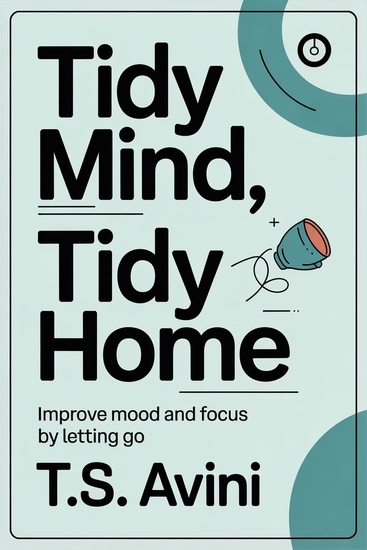
Tidy Mind Tidy Home - Improve Mood and Focus by Letting Go - cover

Tidy Mind Tidy Home - Improve Mood and Focus by Letting Go

T.S Avini

Publisher: T.S. AVINI

  • 0
  • 0
  • 0

Summary

Discover how transforming your home can enhance your mood and clarity in "Tidy Mind, Tidy Home." This compelling guide delves into the significant relationship between our environment and mental state, offering insights into how clutter affects emotions and focus. Learn practical steps to reclaim your space and mind:- Explore the psychology of clutter and its subtle impact.- Gain strategies for mindful decluttering, balancing sentimentality with space.Empower yourself with room-by-room guides and action plans tailored to your lifestyle. Embrace a minimalist mindset, live with intent, and celebrate the peace and focus that come from a well-ordered home. Begin your journey to a clutter-free life today, and let your surroundings uplift your spirit and enhance your clarity.
Available since: 08/15/2025.
Print length: 185 pages.

Other books that might interest you

  • A Light in the Tower - A New Reckoning with Mental Health in Higher Education - cover

    A Light in the Tower - A New...

    Katie Rose Guest Pryal

    • 0
    • 0
    • 0
    With evocative storytelling and incisive research, Katie Rose Guest Pryal brings a new eye to the mental health crisis that higher education has faced for decades. Written from the perspective of a bipolar-autistic professor, A Light in the Tower is both a bracing account of the mental health crisis in higher education and a passionate and informed proposal for how to teach with mental health in mind. 


    Pryal contends that higher education's mental health crisis is the result of long-term systemic problems in education that demand nothing short of a revolution. She examines the anxiety that plagues campuses as a result of exploited and overworked contingent faculty and students, the shock events like COVID-19 and campus shootings that traumatize communities, the systemic and institutional burnout that affects higher education at every level, and the market-driven culture of toxic overwork. These are large-scale problems that need large-scale solutions. Addressing the stigma that haunts mental disability on campus, the ableism that hounds our teaching, and the cascade of mental health struggles that far too many faculty and students face, Pryal provides straightforward solutions to these complex challenges.
    Show book
  • Understanding Obsessive Compulsive Disorder (OCD) - cover

    Understanding Obsessive...

    Dale Mclaughlin

    • 0
    • 0
    • 0
    This audiobook is narrated by an AI Voice.   
    Understanding Obsessive Compulsive Disorder (OCD) by Dale McLaughlin is a clear and compassionate guide to overcoming intrusive thoughts, compulsive behaviors, and anxiety that control the mind. 
    Through real-life examples and modern psychology, you’ll learn what OCD really is, how obsessions and compulsions form, and how to use mindfulness and cognitive-behavioral therapy (CBT) techniques to calm the noise. 
    This audiobook offers step-by-step tools to break the overthinking cycle, reduce stress, and rebuild mental clarity. 
    Discover how to: 
    Recognize obsessive thinking patterns 
    Stop compulsive rituals that feed fear 
    Rewire your brain through simple CBT-based exercises 
    Create daily routines for focus, resilience, and emotional healing 
    Whether you’re managing Obsessive Compulsive Disorder, supporting someone with it, or simply looking for calm and balance, this self-help guide gives you the understanding and structure to reclaim control. 
    Perfect for listeners interested in mental health, anxiety relief, mindfulness, psychology, and practical healing strategies for everyday peace of mind.
    Show book
  • Poverty by America: Book Summary and Analysis - cover

    Poverty by America: Book Summary...

    Briefly Summaries

    • 0
    • 0
    • 0
    This is a concise summary and analysis of Poverty, by America, by Matthew Desmond.
     
    It is not the original book and is not affiliated with or endorsed by Matthew Desmond.
     
    Ideal those seeking a quick and insightful overview.


    Why does poverty persist in the wealthiest nation in the world? Poverty, by America takes listeners on a powerful journey to uncover the systems, policies, and choices that sustain inequality in the United States. With a critical yet hopeful lens, the author reveals how poverty is not an inevitable condition but a deliberate outcome of exploitation, exclusion, and prioritizing wealth over welfare.
     
    Through compelling stories, hard-hitting data, and bold analysis, this audiobook explores the hidden architecture of poverty—from exploitative housing markets and stagnant wages to systemic exclusion from healthcare, education, and justice. It also tackles the provocative question: Who benefits from poverty? The answer will challenge listeners to rethink their understanding of inequality and their own role in perpetuating it.
     
    But Poverty, by America is more than a diagnosis—it’s a call to action. The author outlines proven solutions to reduce poverty and invites listeners to become “poverty abolitionists,” advocating for systemic change and justice. This audiobook is a clarion call for those who believe in creating a society where everyone has the opportunity to thrive.
     
    Perfect for anyone seeking clarity on one of today’s most pressing issues, Poverty, by America inspires hope and action. It’s not just about understanding poverty—it’s about fighting it.
    Show book
  • John Rawls - Justice Fairness and the Veil of Ignorance - cover

    John Rawls - Justice Fairness...

    Hector Davidson

    • 0
    • 0
    • 0
    John Rawls, one of the most influential philosophers of the 20th century, fundamentally reshaped the field of political philosophy with his groundbreaking work, A Theory of Justice (1971). His vision of "justice as fairness" offered a robust framework for understanding social cooperation and the principles that should govern a just society. By blending elements of social contract theory with contemporary concerns about inequality and human rights, Rawls addressed timeless questions about the nature of justice and the moral obligations of institutions.  
    Born on February 21, 1921, in Baltimore, Maryland, Rawls’ early life was marked by tragedy and intellectual rigor. He lost two brothers to illness at a young age, experiences that profoundly influenced his outlook on morality and the fragility of human life. Rawls attended Princeton University, where he earned his undergraduate degree in philosophy, and later completed his doctorate at Harvard University after serving in the U.S. Army during World War II. These formative years shaped his commitment to exploring ethical frameworks that could withstand the complexities of a modern, pluralistic world.  
    Rawls’ magnum opus, A Theory of Justice, introduced several key concepts that would come to define his philosophy. Central to his work was the idea of the "original position," a hypothetical scenario in which individuals design the principles of justice behind a "veil of ignorance." This veil prevents individuals from knowing their social status, wealth, abilities, or personal biases, compelling them to choose rules that are fair and impartial. The result is a system that prioritizes equal basic liberties for all, coupled with the difference principle, which allows social and economic inequalities only if they benefit the least advantaged members of society. 
    Show book
  • End Your Shyness & Social Anxiety - The Adults' Guide & Workbook To Rebuild Your Social Skills And Restore Your Self-Belief In 3 Weeks Or Less - cover

    End Your Shyness & Social...

    LearnWell Books

    • 0
    • 0
    • 0
    🫶 PART 1 - HEAL THE PARTS OF YOU THAT CAUSE YOUR SHYNESS & ANXIETY 
    🙌 PART 2 - BUILD POWERFUL SOCIAL SKILLS AND SELF-BELIEF 
    ✏️ WORKBOOK - EXERCISES & ACTIVITIES TO MAKE THESE CHANGES LAST 
    Do social situations leave you feeling anxious? Does shyness keep you from engaging in conversations you wish you could join? Your social well-being is crucial, and the journey to becoming socially skillful and confident is both possible and rewarding. This comprehensive solution by best-selling publisher LearnWell will help you emerge from the challenging experience of social anxiety. 
    Discover how to:Fearlessly attend events like work events and high school reunions, feeling confident as you reconnect with old friends and make new ones.Deliver a compelling presentation at work that captivates your colleagues and impresses your boss, leading to new opportunities.Strike up a conversation with your crush, feeling self-assured and charming as you make a genuine connection.Enjoy a relaxed, fun night out with friends without worrying about saying the wrong thing or being judged.Use the 'Social Anxiety S.O.S. Plan' to survive and thrive in any last-minute social situation, from job interviews to wedding toasts.Bounce back from an embarrassing moment with the 'Self-Compassion Toolkit' 
    If you're ready to transform your social life and discover the joy of authentic social confidence, this audiobook is your answer. Begin your journey to social freedom today. 
    🔸 SPECIAL FEATURE 🔸  
    The audiobook includes a FREE Interactive Workbook with chapter-by-chapter activities, thoughts, notes, and questions to make a real difference in your life.
    Show book
  • Avars and Magyars The: The History of the Medieval Ethnic Groups that Settled in Hungary - cover

    Avars and Magyars The: The...

    Editors Charles River

    • 0
    • 0
    • 0
    The Avars entered Eastern Europe from the Central Asian steppes in the 6th century, and like the Huns before them and the Cumans and Magyars after them, the Avars were raiders and warriors who lived on their horses. The Avars’ impact on Europe was immediately felt, and from the Byzantine Empire to the Merovingian Kingdom in Gaul, some of Europe’s strongest powers had to learn how to deal with these new people through a combination of diplomacy and warfare. Eventually, the Avars established themselves in what is today Hungary and played an important role in the development of European history during its transitional period by earning a reputation as a fearsome and sometimes avaricious group. The medieval sources described the Avars as efficient and brutal horseback warriors who could devastate entire kingdoms in a matter of days and leave just as quickly. 
    Of all the steppe peoples in the medieval period, perhaps none were more important to European history than the Magyars. Like the Huns and Avars before them and the Cumans and Mongols after them, the Magyars burst into Europe as a destructive, unstoppable horde, taking whatever they wanted and leaving a steady stream of misery in their wake. They used much of the same tactics as the other steppe peoples and lived a similar, nomadic lifestyle. The Magyars also had many early cultural affinities with other steppe peoples, following a similar religion and ideas of kingship and nobility, among other things. That said, as similar as the Magyars may have been to other steppe nomads before and after them, they were noticeably different in one way: the Magyars settled down and became a part of Europe and Western Civilization in the Middle Ages. The Magyars exploded onto the European cultural scene in the late 9th century as foreign marauders, but they made alliances with many important kingdoms in less than a century.
    Show book