Join us on a literary world trip!
Add this book to bookshelf
Grey
Write a new comment Default profile 50px
Grey
Subscribe to read the full book or read the first pages for free!
All characters reduced
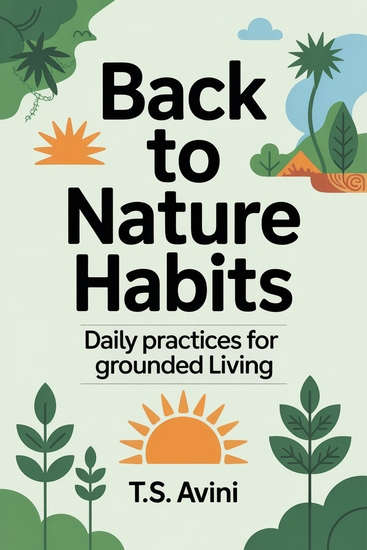
Back to Nature Habits - Daily Practices for Grounded Living - cover

Back to Nature Habits - Daily Practices for Grounded Living

T.S Avini

Publisher: T.S. AVINI

  • 0
  • 0
  • 0

Summary

Discover the rejuvenating power of nature in "Back to Nature Habits: Daily Practices for Grounded Living." This guide is a treasure trove of insights and practical advice designed to help you reconnect with the natural world while enhancing your well-being. Dive into:
 
- Morning rituals and mindful movements that bring you closer to the earth's rhythm.
 
- Sustainable living tips and earth-friendly practices that make a significant impact.
 
Learn about the healing benefits of natural elements like water and light, and explore the calming effects of plant-based meals and forest bathing. With guidance on meditation in nature, digital detox, and community building, this book offers a holistic approach to a balanced and enriched life. Each chapter is crafted to inspire change and facilitate a profound connection with nature, encouraging personal transformation. Embrace grounded living by cultivating a personal plan tailored to intertwine your life with the beauty and wisdom of the natural world. Step into a lifestyle of serenity and peace—start your journey today.
Available since: 07/28/2025.
Print length: 142 pages.

Other books that might interest you

  • Particle Physics - A Very Short Introduction - cover

    Particle Physics - A Very Short...

    Frank Close

    • 0
    • 0
    • 0
    Following the discovery of the Higgs boson, Frank Close has produced this major revision to his classic and compelling introduction to the fundamental particles that make up the universe. Frank Close takes us on a journey into the atom to examine known particles such as quarks, electrons, and the ghostly neutrino, and explains the key role and significance of the Higgs boson. Along the way he provides fascinating insights into how discoveries in particle physics have actually been made, and discusses how our picture of the world has been radically revised in the light of these developments. He concludes by looking ahead to new ideas about the mystery of antimatter and massive neutrinos, and to what the next fifty years of research might reveal about the nature of the Higgs field which molds the fundamental particles and forces.
    Show book
  • Being Online - On Computing Data the Internet and the Cloud - cover

    Being Online - On Computing Data...

    Jian Wang, Jack Ma

    • 0
    • 0
    • 0
    A pioneer of cloud computing and big data offers his vision of the future world taking shape around us. 


    Jian Wang was the founder and architect of Alibaba's cloud and has been the driving force behind its technology innovations. He was also the founder of the City Brain initiative to develop a new digital infrastructure for sustainable cities. Being Online is his meditation on the moment we are in, as the digital era shifts to the internet era, spawning new innovations at a seemingly dizzying pace: cloud computing, 5G, artificial intelligence, big data, wearables, robots, virtual reality, the internet of things, blockchain, and more. For Wang, the invisible hand that connects them is being online. The conjunction of computing, data, and the internet has erased the difference between being online and off. When computing can be done in the cloud, it is on the road to becoming a utility. When data is connected, making it big, its usefulness multiplies exponentially in unforeseeable ways, as does its value. 


    While telling the story of Alibaba's breakthroughs and the development of his own understanding of the internet, Jian Wang's visionary book lays out the implications of this shift and how to think about being online.
    Show book
  • Strength in Numbers - How Polls Work and Why We Need Them - cover

    Strength in Numbers - How Polls...

    G. Elliott Morris

    • 0
    • 0
    • 0
    Public opinion polling is the ultimate democratic process; it gives every person an equal voice in letting elected leaders know what they need and want. But in the eyes of the public, polls today are tarnished. Recent election forecasts have routinely missed the mark and media coverage of polls has focused solely on predicting winners and losers. 


    In Strength in Numbers, data journalist G. Elliott Morris argues that the larger purpose of political polls is to improve democracy, not just predict elections. Whether used by interest groups, the press, or politicians, polling serves as a pipeline from the governed to the government, giving citizens influence they would otherwise lack. No one who believes in democracy can afford to give up on polls; they should commit, instead, to understanding them better. 


    Morris takes listeners from the first semblance of data-gathering in the ancient world through to the development of modern-day scientific polling. He explains how the internet and "big data" have solved many challenges in polling—and created others. He covers the rise of polling aggregation and methods of election forecasting, reveals how data can be distorted and misrepresented, and demystifies the uncertainty of polling. Acknowledging where polls have gone wrong in the past, Morris charts a path for the industry's future.
    Show book
  • Agrostology - Grasses of the World: From Lawns to Prairie Ecosystems - cover

    Agrostology - Grasses of the...

    Mike Crawford

    • 0
    • 0
    • 0
    Agrostology, the scientific study of grasses, is a crucial field of botany that explores the diversity, structure, and ecological significance of grasses. Grasses belong to the Poaceae family, one of the largest and most economically important plant families in the world. These plants play a foundational role in ecosystems, agriculture, and human civilization. From the vast prairies and savannas to the rice and wheat fields that sustain billions of people, grasses shape the landscapes of both natural and human-altered environments. 
    The study of grasses has a long history, dating back to early agricultural societies that first domesticated cereal crops. The ancient civilizations of Mesopotamia, Egypt, and China relied on grasses such as wheat, barley, and rice to establish permanent settlements. Over time, the understanding of grass physiology, reproduction, and ecological functions deepened, leading to advancements in agronomy, ecology, and land management. By the 19th and 20th centuries, agrostology emerged as a specialized discipline within botany, focusing on grass classification, physiology, and ecosystem dynamics. 
    Grasses are uniquely adapted to a wide range of environmental conditions. They thrive in temperate, tropical, and even arid climates, displaying remarkable resilience through specialized growth mechanisms. Their ability to reproduce through both seeds and vegetative propagation allows them to colonize and dominate various habitats. Many grass species employ C4 photosynthesis, an efficient metabolic pathway that enables them to survive in hot, dry environments. This adaptability makes grasses a dominant plant group in many ecosystems, providing habitat and food for numerous animal species.
    Show book
  • The NFT handbook for beginners - learn now how to create NFTs and how to sell them with the complete guide to the secrets of Non Fungible Tokens risk-free - cover

    The NFT handbook for beginners -...

    Marco Zucchetti

    • 0
    • 0
    • 0
    what are NFT and how do they work? how do i safely invest in NFT? is it safe to buy NFT? 
    The world of crypto is very confusing and difficult to understand, especially if you are new to the industry. 
    It can be hard to tell which coins are the most successful, what the differences between coins and tokens are, or how to use them once they're created. 
    NFTs have many benefits and use cases, but without a clear understanding of how they work and how to navigate this new world it's hard for people to realize the potential NFTs can offer. 
    NFTs aren't just for gaming anymore! In this handbook we give you all the information you need about NFTs so that you can create your own tokens and sell them for profit!
    Show book
  • The Great Fire of London - Rats Disease and Uncontrolled Fires Tormenting the English in 1666 - cover

    The Great Fire of London - Rats...

    Kelly Mass

    • 0
    • 0
    • 0
    The Great Fire of London was a massive fire in the ominous year of 1666, which destroyed the homes of more than 80% of the city’s inhabitants, which was around 80,000 people back then. In this guide, we will go over how the fire most likely started, why it took such a toll on the London population, and why it kept growing without them being able to extinguish the flames in time. 
    You will also learn about how the city was built up, how other competing countries saw the fire as a good thing, and how Christopher Wren helped rebuild churches and houses when it was all over. 
    Last but not least, you will discover how something else was even more disturbing at this time: The Great Plague of London, a horrible scourge which is believed to have killed more than 100,000 people, struck with ills from rats and a lack of hygiene, around the same time. 
    Read about or listen to the horrors people in England were confronted with in the beginning of the 17th century.
    Show book