

¡Acompáñanos a viajar por el mundo de los libros!
Añadir este libro a la estantería
Grey
Escribe un nuevo comentario Default profile 50px
Grey
Suscríbete para leer el libro completo o lee las primeras páginas gratis.
All characters reduced
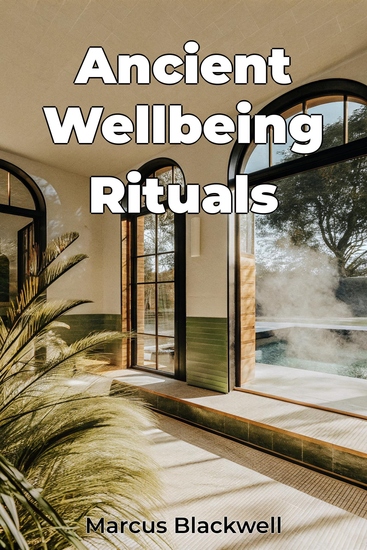
Ancient Wellbeing Rituals - cover

Ancient Wellbeing Rituals

Marcus Blackwell

Traductor A AI

Editorial: Publifye

  • 0
  • 0
  • 0

Sinopsis

Ancient Wellbeing Rituals explores the holistic health practices of past civilizations, revealing the interconnectedness of mind, body, and environment. It looks at daily health rituals from around the world, highlighting how these practices contributed to overall wellness, and providing a historical context for current health trends. For example, the book examines oil pulling, an ancient Ayurvedic practice for oral health, and cold plunges, used across cultures for invigoration. The book takes a multidisciplinary approach, drawing from historical records, anthropological studies, and scientific research.

 
It is structured to provide a comprehensive understanding of ancient wellness, beginning with oral and digestive health rituals, then examining practices aimed at fortifying the body through temperature regulation, and finally investigating the use of natural remedies.
Disponible desde: 13/02/2025.
Longitud de impresión: 77 páginas.

Otros libros que te pueden interesar

  • Urbanization and Growth - The Shaping of Modern Metropolises (3 in 1) - cover

    Urbanization and Growth - The...

    Lyric Vale

    • 0
    • 0
    • 0
    Human civilization is fundamentally a story of movement, migration, and collective settlement—with cities emerging as the most complex and dynamic manifestations of our collective human experience. From ancient settlements clustered around rivers and trade routes to today's sprawling global metropolises, urbanization represents a profound transformation of how humans organize, interact, and envision community. This comprehensive exploration delves into the intricate narrative of The History of Urbanization, the multifaceted Impacts of Urban Growth, and the emergence of Global Cities, tracing the remarkable journey of human settlement from isolated communities to interconnected, sophisticated urban ecosystems. 
    The evolution of cities is far more than a chronological progression of architectural and infrastructural development; it is a nuanced story of social adaptation, economic innovation, and human resilience. By examining the historical trajectories, contemporary challenges, and future potentials of urban growth, this book reveals the complex mechanisms that drive metropolitan transformation. Readers will journey through the social, economic, technological, and cultural forces that shape urban landscapes—uncovering how global cities emerge as crucibles of human potential, where demographic shifts, technological innovations, economic dynamics, and cultural exchanges converge to create living, breathing environments that continually redefine the boundaries of human collective experience.
    Ver libro
  • Egyptian Hieratic and Demotic Scripts - A Study of Ancient Writing Systems - cover

    Egyptian Hieratic and Demotic...

    Omar Khalil

    • 0
    • 0
    • 0
    The writing systems of ancient Egypt are among the most fascinating and intricate aspects of the civilization’s rich cultural heritage. These scripts not only served as practical tools for administration and communication but also held immense symbolic and ritual significance. The evolution of Egyptian scripts reflects the social, political, and religious transformations that took place throughout the millennia of Egyptian history. 
    Egyptian writing developed as a means of recording religious texts, administrative documents, literary works, and personal correspondence. Among the earliest and most iconic forms of writing is the hieroglyphic script, characterized by its detailed pictorial symbols. While hieroglyphs are often associated with monumental inscriptions and sacred texts, they were not the only writing system employed by the ancient Egyptians. As the civilization advanced, the need for more practical and expedient writing methods became apparent, giving rise to the development of cursive scripts. 
    Hieratic script emerged as a more fluid and practical adaptation of hieroglyphs, primarily used for religious texts, administrative records, and personal documents. Unlike the elaborate and artistic nature of hieroglyphs, hieratic writing was simplified, making it faster to write and more suited for daily use. Its cursive nature allowed scribes to quickly document information on papyrus, ostraca, and other media. Despite its practicality, hieratic remained closely tied to its hieroglyphic origins, preserving many of the same signs and structures.
    Ver libro
  • The Passenger: Rome - cover

    The Passenger: Rome

    Passenger The

    • 0
    • 0
    • 0
    The best new writing, photography, art, and reportage from and about Rome—in the series that’s “like a literary vacation” (Publishers Weekly). 
     
    If you believe recent chatter about Rome—in the media and by its residents—the city is on the verge of collapse. Each year, it slips further down the ranking of the world’s most livable cities. To the problems faced by all large capitals—hit-and-run tourism, traffic, the divide between elegant, Airbnb-dominated city centers and run-down suburbs—in recent years Rome seems to have added a list of calamities of its own: a string of failing administrations, widespread corruption, the resurgence of fascist movements, rampant crime. A seemingly hopeless situation, perfectly symbolized by the fact that Rome currently leads the world in the number of self-combusting public buses. 
     
    One might expect mass migration in the face of problems like these—yet the vast majority of Romans don’t think for a second of “betraying” their hometown, and the many newcomers who’ve populated it in recent decades resemble the natives in the profound love that binds them to the city. 
     
    The largest metropolis in Europe is a place of contradictions and opposites. We think of it as ancient, but it is profoundly modern—it was founded almost three millennia ago, but 92 per cent of its buildings have been built after 1945. To understand Rome and fix its problems, we should start considering it a normal city, not unlike Chicago or Manchester . . . just incomparably more beautiful. This volume is filled with portraits of Rome and thoughts not just on its famous past but its present and future, including: 
     
    Rome doesn’t judge you by Nicola Lagioia · The soul of the city by Matteo Nucci · 39 memos for a book about Rome by Francesco Piccolo · Plus: a guide to the sounds of Rome by Letizia Muratori; the feigned unrest and real malaise of the suburbs; the influence of the Vatican; the excessive power of real estate speculators and the rule of gangs; disillusioned trappers; football fans of every age, and much more . . .  
     
    “A pleasure to read.” —La Repubblica
    Ver libro
  • Campus Free Speech - A Pocket Guide - cover

    Campus Free Speech - A Pocket Guide

    Cass R. Sunstein

    • 0
    • 0
    • 0
    Free speech is indispensable on college campuses: allowing varied views and frank exchanges of opinion is a core component of the educational enterprise. But free speech does not mean a free-for-all. The First Amendment prohibits "abridging the freedom of speech," yet laws against perjury or bribery, for example, are still constitutional. In the same way, valuing freedom of speech does not stop a university from regulating speech when doing so is necessary for its educational mission. So where is the dividing line? How can we distinguish reasonable restrictions from impermissible infringement? 


    In this pragmatic, no-nonsense explainer, Cass Sunstein takes us through a wide range of scenarios involving students, professors, and administrators. He discusses why it's consistent with the First Amendment to punish students who shout down a speaker, but not those who chant offensive slogans; why a professor cannot be fired for writing a politically charged op-ed, yet a university might legitimately consider an applicant's political views when deciding whether to hire her. He explains why private universities are not legally bound by the First Amendment yet should, in most cases, look to follow it. And he addresses the thorny question of whether a university should officially take sides on public issues or deliberately keep the institution outside the fray.
    Ver libro
  • Unfinished Business - The Evolution of Devolution in Scotland - cover

    Unfinished Business - The...

    Henry McLeish, James Mitchell

    • 0
    • 0
    • 0
    We want to move beyond politics in which each party seeks to outmanoeuvre others and score a decisive victory. This leads to political stalemate. We want to reflect on the successes and failures of devolution and offer a series of proposals for reform that could be embraced by a broad swathe of opinion.
    What were the hopes and aspirations of devolution?
    To what extent has devolution been successful?
    What are the challenges and opportunities ahead?
    How can we meet the challenges and best take advantage of opportunities?
    Where is Scotland heading on its unfinished journey?
    How will changes in the rest of the UK impact on this journey?
    In  1999, legislation was passed to create the Scottish Parliament and the Consultative Steering Group (CSG) issued its report on the Scottish Parliament's guiding principles. Four key principles were set out in the CSG report reflecting the hopes and aspirations of campaigners for a Scottish Parliament: sharing power between the people, legislators and government; greater accountability from government to Parliament to the people; facilitating accessibility, openness and responsiveness; and promoting equality. These principles remain as relevant today as they were at the Parliament's establishment though much has changed in the intervening quarter century.
    In this book, former First Minister Henry McLeish, Minister responsible for devolution and chair of the CSG, and Professor James Mitchell of Edinburgh University consider the journey Scotland has been on – the challenges, obstacles and opportunities in seeking to achieve these hopes and expectations.
    Ver libro
  • Summary: The Wager - A Tale of Shipwreck Mutiny and Murder by David Grann: Key Takeaways Summary & Analysis Included - cover

    Summary: The Wager - A Tale of...

    Brooks Bryant

    • 0
    • 0
    • 0
    Disclaimer: This is NOT the official book, but a summary & it does NOT accompany the official. 
    In "The Wager: A Tale of Shipwreck, Mutiny, and Murder" by David Grann, readers are thrust into a thrilling narrative based on true events surrounding the shipwreck of His Majesty's Ship the Wager in the 1740s. On a secret mission during an imperial war with Spain, the Wager pursued a treasure-laden Spanish galleon before meeting its tragic fate off the Patagonian coast. The wreckage and the ensuing survival tale provoke questions surrounding heroism, mutiny, and the human capacity for survival under the most extreme conditions. 
    The survivors' ordeal spans many months of starvation and anarchy, as they battled to endure in a harsh, desolate environment. The narrative takes a dramatic turn when two groups of survivors — one landing in Brazil and the other in Chile — narrate conflicting accounts of the events that transpired during their harrowing journey. This divergence sets the stage for a court-martial, where the truth hangs in a precarious balance with life-and-death stakes. 
    Grann excels in bringing this historic tale to life, paralleling the depth of narrative nonfiction greats and survival literature classics. The unraveling court-martial narrative holds the savvy of a courtroom thriller, beckoning readers into a vividly recreated world of 18th-century naval warfare and exploration.
    Ver libro
