Junte-se a nós em uma viagem ao mundo dos livros!
Adicionar este livro à prateleira
Grey
Deixe um novo comentário Default profile 50px
Grey
Assine para ler o livro completo ou leia as primeiras páginas de graça!
All characters reduced
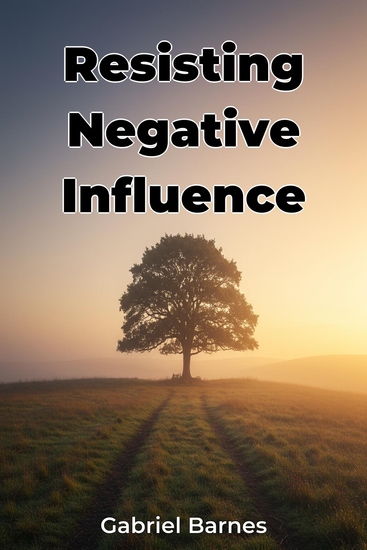
Resisting Negative Influence - cover
LER

Resisting Negative Influence

Gabriel Barnes

Tradutor A AI

Editora: Publifye

  • 0
  • 0
  • 0

Sinopse

Resisting Negative Influence offers a guide to recognizing and managing the pervasive forces that impact our mental and emotional health. It addresses how social pressures and manipulative tactics can undermine self-determination, and it provides strategies for cultivating mental resilience. The book explores the psychology of persuasion, revealing how understanding these mechanisms can empower individuals to take control. For instance, it highlights how awareness of cognitive biases can shield against misinformation, and how assertive communication strengthens personal boundaries.

 
This self-help psychology book emphasizes the importance of self-awareness and critical thinking in resisting unwanted influence. By drawing from psychological theories, communication studies, and real-world examples, the author introduces practical techniques for assertive communication and boundary setting.

 
The text progresses logically, beginning with an overview of negative influence, then delving into inner defenses such as mindfulness, and culminating in real-world applications. This approach ensures readers gain actionable skills to enhance their emotional well-being and reclaim their autonomy.
Disponível desde: 28/02/2025.
Comprimento de impressão: 127 páginas.

Outros livros que poderiam interessá-lo

  • Structuralism - Philosophy and Patterns in Human Culture - cover

    Structuralism - Philosophy and...

    Hector Davidson

    • 0
    • 0
    • 0
    Structuralism is an intellectual movement that emerged in the early to mid-20th century, primarily influenced by the works of linguists, anthropologists, and philosophers. Its foundational premise is that human culture, including language, myths, and social institutions, can be understood through underlying structures that govern them. These structures are not always immediately visible but influence how individuals and societies behave, think, and organize themselves. 
    At its core, structuralism asserts that elements of human culture must be studied in relation to one another within a larger system. For example, language can only be fully understood when the relationships between words and their meanings are considered. This perspective contrasts with earlier intellectual traditions that focused on individual elements, seeking meaning through isolated concepts. Instead, structuralism emphasizes the interconnections and patterns that form the basis of human existence. 
    The intellectual origins of structuralism can be traced back to the work of Swiss linguist Ferdinand de Saussure. In his work, Saussure argued that language is a system of signs, each of which acquires meaning not by its inherent qualities but through its relationship to other signs. His concept of the "signifier" (the word or symbol) and the "signified" (the concept or meaning) set the stage for structuralist thought. Saussure’s approach highlighted the importance of studying language as a system of differences, where meanings are produced not in isolation but in opposition to other meanings.
    Ver livro
  • Alignment - A Montessori Approach to Reimagining Work-Life Balance - cover

    Alignment - A Montessori...

    Katie Keller Wood

    • 0
    • 0
    • 0
    USA TODAY BESTSELLER Your work matters. You matter more. You know you make a difference. Your talent and expertise come together in your work to make an important contribution to the world. But your dedication shouldn’t mean sacrificing all the other parts of yourself. Inspired by principles from Montessori classrooms, educator and researcher Dr. Katie Keller Wood offers an alternative approach to thinking about your work and life—one that embraces you as a whole person rather than splitting you in two.Drawing on decades of experience teaching Montessori students and adults, Keller Wood rejects the concept of work-life balance in favor of a more holistic alliance between you and your work. Your life is not a balancing act but a constantly evolving mosaic, and when the pieces are all aligned, thriving follows. There can be space enough for all the things that matter.With real-world examples, exercises, and activities, this transformative, research-informed book will help you catch the first signs of misalignment and then show you how to move through a realignment process, so that you can find joy and value in all parts of your life, including your meaningful work. It’s time to ditch the balancing act and get yourself into Alignment.
    Ver livro
  • The Korean Conflict - From Causes to Consequences - Exploring the Events of the Korean War - cover

    The Korean Conflict - From...

    History Retold

    • 0
    • 0
    • 0
    Are you looking for a guide to the history of the Korean War? 
    This short book provides a clear and accessible overview of the causes, events, and consequences of the Korean War. 
    The book is packed with detailed descriptions of key battles, insightful analysis of major political decisions, and eye-opening accounts of life on both sides during wartime.  
    You'll learn about:  
    • The origins of the conflict in Korea's divided government  
    • The role played by regional powers like China and Japan  
    • How America's Cold War policies impacted the fighting  
    • The devastating humanitarian costs suffered by civilians on both sides  
    • And much more! 
      
    This book is sure to help you gain a better understanding of this crucial period in modern history. 
     Don't miss out on your chance to understand one of history’s most important conflicts – buy the book today!
    Ver livro
  • Sumerians - Their History Religion and Inventions - cover

    Sumerians - Their History...

    Kelly Mass

    • 0
    • 0
    • 0
    The Sumerians were the people from Sumer, the first recognized society in the historic area of southern Mesopotamia (now southern Iraq), developed throughout the 6th and 5th centuries BC throughout the Chalcolithic and early Bronze Ages. In addition to age-old Egypt, the Caral-Supe culture, the Indus Valley civilization, the Minoan civilization, and age-old China, it is also one of the world's early civilizations. Sumerian farmers who lived along the Tigris and Euphrates valleys grew a great deal of grain and other items, which allowed them to establish metropolitan towns. Before 3000 BC, there was proto-writing. The earliest files date from between 3500 and 3000 BC and are from the cities of Uruk and Jemdet Nasr. 
    Most historical analysts believe that Sumer was first completely occupied between c. 5500 and 4000 BC by a West Asian population who spoke the Sumerian language, a non-Semitic and non-Indo-European agglutinative language isolate (as evidenced by the names of cities, rivers, standard professions, and so on). It wasn't an inflected language, in contrast to its Semitic cousins. 
    Go ahead and get stared, and get to know more about the Sumerians, what they did, who they were, and why so many people know so little about them.
    Ver livro
  • Mission Iran - Special Forces Berlin & Operation Eagle Claw JTF 1-79 - cover

    Mission Iran - Special Forces...

    James Stejskal

    • 0
    • 0
    • 0
    On November 4, 1979, "student" supporters of the Ayatollah seized the U.S. Embassy with over sixty hostages. Although the Cold War was in full swing, the Iran hostage crisis was a watershed for the United States. 


    Detachment A had been established in Berlin early in the Cold War to harass and delay any Soviet military advance west. This Special unit trained relentlessly for every aspect of unconventional warfare, and was later assigned a second mission of counterterrorism. 


    The plan for Operation Eagle Claw, as it became known, was extremely complex. The first stage was intelligence gathering—no mean feat as most of the CIA's capabilities in the country had been eliminated. With operatives trained in intelligence work, fluent in many languages, and adept at blending in, Det A took on the advanced recon of the targets. Then, when Delta Force admitted that it could only manage the assault of the Embassy, Det A volunteered to rescue the three Americans at the Foreign Ministry. 


    Veteran and historian James Stejskal details Det A's unique and integral role in Operation Eagle Claw, based upon firsthand accounts of the operatives involved.
    Ver livro
  • Battle of Edgehill The: The History and Legacy of the Opening Battle of the English Civil War - cover

    Battle of Edgehill The: The...

    Editors Charles River

    • 0
    • 0
    • 0
    The outcome of the English Civil War was no doubt unthinkable to many across Europe before it actually happened, and the Battle of Edgehill represented the first sign that things might not go according to the typical plan. The tiny hamlet of Edgehill sits atop an escarpment in the parish of Ratley and Upton in Warwickshire, England, an unremarkable location in and of itself, like many others in Warwickshire. It attracts a few tourists, some of whom are on the lookout for ghosts. Some claim to hear cries of pain and terror, the clash of swords, cannon fire, and the lament of lost souls. The first report of such phenomena was made shortly before Christmas 1642 when a number of Edgehill inhabitants claimed to have seen two ghostly armies fighting in the sky. So strong and widespread did these claims become that King Charles I sent a commission to investigate. The commissioners supposedly witnessed the apparitions and were able to identify some of the combatants as participants in the Battle of Edgehill, which occurred three months earlier on October 23, 1642. This included Sir Edmund Verney, who lost a hand in the battle and was observed missing an appendage. The apparitions supposedly ended when villagers buried the corpses of soldiers who still lay on the battlefield, but people still claim to hear signs of the celestial battle 370 years later. 
    The enormous upheaval in English society in 1642 may very well have engendered such tales. For the simple villagers, it seemed as if heaven and earth had been rent asunder. After all, the whole concept of divinely ordained kings was that God had created the system and placed a king over England, making the monarch, Charles I of the House of Stuart, God’s viceregent. But that year, the unthinkable happened when the king and Parliament broke with each other, raising their standards of war. The divinely appointed order was broken, and the result was bloodshed, terror, and chaos.
    Ver livro