Join us on a literary world trip!
Add this book to bookshelf
Grey
Write a new comment Default profile 50px
Grey
Subscribe to read the full book or read the first pages for free!
All characters reduced
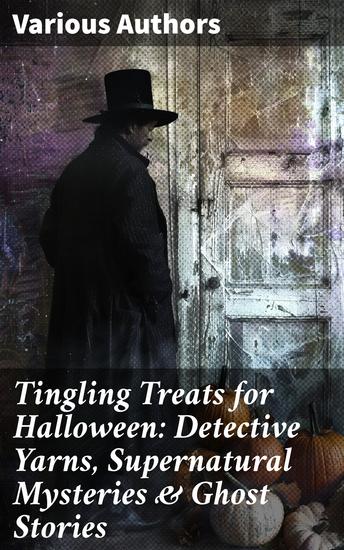
Tingling Treats for Halloween: Detective Yarns Supernatural Mysteries & Ghost Stories - Unveiling Shadows: Evolution of Mystery & the Supernatural - cover

Tingling Treats for Halloween: Detective Yarns Supernatural Mysteries & Ghost Stories - Unveiling Shadows: Evolution of Mystery & the Supernatural

Mark Twain, Robert Louis Stevenson, Edgar Allan Poe, Jack London, Théophile Gauthier, Arthur Conan Doyle, Ralph Adams Cram, Guy de Maupassant, Thomas Hardy, William Archer, Daniel Defoe, Cleveland Moffett, Rudyard Kipling, Ambrose Bierce, Frederick Marryat, Ellis Parker Butler, Nathaniel Hawthorne, Wilkie Collins, Thomas W Hanshew, Erckmann- Erckmann-Chatrian, Mary E. Hanshew, Leopold Kompert, Chester Bailey Fernald, Florence Marryat, Vincent O'Sullivan, E.F. Benson, M.R. James, Arthur B Reeve, E.T.A. Hoffman, Anton Chekhov, Margaret Oliphant, A. T. Quiller-Couch, Amelia B. Edwards, Anna Katherine Green, Fitz James O'Brien, Katherine Rickford, Pliny the Younger, Helena Blavatsky, Villiers l'Isle de Adam, William F. Harvey, Fiona McLeod, William T. Stead, Gambier Bolton, Andrew Jackson Davis, Nizida, Walter F. Prince, Sir Robert Anderson, Edward Bulwer-Lytton

Translator Julian Hawthorne, William Melmoth

Publisher: Good Press

  • 0
  • 0
  • 0

Summary

Tingling Treats for Halloween: Detective Yarns, Supernatural Mysteries & Ghost Stories offers a tantalizing trip through the mysterious and the eerie. This anthology captures an exceptional range of literary styles from late 19th to early 20th century authors, crafting an atmospheric mosaic of detective tales, supernatural mysteries, and ghost stories. The collection draws the reader into a world teeming with shadows and enigmas, where narrative craft and suspense converge to haunt the imagination. With its well-curated selection, the anthology not only highlights macabre delights but also offers a profound engagement with themes of irrational fear, the otherworldly, and the enigmatic. The assemblage of authors includes literary luminaries like Mark Twain, Edgar Allan Poe, and Arthur Conan Doyle, whose fine storytelling has shaped their contemporary genres. Whether entrenched in Gothic horror or branching into psychological supernaturalism, these voices collectively mirror the era's fascination with the unknown. The anthology uniquely aligns with the Romantic and Victorian obsessions with exploring the boundaries of reality versus the supernatural, providing a cultural and historical window into the thematic experimentation of their times. A vital treat for enthusiasts of classic literature, this anthology provides a rare opportunity to explore the varied approaches to mystery and the supernatural. Readers are encouraged to delve into these meticulously crafted tales, gaining rich insights into the era's literary innovations and the diversity of styles and perspectives. Whether read for scholarly exploration or sheer enjoyment, Tingling Treats for Halloween is indispensable for anyone keen on understanding'Äîand experiencing'Äîthe delights of suspenseful, eerie storytelling from some of literary history's most inventive minds.
Available since: 11/19/2023.
Print length: 1111 pages.
Other books that might interest you

  • Imaginative Woman An - From their pens to your ears genius in every story - cover

    Imaginative Woman An - From...

    Thomas Hardy

    • 0
    • 0
    • 0
    Thomas Hardy was born in the hamlet of Upper Bockhampton about three miles east of Dorchester in Dorset, England, on 2nd June 1840.  
    Despite a fairly wide education and being an avid reader his parents thought it unlikely he would lead a successful scholarly or clerical career and he was apprenticed in 1856, at age 16, to a local architect whose speciality was in church restoration.  Hardy’s only opportunity to read was in the morning before work between the hours of five and eight.  
    On the back of a failed love affair he moved to London and spent five years working as an assistant to the architect Arthur Blomfield, also a restorer and designer of churches. Hardy though had by now become disillusioned with institutionalised forms of Christianity and abandoned any lingering hopes of ordination in the Anglican Church.  However, his writing of poetry was now flourishing, although it was still rejected for publication.  
    His novel ‘Desperate Remedies’, was published anonymously in 1871 and he now resolved to write full time though he was not yet in a position to achieve financial security or literary success. His second novel, ‘Under the Greenwood Tree’, appeared in 1872 and in 1873 ‘A Pair of Blue Eyes’, the most autobiographical of his works arrived. With ‘Far From the Madding Crowd’ in 1874, came critical acclaim, public attention and financial success. This was repeated in 1878 with ‘The Return of the Native’, and the ensuing years saw him rise to ever greater popularity.  
    His classic ‘The Mayor of Casterbridge’ arrived in 1886 and 5 years later ‘Tess of the d’Urbervilles’. The latter only saw publication after extensive alterations to its plot and the deletion of long passages to lessen the shock to the prudish Victorian audience who were dismayed by the seduction and ruin of a young girl by a rakish aristocrat.  
    ‘Jude the Obscure’, his last novel, suffered the same fate when it was published in 1895.  The uproar so disturbed him that he returned to poetry. In 1898 he had an earlier poetry collection, ‘Wessex Poems’ published. 
    Hardy spent the years between 1903 and 1908 writing ‘The Dynasts’, an epic poem on the Napoleonic Wars. 
    In his twilight years came honours and awards from the great and the good in recognition of his stature as one of the most outstanding of British authors across novels, short stories and poetry. George V conferred on him the Order of Merit in 1910. 
    From 1920 to 1927 he worked, in secret, on his autobiography, which was later published after his death as the work of his second wife, Florence Hardy.  
    Thomas Hardy OM died on the 11th January 1928. 
    His heart was buried alongside his first wife in Stinsford churchyard, Dorchester.
    Show book
  • Wonder Of Women - Stories About Affairs - Celebrate the true pioneers of female literature - cover

    Wonder Of Women - Stories About...

    Kate Chopin, Edith Nesbit, Edith...

    • 0
    • 0
    • 0
    Let’s be clear. We are all equal under the law.  However, even in these more modern times that is not an absolute and still remains a distant ambition for many.  
     
    In the days when Britain ruled the waves and bestrode the world as its policeman and plunderer in chief it also subjugated half of its own people to second class status.  Women were chattel and property.  There were some exceptions based on wealth and birthright but for the overwhelming majority your lot was to fall in with the rules and do as you were told.  Many did. 
     
    But whilst male society sought to place obstacles in the path to equality, it could not deny their literary talents, which many times they circumvented by using male pseudonyms.  However, the soaring sales of magazines and periodicals during the Victorian Age meant they had voracious appetites for literature, whatever the sex of its gender. 
     
    Dozens of authors appeared to fill the need.  Narratives had new ideas.  Characters were emboldened by societal changes and the female voice taking responsibility. 
     
    The women included here are talents that dazzle.  Put them up against anyone and they rise to the top.  Whether they remain with an avid readership today or faded to obscurity with the passing of the times their quality remains undimmed.   
     
    1 - Women of Wonder - Affairs - An Introduction 
    2 - The Storm by Kate Chopin 
    3 - From the Dead by Edith Nesbit 
    4 - Souls Belated by Edith Wharton 
    5 - The Legacy by Virginia Woolf 
    6 - The Pleasant Husband by Marjorie Bowen 
    7 - Lucy Wren by Ada Radford 
    8 - Lena Wrace by May Sinclair 
    9 - The Difference by Ellen Glasgow 
    10 - Behind the Curtain by Gertrude Barrows Bennett writing as Francis Stevens 
    11 - The Kiss by Kate Chopin
    Show book
  • The Readjustment - From their pens to your ears genius in every story - cover

    The Readjustment - From their...

    Mary Austin

    • 0
    • 0
    • 0
    The bookshelves of American literature are incredible collections that have gathered together centuries of very talented authors.  From this continent their fame spread and whilst among their number many are now forgotten or neglected their talents endure.  Among them is Mary Austin'
    Show book
  • A Chameleon - From their pens to your ears genius in every story - cover

    A Chameleon - From their pens to...

    Anton Chekhov

    • 0
    • 0
    • 0
    Anton Pavlovich Chekhov was born on 29th January 1860 in Taganrog, on the south coast of Russia.  
    His family life was difficult; his father was strict and over-bearing but his mother was a passionate story-teller, a subject Chekhov warmed to. As he later said; ‘our talents we got from our father, but our soul from our mother’.  
    At school Chekhov was distinctly average. At 16 his father mis-managed his finances and was declared bankrupt. His family fled to Moscow. Chekhov remained and eked out a living by various means, including writing and selling short sketches to newspapers, to finish his schooling. That completed and with a scholarship to Moscow University obtained he rejoined his family. 
    He was able to help support them by selling satirical sketches and vignettes of Russian lifestyles and gradually obtained further commissions. In 1884, he qualified as a physician and, although it earned him little, he often treated the poor for free, he was fond of saying ‘Medicine is my lawful wife, and literature is my mistress.’ 
    His own health was now an issue as he began to cough up blood, a symptom of tuberculosis.  Despite this his writing success enabled him to move the family into more comfortable accommodation.  
    Chekhov wrote over 500 short stories which included many, many classics including ‘The Kiss’ and ‘The Lady with a Dog’.  His collection ‘At Dusk’ won him the coveted Pushkin Prize when was only 26.  
    He was also a major playwright beginning with the huge success of ‘Ivanov’ in 1887.   
    In 1892 Chekhov bought a country estate north of Moscow. Here his medical skills and money helped the peasants tackle outbreaks of cholera and bouts of famine. He also built three schools, a fire station and a clinic.  It left him with less time for writing but the interactions with real people gained him detailed knowledge about the peasantry and their living conditions for his stories.  
    His most famous work, ‘The Seagull’ was received disastrously at its premiere in St Petersburg. It was later restaged in Moscow to highlight its psychological aspects and was a huge success. It led to ‘Uncle Vanya’, ‘The Three Sisters’ and ‘The Cherry Orchard’.  
    Chekhov suffered a major lung hemorrhage in 1897 while visiting Moscow. A formal diagnosis confirmed tuberculosis and the doctors ordered changes to his lifestyle.  
    Despite a dread of weddings the elusive literary bachelor quietly married the actress Olga Knipper, whom he had met at rehearsals for ‘The Seagull’, on 25th May 1901. 
    By May 1904 with his tuberculosis worsening and death imminent he set off for the German town of Badenweiler writing cheerful, witty letters to his family and assuring them his health was improving.  
    On 15th July 1904 Anton Chekhov died at Badenweiler.  He was 44.
    Show book
  • A Voice from the Pit - From their pens to your ears genius in every story - cover

    A Voice from the Pit - From...

    Bernard Capes

    • 0
    • 0
    • 0
    Bernard Edward Joseph Capes was born on the 30th August 1854 in London.  He was one of 11 children. 
    His early work was as a journalist and this developed into writing many short stories for the periodicals of the time including Blackwood's, Cassell's, Cornhill Magazine, Illustrated London News, Macmillan's Magazine, Mall Magazine, Pearson's Magazine, The Idler, and The Queen. 
    It took him many years to decide that writing full-time could be a sustainable career path.  His initial success came with ‘The Mill of Silence’.  As well as being published it garnered second prize at a competition sponsored by the Chicago Record.  He exceeded that by winning it the following year with ‘The Lake of Wine’.   
    Capes quickly became both prolific and popular.  As well as his stories and articles for the periodicals he wrote around 40 volumes across novels, poetry, history as well as romance and mystery novels. 
    Bernard Capes died on 2nd November 1918 in the flu epidemic.
    Show book
  • A Little Cloud - From their pens to your ears genius in every story - cover

    A Little Cloud - From their pens...

    James Joyce

    • 0
    • 0
    • 0
    James Augustine Aloysius Joyce was born on the 2nd February 1882 in Dublin into a middle-class family, and the eldest of ten surviving siblings 
    Admired as a brilliant student he briefly attended the Christian Brothers-run O'Connell School before excelling at the Jesuit schools of Clongowes and Belvedere.  From there he went on to attend University College Dublin from 1898, studying English, French and Italian 
    In 1902, Joyce was now in his early twenties, and went to Paris to study Medicine but soon abandoned his teachings.  Back in Dublin to attend to his dying Mother he met Nora Barnacle. They bonded immediately into a life-long match. Together they decided to emigrate to Europe.  The couple lived in Trieste, Rome, Paris, and finally Zürich where Joyce pursued a variety of jobs and ventures to supplement his literary pursuits but none of these paid off.  
    After publishing a poetry volume, ‘Chamber Music’, in 1907, his short story collection ‘The Dubliners’, in 1914, helped establish his talent in the rapidly changing world.  
    Although far from home Joyce’s literary heart and works were set in his recollections of Dublin.  Characters are close resemblances of family and friends and indeed enemies.  His landmark work ‘Ulysses’, published in 1922, is set in the streets and alleyways of the city as it parallels Homer’s Odyssey in a variety of styles including its famed stream of consciousness. 
    His pen continued to produce classics of the order of ‘A Portrait of the Artist as A Young Man’ and ‘Finnegan’s Wake’ together with several volumes of poetry and a play ‘The Exiles, in 1918.   
    On the 11th January 1941, Joyce underwent surgery in Zürich for a perforated duodenal ulcer. The next day he fell into a coma. On the 13th after a brief period of lucidity in which he called for his wife and son he passed.  He was 58.
    Show book