¡Acompáñanos a viajar por el mundo de los libros!
Añadir este libro a la estantería
Grey
Escribe un nuevo comentario Default profile 50px
Grey
Suscríbete para leer el libro completo o lee las primeras páginas gratis.
All characters reduced
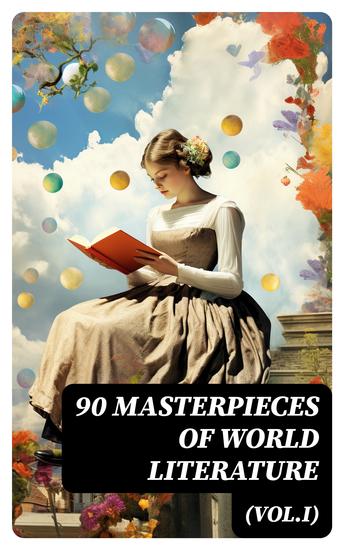
90 Masterpieces of World Literature (VolI) - Novels Poetry Plays Short Stories Essays Psychology & Philosophy - cover

90 Masterpieces of World Literature (VolI) - Novels Poetry Plays Short Stories Essays Psychology & Philosophy

Edgar Allan Poe, George Eliot, Benito Pérez Galdós, William Shakespeare, Juan Valera, Charles Dickens, Lewis Carroll, Mark Twain, Louisa May Alcott, Jane Austen, Oscar Wilde, Herman Melville, Alexandre Dumas, Joseph Conrad, Charlotte Brontë, Daniel Defoe, Henry David Thoreau, L. Frank Baum, Emily Brontë, Washington Irving, Walt Whitman, Henry James, Hans Christian Andersen, D. H. Lawrence, Anthony Trollope, Giovanni Boccaccio, Guy de Maupassant, Sigmund Freud, Marcus Aurelius, Frederick Douglass, Stephen Crane, William Makepeace Thackeray, Anne Brontë, Robert Louis Stevenson, John Keats, Anton Chekhov, Marcel Proust, George Bernard Shaw, Charles Baudelaire, Walter Scott, R. D. Blackmore, Sun Tzu, H.P. Lovecraft, Frances Hodgson Burnett, Mary Shelley, Rudyard Kipling, Upton Sinclair, Kahlil Gibran, Edgar Rice Burroughs, Ernest Hemingway, Agatha Christie, Herman Hesse, E. M. Forster, H. A. Lorentz, Theodore Dreiser, Plato, H. G. Wells, Nikolai Gogol, Arthur Conan Doyle, Brothers Grimm, Wallace D. Wattles, Selma Lagerlöf, Victor Hugo, Fyodor Dostoevsky, James Joyce, T. S. Eliot, James Allen, Apuleius, Margaret Cavendish, Thomas Hardy, Jack London, Jules Verne, Soseki Natsume, Miguel de Cervantes, Leo Tolstoy, Princess Der Ling, Johann Wolfgang Goethe, Pierre Choderlos de Laclos, Voltaire

Editorial: DigiCat

  • 0
  • 0
  • 0

Sinopsis

In "90 Masterpieces of World Literature (Vol.I)", readers are invited to explore a rich tapestry woven from some of the most influential and diverse voices in literature. This anthology captures a vast spectrum of styles, from the surreal landscapes of Lewis Carroll to the incisive realism of Charles Dickens, and the natural mysticism of Walt Whitman. Within these pages, short stories, essays, and excerpts unfold themes of existential quest, social justice, romantic idealism, and philosophical intrigue. Each piece stands as a testament to the eras and milieus that birthed them, showcasing the expanse of human creativity and thought that transcends time. The anthology benefits from the collective power of its contributors, drawing upon a wide array of cultural and historical contexts. The voices of Plato and Marcus Aurelius converge with the modern insights of Sigmund Freud and D. H. Lawrence, while global narratives from Soseki Natsume to Miguel de Cervantes resonate through time. This collection is a reflection of the transformative movements in literature, such as Romanticism, Realism, and Modernism, bridging Western and Eastern storytelling traditions. Together, these authors offer insights into the universal human experience, enriched by their unique backgrounds and perspectives. This volume serves as a voyage through the corridors of time and thought, offering readers an unparalleled breadth of insights in one curated tome. Whether a seasoned scholar or an enthusiastic newcomer, "90 Masterpieces of World Literature (Vol.I)" provides an invaluable educational resource that fosters an appreciation for the multifaceted dialogues in world literature. Dive into this anthology to uncover the intricate layers and timeless wisdoms it offers, making it not just a reading experience, but a profound exploration of literary brilliance.
Disponible desde: 16/11/2023.
Longitud de impresión: 28094 páginas.

Otros libros que te pueden interesar

  • They Call Me Carpenter - A Tale of the Second Coming - cover

    They Call Me Carpenter - A Tale...

    Upton Sinclair

    • 0
    • 0
    • 0
    Enter the provocative world of "They Call Me Carpenter: A Tale of the Second Coming" by Upton Sinclair. Set in post-World War I America, this satirical novel follows the miraculous appearance of a carpenter, bearing an uncanny resemblance to Jesus Christ, on the streets of Western City. As he confronts greed, corruption, and social injustice, his teachings spark both inspiration and outrage. Sinclair's compelling narrative challenges societal norms and explores the enduring quest for spiritual and moral awakening, making it a thought-provoking read.
    Ver libro
  • Amoretti: a Sonnet Sequence - cover

    Amoretti: a Sonnet Sequence

    Edmund Spenser

    • 0
    • 0
    • 0
    ""Amoretti" is a captivating sequence of 89 sonnets written by the renowned English poet Edmund Spenser. These sonnets follow the tradition of Petrarchan sonnets, a popular form during the Renaissance period. Let's explore more about this poetic work:  The Amoretti (meaning little love poems) is a sequence of 89 sonnets written in the tradition of the Petrarchan sonnets, a popular form for poets of the Renaissance period. Spenser's sequence has been largely neglected in modern times, while those of his contemporaries William Shakespeare and Sir Philip Sidney have been acclaimed. However, because of the artistic skill, along with the emotion and the humor exhibited, these poems deserve a broader hearing, even though they may be somewhat difficult for the present-day reader, partly through Spenser's love for words and expressions that were already archaic in his time."
    Ver libro
  • After Many a Summer Dies the Swan - A Novel - cover

    After Many a Summer Dies the...

    Aldous Huxley

    • 0
    • 0
    • 0
    A Hollywood millionaire with a terror of death, whose personal physician happens to be working on a theory of longevity—these are the elements of Huxley's caustic and entertaining satire on man's desire to live indefinitely. 
     
    "A highly sensational plot that will keep astonishing you to practically the final sentence." —The New Yorker.
    Ver libro
  • 1984 - cover

    1984

    George Orwell

    • 0
    • 0
    • 0
    "1984" is a dystopian novel that was published in 1949. The story is set in Airstrip One (formerly known as Great Britain), a province of the superstate Oceania in a world of perpetual war, government surveillance, and manipulation of truth. The novel follows the life of Winston Smith, a low-ranking member of the Party who becomes disillusioned with the oppressive regime led by the enigmatic figure known as Big Brother.
    Ver libro
  • West-Running Brook - cover

    West-Running Brook

    Robert Frost

    • 0
    • 0
    • 0
    "West-Running Brook" is a collection of poetry by the renowned American poet Robert Frost, first published in 1928. The title poem serves as the centerpiece of the collection, with the overarching theme of the flow of time and the interconnectedness of past, present, and future. 
    In "West-Running Brook," Frost uses the metaphor of a brook that flows contrary to the usual direction, symbolizing the poet's own journey against the current of conventional wisdom and tradition. The brook becomes a powerful symbol of resilience and individuality, as well as a reflection of the poet's own introspection and exploration of the human experience. 
    Throughout the collection, Frost's signature style of writing in accessible yet profound language is evident. His poetry often explores themes of nature, rural life, and the complexities of human existence. With vivid imagery and keen observation, Frost invites readers to contemplate the beauty and mystery of the natural world, as well as the deeper truths and universal truths that lie beneath the surface. 
    Among the notable poems in the collection are "Spring Pools," which reflects on the cyclical nature of life and the passage of time; "The Silken Tent," a metaphor for the delicate balance between strength and flexibility in human relationships; and "Desert Places," which explores themes of isolation and existential despair amidst the vastness of the natural world. 
    "West-Running Brook" showcases Frost's mastery of form and language, as well as his ability to capture the complexities of the human condition with depth and nuance. Through its exploration of timeless themes and its lyrical beauty, the collection remains a testament to Frost's enduring legacy as one of America's most beloved poets.
    Ver libro
  • Mysteries Of Atlantis - cover

    Mysteries Of Atlantis

    William Scott-Elliot

    • 0
    • 0
    • 0
    This classic work, written by Theosophist, W. Scott-Elliot, this book goes into detail about the lost city of Atlantis. The information came from C. W. Leadbeater, who said he received his information from astral clairvoyance. Scott-Elliot provides info on the people of Atlantis, such as their religion, races, different periods money, education, and much more. 
     
    Atlantis, is a legendary island in the Atlantic Ocean, lying west of the Strait of Gibraltar. The principal sources for the legend are two of Plato’s dialogues, Timaeus and Critias. In the former, Plato describes how Egyptian priests, in conversation with the Athenian lawgiver Solon, described Atlantis as an island larger than Asia Minor and Libya combined and situated just beyond the Pillars of Hercules (the Strait of Gibraltar). About 9,000 years before the birth of Solon, the priests said, Atlantis was a rich island whose powerful princes conquered many of the lands of the Mediterranean until they were finally defeated by the Athenians and the latter’s allies. The Atlantians eventually became wicked and impious, and their island was swallowed up by the sea as a result of earthquakes. In the Critias, Plato supplied a history of the ideal commonwealth of the Atlantians. 
     
    Medieval European writers who received the tale from Arab geographers believed the stories to be true, and later writers tried to identify it with an actual country. After the Renaissance, for example, attempts were made to identify Atlantis with America, Scandinavia, and the Canary Islands. The story of Atlantis, if Plato did not invent it, may in fact reflect ancient Egyptian records of a volcanic eruption on the island of Thera about 1500 BCE. This eruption, one of the most stupendous of historical times, was accompanied by a series of earthquakes and tsunamis that shattered civilization on Crete, thereby perhaps giving rise to the legend of Atlantis.
    Ver libro