Join us on a literary world trip!
Add this book to bookshelf
Grey
Write a new comment Default profile 50px
Grey
Subscribe to read the full book or read the first pages for free!
All characters reduced
Dem Days Was Hell - Recorded Testimonies of Former Slaves from 17 US States - Enriched edition - cover

Dem Days Was Hell - Recorded Testimonies of Former Slaves from 17 US States - Enriched edition

Work Projects Administration

Publisher: DigiCat

  • 0
  • 0
  • 0

Summary

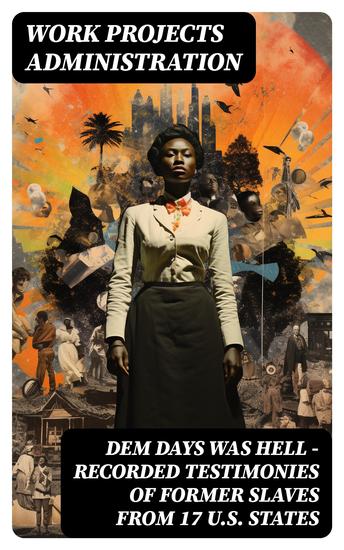
Dem Days Was Hell - Recorded Testimonies of Former Slaves from 17 U.S. States is a poignant culmination of oral histories collected by the Work Projects Administration during the Great Depression. This remarkable work captures the harrowing accounts of former enslaved individuals, offering a raw and unfiltered glimpse into the horrors of slavery and the resilience of the human spirit. Utilizing a narrative style that blends documentary prose with lyrical recollection, the book contextualizes these testimonies within the socio-political landscape of early 20th-century America, seeking to document the lived experiences of those who endured the brutality of slavery as a means of preserving their voices for future generations. The Work Projects Administration, formed under President Franklin D. Roosevelt's New Deal, aimed to empower communities through employment and skill-building initiatives. Though initially focused on infrastructure, its initiatives also recognized the significance of cultural documentation. The WPA's focus on reconstructing American history through these testimonies reflects a broader commitment to social justice and historical accountability, profoundly influenced by contemporary movements for civil rights and racial equality. This essential anthology is a must-read for anyone seeking to understand the complex legacies of slavery in America. By giving voice to the silenced, Dem Days Was Hell acts as a crucial historical document, inviting readers to engage with the past and ponder its repercussions on present and future generations. Readers will find themselves immersed in a rare tapestry of poignant memories, collective trauma, and enduring hope.

In this enriched edition, we have carefully created added value for your reading experience:
- An Introduction draws the threads together, discussing why these diverse authors and texts belong in one collection.
- Historical Context explores the cultural and intellectual currents that shaped these works, offering insight into the shared (or contrasting) eras that influenced each writer.
- A combined Synopsis (Selection) briefly outlines the key plots or arguments of the included pieces, helping readers grasp the anthology's overall scope without giving away essential twists.
- A collective Analysis highlights common themes, stylistic variations, and significant crossovers in tone and technique, tying together writers from different backgrounds.
- Reflection questions encourage readers to compare the different voices and perspectives within the collection, fostering a richer understanding of the overarching conversation.
Available since: 12/11/2023.
Print length: 7860 pages.

Other books that might interest you

  • Unwritten History Lincoln A Dark & Dangerous Vision - Learning From Renegade Scholar Lerone Bennett Jr - cover

    Unwritten History Lincoln A Dark...

    Geoffrey Giuliano

    • 0
    • 0
    • 0
    Lincoln's connection to black history may go much further than his role in slavery. In the 2001 book 'Black People and Their Place in History', historian Leroy Vaughn, alleges that Lincoln’s father was African American and his mother had Ethiopian ethnicity, both of which may have explained his “very dark skin and coarse hair.” The fact is his rivals campaigned using propaganda that depicted Lincoln as “Abraham Africanus the First,” an African man.It is claimed that Abraham Lincoln, who became America’s 16th President in 1860, was a Melungeon; a person of European, African-American and Native American ancestry.But beyond even that thoughtful historical proposition the late scholar Lerone Bennet Jr. sees America's most beloved president in a very different light to how he has been portrayed throughout time. Bennet hit a nerve in his research and writing on Lincoln. His book, 'Forced into Glory: Abraham Lincoln's White Dream', questions Lincoln's role as the "Great Emancipator". The work was described by one reviewer as a "flawed mirror." It was further criticized by historians of the Civil War period as faulty.In his introduction, Bennett wrote:"The idea of the book is simple: Everything you think you know about Lincoln and race is wrong. Every schoolchild, for example, knows the story of "the great emancipator" who freed Negroes with a stroke of the pen out of the goodness of his heart. The real Lincoln ... was a conservative politician who said repeatedly that he believed in white supremacy. Not only that: He opposed the basic principle of the Emancipation Proclamation until his death and was literally forced – Count Adam Gurowski said he was literally whipped – "into the glory of having issued the Emancipation Proclamation," which Lincoln drafted in such a way that it did not in and of itself free a single slave."Bennett's critics, including historians as well as political scientists, believe he ignores Lincoln's political and moral growth during the course
    Show book
  • Day in the Life of the Maya A: History Culture and Daily Life in the Mayan Empire - cover

    Day in the Life of the Maya A:...

    Editors Charles River

    • 0
    • 0
    • 0
    Many ancient civilizations have influenced and inspired people in the 21st century. The Greeks and Romans continue to fascinate the West today. But of all the world’s civilizations, none have intrigued people more than the Mayans, whose culture, astronomy, language, and mysterious disappearance all continue to captivate people. 
    In 2012 especially, there has been a renewed focus on the Mayans, whose advanced calendar has led many to speculate the world will end on the same date the Mayan calendar ends. The focus on the “doomsday” scenario, however, has overshadowed the Mayans’ true contribution to astronomy, language, sports, and art. 
    The preoccupation with 2012 and the Mayan calendar has also overshadowed the discussion over who exactly the Mayans were. The Maya are one of the most famous civilizations in history, but what was it like to be Mayan at the height of their civilization in the 15th century? What did they eat? What did they play? What was their religion? How did they build their cities and organize their empire? How did they fight? 
    A Day in the Life of the Maya answers these questions by comprehensively examining and analyzing everything about their culture, including their history, religion, architecture, farming, calendar, ball game, cosmology and origins. 
    Show book
  • Mesoamerican Capitals - Cities of Stone and Gold (4 in 1) - cover

    Mesoamerican Capitals - Cities...

    Rolf Hedger

    • 0
    • 0
    • 0
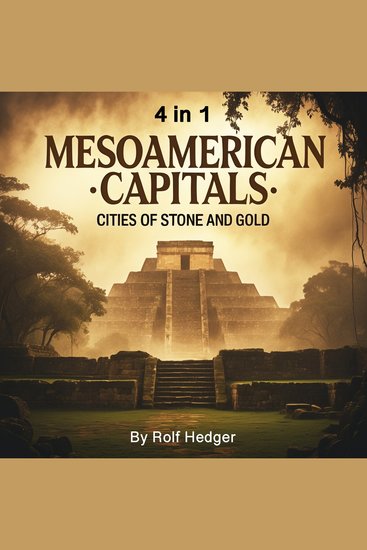
    From the mist-shrouded valleys of central Mexico to the glimmering highlands of Colombia, the ancient Americas witnessed the rise of extraordinary urban centers that would shape the destiny of countless generations. In "Mesoamerican Capitals: Cities of Stone and Gold," we embark on a journey through time to explore four of the most influential civilizations that rose to prominence long before European contact transformed the Western Hemisphere. 
    These weren't merely settlements but complex metropolitan hubs—centers of innovation, artistry, and power that rivaled their Old World contemporparts in sophistication and grandeur. Teotihuacan, with its monumental Avenue of the Dead and towering pyramids, once housed over 125,000 inhabitants in a masterfully planned cityscape that influenced cultures throughout Mesoamerica. The Toltec capital of Tula stood as a beacon of military might and cultural refinement, establishing patterns of rulership and religious practice that would echo for centuries. Monte Albán, crown jewel of the Zapotec civilization, commanded the valleys of Oaxaca from its mountain perch, while the Muisca Confederation created a network of urban centers across the Colombian highlands, their wealth in gold becoming the stuff of legend. 
    These weren't simply places where people gathered—they were the physical manifestations of worldviews, cosmologies encoded in stone and adobe. Each represented distinct approaches to urban planning, governance, and the relationship between the sacred and the profane. Their rulers wielded power through combinations of divine authority, military prowess, and control of vital trade routes that connected distant regions through complex networks of exchange. 
    As you turn listen to this book, you'll discover how these remarkable urban centers functioned as crucibles of innovation, where art, architecture, mathematics, astronomy, and religious thought flourished in distinctive ways.
    Show book
  • Pandemonium - Power Politics and Ireland's Pandemic - cover

    Pandemonium - Power Politics and...

    Jack Horgan-Jones, Hugh O'Connell

    • 0
    • 0
    • 0
    The Inside Story of Ireland's Pandemic: Every Decision, Every Player, Every Text, Every Leak
    Ireland's lockdowns were among the harshest and longest in Europe. As the state was battered by waves of disease time and again, unparalleled pressures and untold tensions emerged as the country went to war with Covid, and policymakers and politicians did battle with each other.
    How were the key decisions made? Who held all the power?
    Boasting unrivalled access to the key decision-makers and drawing on hundreds of hours of interviews and thousands of pages of documents, including confidential and unpublished material, Pandemonium reveals the moves, the power-plays and the – at times jaw-dropping – tactics of a government with the health of a nation in its hands.
    'If a movie is ever made of how Ireland responded to the Covid-19 pandemic, Pandemonium may well provide the script … You will feel as if you were in the room when key conversations happened and decisions were made.' Professor Luke O'Neill
    'Illuminates the corners of institutions usually able to operate in the dark' Fintan O'Toole
    'A page-turner … an exceptional insight' Matt Cooper
    'Unflinching and unrelenting' Dearbhail McDonald
    Show book
  • Won't You Love Me? - cover

    Won't You Love Me?

    Toni Maguire, Ava Thomas

    • 0
    • 0
    • 0
    From the bestselling author Toni Maguire comes a new true story of abuse and survival. 


    'Whatever you do, don't go back to him, not this time. If not for your sake, then for your children's.' 


    Ava Thomas knew leaving was the right decision. Trapped and manipulated in her relationship, and after yet another violent beating whilst she was pregnant, Ava was helped to a women's refuge with her children. 


    Listening to the stories of other women there, Ava began thinking back to where it all started to go wrong. Brought up by a mother who never loved her, Ava sought that missing care and warmth elsewhere. Running away to her father's home as a teenager, she thought she might finally be safe. But after being abused by her own brother, she was thrown out onto the streets. Ava searched for the love she had been desperately missing her whole life and ended up in a relationship controlled by domestic violence. 


    Lifted by the strength of the other women around her, Ava found a new home, a fresh start and never looked back—with her loving children by her side. 


    Contains mature themes.
    Show book
  • Hekate - Goddess of Witches - cover

    Hekate - Goddess of Witches

    Courtney Weber

    • 0
    • 6
    • 0
    Learn the myths and legends behind this beloved goddess plus practices and suggestions for making Hekate part of your spiritual path. Courtney Weber (author of Brigid and The Morrigan) offers an informed, accessible journey through the lore and history of Hekate, the ancient goddess of crossroads, ghosts, and witchcraft, and reflects on Hekate’s relevance today. Tools and techniques for incorporating this goddess into your personal journey round out the book.  Similar to her other works, Weber strikes a balance between the scholarly and the spiritual. Her exploration of Hekate combines solid research with practical, modern applications. The spiritual content is accessible to anyone with an interest in witchcraft, regardless of their faith or background.   Each chapter focuses on a different aspect of Hekate, exploring original mythology, historical context, and contemporary connotations, concluding with spells and personal rituals. The final chapter is a grimoire full of rituals, offerings, and other practices designed to help readers align themselves with this extraordinary goddess. The book also explores magickal ethics, what it means to be a witch in the twenty-first century, and best practices for successful witchcraft.
    Show book