Join us on a literary world trip!
Add this book to bookshelf
Grey
Write a new comment Default profile 50px
Grey
Subscribe to read the full book or read the first pages for free!
All characters reduced
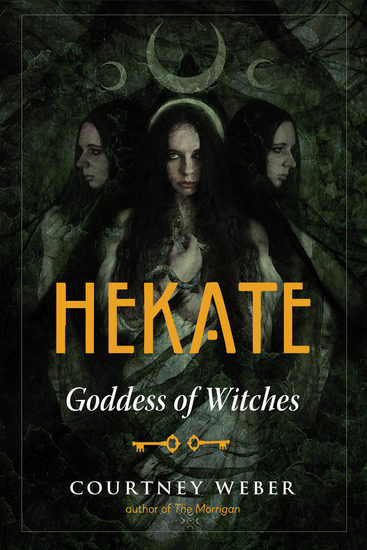
Hekate - Goddess of Witches - cover

Hekate - Goddess of Witches

Courtney Weber

Publisher: Weiser Books

  • 0
  • 6
  • 0

Summary

Learn the myths and legends behind this beloved goddess plus practices and suggestions for making Hekate part of your spiritual path. Courtney Weber (author of Brigid and The Morrigan) offers an informed, accessible journey through the lore and history of Hekate, the ancient goddess of crossroads, ghosts, and witchcraft, and reflects on Hekate’s relevance today. Tools and techniques for incorporating this goddess into your personal journey round out the book.  Similar to her other works, Weber strikes a balance between the scholarly and the spiritual. Her exploration of Hekate combines solid research with practical, modern applications. The spiritual content is accessible to anyone with an interest in witchcraft, regardless of their faith or background.   Each chapter focuses on a different aspect of Hekate, exploring original mythology, historical context, and contemporary connotations, concluding with spells and personal rituals. The final chapter is a grimoire full of rituals, offerings, and other practices designed to help readers align themselves with this extraordinary goddess. The book also explores magickal ethics, what it means to be a witch in the twenty-first century, and best practices for successful witchcraft.
Available since: 08/01/2021.
Print length: 224 pages.

Other books that might interest you

  • The Outward Path - The Wisdom of the Aztecs - cover

    The Outward Path - The Wisdom of...

    Sebastian Purcell

    • 0
    • 0
    • 0
    A practical and eye-opening guide to the Aztec philosophy on how to live. 


    The Outward Path refers to the central insight that our true desire as human beings is not really for "happiness," a fleeting mood. What we really want is a rich and worthwhile life, which we can only achieve by pursuing an outward path of engagement with other people. Wisdom is not a matter of "thinking for oneself," but comes through deliberating well in concert with others. Stoic and Buddhist philosophies will teach you to still your mind to address the outside world; but according to the Aztecs, we should cultivate healthy relationships first and then use those to forge a path forward. This "outward path" offers an alternative to the presumptions of our highly individualistic, competitive Western culture, with its epidemic of loneliness and other social ills. 


    Aztec self-help for the modern world, this is the first book in any modern language to present the core ethical principles of the Aztecs. It provides us with surprising insights about how to address concerns common to everyone, from how to make a good decision or strengthen your willpower, to how to sustain love and survive tragedy. Structured around twelve lessons and seven exercises, it's an ethical workout routine designed to help you become a better person—one more deeply rooted and fulfilled.
    Show book
  • Maxims Contemplations & Perspectives on Perfectionism - cover

    Maxims Contemplations &...

    Mario D. Leone

    • 0
    • 0
    • 0
    In my book The Beautiful Flaw, I have revealed perfectionism for you as a self-imposed barrier that prevents our true growth and full self-acceptance. When we are embracing our imperfection, we unlock the freedom to evolve and fully embrace who we are, flaws and all.
    Show book
  • Russian Military Thought - The Evolution of Strategy Since the Crimean War - cover

    Russian Military Thought - The...

    Gudrun Persson

    • 0
    • 0
    • 0
    Novel insights into Russian military thought―from the Crimean War to the war in UkraineThe development of the Russian military's strategic thought is an understudied and thus misunderstood subject in the West. Strategy in Russia encompasses the broader context of foreign and domestic policy as well as the military's ties to the country's leadership. The military's strategic thought is closely linked to Russia's existence as a state and explains patterns of Russian confrontation.In Russian Military Thought, the renowned scholar Gudrun Persson offers novel insights into Russian military thought on doctrine and strategy, from the Crimean War to Russia's full-scale invasion of Ukraine. Persson dismantles the simplistic notion that Russian military thought is "backward," instead presenting a deeper analysis of the drivers that influence the changes in Russian military strategy. Through archival research based on Russian language sources, Persson offers a multidisciplinary perspective, drawing on theoretical insights from history and political science that enable her to make a nuanced, qualitative analysis. This book will be essential for practitioners, scholars, and students who seek to understand the mindset of the current Russian leadership and the constraints that shape Russia's future possibilities.
    Show book
  • The Viking Age - Raiders and Traders - cover

    The Viking Age - Raiders and...

    Harris Ropes

    • 0
    • 0
    • 0
    The story of the Vikings begins in the rugged, coastal lands of Scandinavia, where modern-day Norway, Sweden, and Denmark now stand. These northern regions, characterized by their cold climate, deep fjords, and dense forests, shaped a resilient and resourceful people. Isolated by geography and challenged by limited arable land, the early Norse communities developed a strong connection to nature, the sea, and their close-knit societies. Life in Scandinavia during the early Middle Ages was not easy, but it fostered a culture of survival, adaptability, and innovation. 
    At the heart of Viking society was a deep belief in their mythology and gods. Norse mythology offered a complex system of deities, heroes, and mythical creatures that guided the moral and spiritual lives of the people. Central figures like Odin, the wise All-Father; Thor, the thunder god and protector; and Freyja, the goddess of love and fertility, were not just worshipped but also deeply integrated into the everyday lives of the Norse. These myths were passed down through oral storytelling, poetic sagas, and ritual practices, helping to create a shared identity among the diverse Scandinavian tribes. 
    Viking society was organized into a hierarchical structure that valued strength, honor, and loyalty. At the top were the jarls, or chieftains, who held power over clans and led warriors into battle or on raids. Below them were the karls, the free farmers, craftsmen, and traders who formed the backbone of Viking communities. At the bottom were the thralls, or slaves, who were usually captured during raids or born into servitude. Despite this stratification, Viking culture emphasized personal achievement and reputation, allowing individuals to rise in status through bravery, skill, and loyalty.
    Show book
  • Baikonur Man - Space Science American Ambition and Soviet Chaos at the Cold War's End - cover

    Baikonur Man - Space Science...

    Barry L. Stoddard

    • 0
    • 0
    • 0
    Against the backdrop of the late Cold War, a tiny American start-up company forged a secret deal to place American scientific payloads aboard the Soviet space station MIR. Born out of sheer desperation after the Challenger explosion and grounding of the United States space shuttle program, the agreement was negotiated and approved behind the backs of NASA and Congress, with the help of United States government officials inside the Commerce and Defense departments. 


    On a cold gray morning in February 1988, the company founder met with three graduate students and their professor at the Massachusetts Institute of Technology to put his plans into action. Baikonur Man, written by one of those students, recounts the subsequent five-year saga of how science, comradery, hardship, drama, and occasional lunacy led to the first American experiments and payloads to fly on Russian rockets.
    Show book
  • Dubai - cover

    Dubai

    Klaus H. Carl

    • 0
    • 0
    • 0
    Saint-Exupéry might have had the Little Prince say that he liked the desert because that is where camels can hide out. Dubai is one of the seven Gulf Emirates and has become a high-tech avantgarde metropolis where superlatives are superfluous. Major wonders of architectural imagination and scale include the National Bank of Dubai, Clock Tower, Creek Side and Dubai Internet City. It also operates the world's largest man-made harbour in Jebel Ali, which features a major water desalination plant. It is the world's third largest trans-shipment hub after Hong Kong and Singapore. Nonetheless, Dubai preserves close ties to the past, based on Bedouin tradition, camel racing, falconry, pearl diving and the world of palm groves. The land thrived before the era of oil derricks and is now preparing to live again after they leave as it invests in higher education that heartily welcomes women. Time-honoured legends of Arab cavalries that swept across the deserts still survive in horse races that display equestrian tradition against a background of exclusive state-of-the-art driving machines: Welcome to this sneak preview of the 21st Century!
    Show book