Join us on a literary world trip!
Add this book to bookshelf
Grey
Write a new comment Default profile 50px
Grey
Subscribe to read the full book or read the first pages for free!
All characters reduced
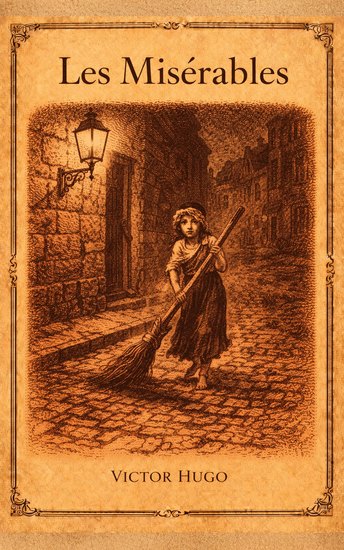
Les Misérables - cover

Les Misérables

Victor Hugo

Publisher: CLXBX

  • 0
  • 0
  • 0

Summary

An epic tale of justice, redemption, love, and sacrifice, Les Misérables by Victor Hugo stands as one of the greatest achievements in world literature. Set against the turbulent backdrop of 19th-century France, this monumental novel weaves together the lives of unforgettable characters in a powerful exploration of human suffering and moral transformation.

At the heart of the story is Jean Valjean, a man imprisoned for stealing bread to feed his sister's starving children. After years of hardship and injustice, he is given a second chance at life through an act of extraordinary compassion. Determined to reinvent himself and live honorably, Valjean must evade the relentless Inspector Javert, whose rigid devotion to the law drives him to pursue Valjean across decades.

Around this central conflict unfolds a sweeping panorama of society: the tragic plight of Fantine, forced into despair to provide for her daughter Cosette; the courage and idealism of young revolutionaries; the struggles of the poor and powerless; and the enduring power of love and hope in the face of oppression. Hugo masterfully intertwines personal stories with historical events, culminating in the dramatic uprising on the streets of Paris.

More than a historical novel, Les Misérables is a profound meditation on mercy, justice, and the human capacity for change. Hugo challenges readers to question the structures of society and to consider whether compassion can triumph over punishment, and grace over judgment.

Rich in emotion, philosophical depth, and unforgettable drama, Les Misérables remains a timeless masterpiece. Its sweeping narrative and deeply human characters continue to inspire generations, offering a stirring testament to resilience, redemption, and the enduring struggle for dignity and freedom.
Available since: 02/14/2026.
Print length: 2028 pages.

Other books that might interest you

  • Singa-Pura-Pura - Malay Speculative Fiction from Singapore - cover

    Singa-Pura-Pura - Malay...

    Nazry Bahrawi

    • 0
    • 0
    • 0
    From a future of electronic doas and AI psychotherapists, sense-activated communion with forests and a portal to realms undersea, to a reimagined origin and afterlife—editor and translator Nazry Bahrawi brings together an exciting selection of never-before translated and new Malay spec-fic stories by established and emerging writers from Singapore.  
     
     
    Especially in an anglophone-dominated genre, very little of Malay speculative fiction from Singapore is known to readers here and beyond. Yet contemporary Bahasa literature here is steeped in spec-fic writing that can account as a literary movement (aliran)—and unmistakably draws from the minority Malay experience in a city obsessed with progress.
    Show book
  • Candide - cover

    Candide

    Voltaire

    • 0
    • 0
    • 0
    Candide is a sharp, brilliantly satirical masterpiece that skewers blind optimism and challenges the philosophical complacency of its time. Written by Voltaire, this enduring classic follows the absurdly misfortunate adventures of a naïve young man whose unwavering belief that he lives in "the best of all possible worlds" is relentlessly tested by catastrophe, cruelty, and chaos.
    
    The story begins in a sheltered castle, where Candide is raised under the influence of his tutor, Pangloss, a philosopher who insists that everything happens for the best. Cast out into a turbulent world, Candide embarks on a whirlwind journey across continents, encountering war, natural disasters, corruption, greed, betrayal, and human folly at every turn. From Europe to South America and beyond, each episode exposes the harsh realities that contradict his carefully instilled optimism.
    
    Along the way, Candide reunites with lost companions, survives astonishing misfortunes, and witnesses both the heights of human absurdity and the depths of suffering. Voltaire's storytelling is swift and ironic, blending dark humor with biting social commentary. Through exaggerated events and colorful characters, he critiques organized religion, political tyranny, philosophical dogma, and the blind acceptance of suffering as part of a supposedly perfect design.
    
    Yet beneath its comedic surface lies a serious philosophical inquiry. As Candide's illusions crumble, he is forced to reconsider the comforting but simplistic worldview he once embraced. The novel ultimately suggests a pragmatic alternative to empty theorizing: rather than speculating endlessly about cosmic purpose, one should focus on practical work, personal responsibility, and cultivating a meaningful life in the present.
    
    Compact yet profound, Candide remains one of the most influential works of Enlightenment literature. Its wit is as sharp today as when it was first published, and its questions about optimism, resilience, and moral responsibility continue to resonate. With its blend of humor, adventure, and philosophical depth, Candide invites readers to laugh, reflect, and reconsider what it truly means to live wisely in an unpredictable world.
    Show book
  • Gentle Breathing - From their pens to your ears genius in every story - cover

    Gentle Breathing - From their...

    Ivan Bunin

    • 0
    • 0
    • 0
    Ivan Alekseyevich Bunin was born on 22nd October 1870 in Voronezh province, in the South-West of the Russian Empire. 
    His early life was plagued by his Father’s gambling habits which caused his education to be erratic and the family to lose most of their wealth. 
    Bunin published his first poem in 1887 in St Petersburg and later in Oryol he worked for the local paper and became its editor, handily allowing him to publish his own poems and short stories.  There he met and married Varvara Pashchenko.  Ivan Bunin's debut book of poetry ‘Poems (1887–1891)’ was published in 1891. 
    This poetry and his translation of Longfellow garnered him his first Pushkin Prize.  Now he switched to writing prose and his novella ‘Antonov Apples’ is regarded as his first masterpiece.  Many more would follow. 
    The October Revolution of 1905 found Bunin in the Crimea.  Scenes of ‘class struggle’ he saw more as the oppressed people's craving for anarchy and destruction. 
    In November 1906 he began a passionate affair with Vera Muromtseva, within a few months they were touring through Egypt and Palestine.  ‘The Bird's Shadow’ collection was the result.   
    His second Pushkin Prize came in 1909 for Poems (1903–1906) and further translations.  He was now elected to the prestigious Russian Academy. 
    More widespread fame came in 1910 with ‘The Village’, a controversial and bleak portrayal of Russian country life.  Travel too beckoned them back to the Middle East, Ceylon (now Sri Lanka) and for winters in Capri with their friend Maxim Gorky.  
    That friendship suddenly ended in April 1917 as the revolution began to ferment in war-ravaged Russia.  After the Bolsheviks took power and the upheavals continued, he decided to leave Russia, finally achieving that in early 1920.  
    It would take some time to heal the wounds and stress he had been under and for his writing to begin again.  Settled in France, Bunin published many of his previous works and collections of novellas.  He also made regular contributions to the Russian emigre press.  
    Although reluctant to become involved in politics, Bunin was now feted as both a writer and the figurehead of non-Bolshevik Russian values and traditions.  In 1933 he became the first Russian to be awarded the Nobel Prize for Literature ‘for following through and developing with chastity and artfulness the traditions of Russian classic prose.’  
    In 1938 Bunin began working on the celebrated cycle of nostalgic, and erotically themed stories known Dark Avenues (or Dark Alleys).  
    As World War II broke out he chose to remain in Grasse spending the war at his remote Villa Jeanette, high in the mountains.  
    Ivan Bunin was a staunch anti-Nazi, and often, under difficult conditions, sheltered fugitives after Vichy was occupied by the Germans.  He wrote but did not publish during these years until on August 23rd the Nazi’s fled Grasse without a fight.  The next day the Americans came.  
    In May 1945 he returned to Paris and, apart from convalescing at times in Juan-les-Pins, he stayed for the rest of his life. 
    After 1948, with his health deteriorating, Bunin concentrated upon writing his memoirs and a book on Chekhov.  His last years were overshadowed by bitterness and despair at the situation in Russia and the treatment of its peoples.  He was suffering now from asthma, bronchitis and chronic pneumonia. 
    Ivan Alekseyevich Bunin died in a Paris attic flat on 8th November 1953.  Heart failure, cardiac asthma and pulmonary sclerosis were given as the causes of death.  He was 83.
    Show book
  • Wuthering Heights - Audiobook - cover

    Wuthering Heights - Audiobook

    Emily Brontë, Classic...

    • 0
    • 0
    • 0
    Wuthering Heights, written by Emily Brontë, is a haunting tale of passion, revenge, and unrelenting love set against the windswept moors of Yorkshire. The novel weaves a multi-generational story of the intense, destructive relationship between Heathcliff, an orphan taken in by the Earnshaw family, and Catherine Earnshaw, the spirited daughter of the house. Their love defies societal norms and transcends morality, but it is marred by cruelty, betrayal, and an insatiable longing that ultimately consumes them.Told through the narrative of a tenant named Mr. Lockwood and the housekeeper Nelly Dean, the story explores the dark, intertwined fates of the Earnshaws and their neighbors, the Lintons. Themes of class conflict, the destructive nature of vengeance, and the supernatural thread of eternal love dominate the plot. The bleak, untamed landscapes mirror the wild emotions of the characters, creating a gothic masterpiece that defies conventional romance and delves deep into the complexities of human nature.A tale of enduring love and tragic consequences, Wuthering Heights challenges readers to confront the fine line between passion and obsession, making it one of the most memorable works in English literature.
    Show book
  • Oedipus Rex (unabridged) - cover

    Oedipus Rex (unabridged)

    Sophocles

    • 0
    • 0
    • 0
    Rediscover an enduring classic in a transformative new light. "Oedipus Rex," the remarkable tragedy penned by Sophocles, has been masterfully revitalized in this riveting and immersive audiobook experience.Regarded as a cornerstone of Western literature, Oedipus Rex's timeless tale of fate, power, and the relentless pursuit of truth continues to captivate audiences millennia after its initial conception. Delve into the heart of Thebes, navigating the winding paths of power, prophecy, and self-discovery alongside the tragic figure of Oedipus, the King who must grapple with the devastating consequences of his past actions.This meticulously crafted audiobook takes the immersive nature of this tragic masterpiece to new heights. Brought to life through a vibrant, dynamic narration, each character springs forth in brilliant clarity, their complexities and inner turmoil echoing in every inflection, every pause.Our talented narrator breathes life into ancient Thebes, with a performance rich in passion and authenticity. From the anguished cries of Oedipus to the sage wisdom of Tiresias, every dialogue and soliloquy is delivered with a precision that captures the spirit of the original text.What sets this version of Oedipus Rex apart is not only the emotive narration but also the crisp and clear audio quality. Our top-notch production team has endeavored to ensure that every word, every pause, every breath is captured with utmost clarity. Rigorously edited to remove any distractions, the audio quality is pristine, heightening your immersion in the tragic narrative.The seamless integration of an emotionally charged performance with expert audio editing creates an auditory experience that is as captivating as it is transformative. This polished rendition of Oedipus Rex does more than recount a tale—it resonates, it echoes, it transforms.
    Show book
  • From Beyond - cover

    From Beyond

    H.P. Lovecraft

    • 0
    • 0
    • 0
    Title: From Beyond 
    Author: H. P. Lovecraft 
    Narrator: Jonathan Dunne 
    Original Publication: 1934 
    Public Domain: Yes 
    Series: Timeless Terrors 
    Number: 109 
    Description: 
    From Beyond is a chilling tale of forbidden science and unseen dimensions, in which the boundaries between reality and nightmare are catastrophically dissolved. 
    The story follows an unnamed narrator who recounts his association with the brilliant yet unhinged scientist Crawford Tillinghast. Obsessed with unlocking hidden layers of existence, Tillinghast constructs a machine designed to stimulate the human pineal gland — a device he claims will allow the mind to perceive realities that lie beyond ordinary sensory limitations. 
    When activated, the machine does not merely expand perception — it shatters it. The narrator soon becomes aware of writhing, luminous entities occupying the same physical space as humanity, creatures previously invisible only because human senses were mercifully blind to them. What was once unseen now presses close, monstrous and incomprehensible. 
    As Tillinghast exults in his terrible discovery, the narrator is overcome with mounting dread. The revelation is not enlightenment but violation — an intrusion of alien life into the fragile sphere of human understanding. Science, in its arrogance, has torn open a veil that was never meant to be lifted. 
    Narrated by Amazon-bestselling horror author Jonathan Dunne, this performance captures the mounting tension and otherworldly dread at the heart of Lovecraft’s vision. From Beyond remains a haunting exploration of what may lurk just outside the narrow limits of human perception — waiting for the moment we learn how to see.
    Show book