Join us on a literary world trip!
Add this book to bookshelf
Grey
Write a new comment Default profile 50px
Grey
Subscribe to read the full book or read the first pages for free!
All characters reduced
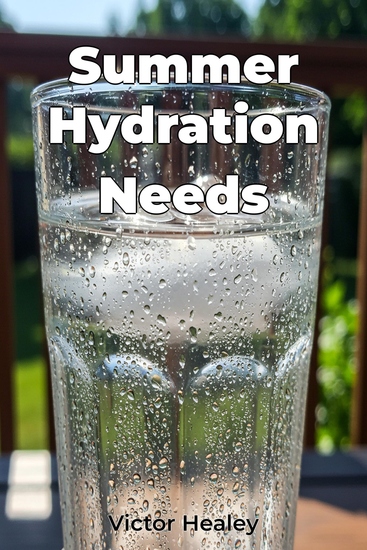
Summer Hydration Needs - cover

Summer Hydration Needs

Victor Healey

Translator A AI

Publisher: Publifye

  • 0
  • 0
  • 0

Summary

Summer Hydration Needs explores the critical link between adequate water intake during hot weather and its impact on public health. Did you know that dehydration can lead to severe consequences like heatstroke and kidney problems? The book explains the science behind hydration, focusing on how our bodies respond to heat stress and maintain fluid balance, or thermoregulation. It highlights that current hydration guidelines may not fully address individual needs during extreme heat, potentially endangering vulnerable populations.

 
The book progresses logically, beginning with the basics of hydration and dehydration. It then examines the impact of high temperatures, including how heat alters electrolyte balance. Finally, it offers practical, evidence-based strategies for optimizing hydration for individuals, healthcare professionals, and public health officials.

 
By connecting physiology, environmental science, and public health, Summer Hydration Needs provides valuable insights and recommendations for improving summer health and mitigating heat-related illness.
Available since: 02/20/2025.
Print length: 98 pages.

Other books that might interest you

  • Re-Wild - 50 Paths to Reconnect with Nature - cover

    Re-Wild - 50 Paths to Reconnect...

    Stefano Luca Tosoni

    • 0
    • 0
    • 0
    Fifty practices to help bring nature home—from starting a hiking journal and mindful breathing to forest bathing and foraging.Divided by levels of difficulty, this nature guide book gives swaths of practical advice. From simple things like how to feel at home in nature and learning fun nature facts to finding a trail if you’re lost to foraging plants, mushrooms, herbs, or wild harvesting knick-knacks on nature trails, this hiking book has something to teach you.In the day-to-day, we can lose ourselves in the stress and anxiety of the world we have built. Nature is enough to help you reconnect physically and spiritually to your roots. Simple practices such as taking a walk in the woods or swimming in a cold lake can help you to get outside your head and become one with nature. Immerse yourself in the beautiful images of places you’ve never been and find the most primitive form of peace you have ever known with Re-Wild.Inside Re-Wild, you’ll find:Fifty accessible and simple practices to reconnect with natureA stirring mix of evocative illustrations and photographsTips on everything from wild harvesting to mindfulness, helping readers from both a practical and conceptual point of viewIf you liked The Nature Fix, Surviving the Wild, or The Forager’s Guide to Wild Foods, you’ll love Re-Wild.
    Show book
  • The Care Divide - Two Lives Two Systems and the Case for Universal Healthcare - cover

    The Care Divide - Two Lives Two...

    Christopher Voss MD MBA MS MLS...

    • 0
    • 0
    • 0
    The Care Divide by Dr. Christopher Voss reveals how healthcare systems shape lives, opportunity, and dignity. 
    Through two vivid stories—Ava, growing up in America’s fragmented system, and Zoe, raised with universal coverage—Dr. Voss shows the stark contrast between fear and freedom. Ava’s life is defined by delayed treatments, surprise bills, and chronic conditions that derail her future. Zoe’s is marked by seamless care, early support, and the freedom to pursue her dreams without fear of losing coverage. 
    Blending human stories with meticulous research, The Care Divide exposes the costs of America’s system: physicians burned out by bureaucracy, families bankrupted by illness, and entrepreneurs trapped in jobs for insurance. In contrast, universal systems worldwide deliver healthier outcomes, stronger communities, and security across generations. 
    More than a policy critique, this book is a call to action. With compassion and clarity, Dr. Voss urges us to envision a future where no one must choose between health and financial security. 
    The Care Divide is essential reading for healthcare professionals, policymakers, and citizens who believe care is a human right. It will open your eyes, stir your heart, and inspire you to join the movement for a system that leaves no one behind.
    Show book
  • Pollution - The Environmental Crisis That Threatens Our Health - cover

    Pollution - The Environmental...

    Marcus Klein

    • 0
    • 0
    • 0
    Pollution is a pervasive and urgent global issue that affects every corner of the planet, from the air we breathe to the water we drink and the land we depend on for survival. Over the past century, the rapid pace of industrialization, urbanization, and population growth has contributed significantly to environmental degradation. What was once seen as the price of progress has now become a formidable challenge that threatens the health of humans, animals, and ecosystems alike.  
      
    The scope of pollution is vast and multifaceted. It encompasses a wide range of pollutants, including chemicals, plastics, heavy metals, and greenhouse gases, which infiltrate the air, water, and soil. While air pollution from vehicle emissions and industrial activities poses immediate health risks, water pollution contaminates vital freshwater resources, threatening marine ecosystems and human livelihoods. Land pollution, driven by improper waste disposal and deforestation, further exacerbates the crisis by depleting soil fertility and destroying habitats. Together, these forms of pollution create a complex web of environmental and health hazards that demand immediate attention.  
      
    Human health is intricately tied to the environment, making pollution a direct and indirect cause of numerous diseases and conditions. Respiratory ailments, cardiovascular issues, and neurological disorders are increasingly linked to exposure to polluted air and toxic chemicals. Vulnerable populations, such as children and low-income communities, bear a disproportionate burden of these impacts, amplifying social inequalities. Beyond physical health, the psychological toll of living in a degraded environment adds another layer of complexity to the crisis. 
    Show book
  • In This Together - Connecting with Your Community to Combat the Climate Crisis - cover

    In This Together - Connecting...

    Marianne E. Krasny

    • 0
    • 0
    • 0
    In This Together explores how we can harness our social networks to make a real impact fighting the climate crisis. 
    Against notions of the lone environmental crusader, Marianne E. Krasny shows us the power of “network climate action"―the idea that our own ordinary acts can influence and inspire those close to us. Through this spread of climate-conscious practices, our individual actions become collective ones that can eventually effect widespread change.Weaving examples of everyday climate-forward initiatives in with insights on behavioral and structural change, Krasny demonstrates how we can scale up the impact of our efforts through leveraging our community connections. Whether by inviting family, friends, or colleagues to a plant-rich meal or by becoming activists at climate nonprofits, we can forge the social norms and shared identities that can lead to change.With easy-to-follow dos and don’ts, In This Together shows us a practical and hopeful way forward into our shared future.
    Show book
  • Nineteen Ways of Looking at Consciousness - cover

    Nineteen Ways of Looking at...

    Patrick House

    • 0
    • 0
    • 0
    A concise, elegant, and thought-provoking exploration of the mystery of consciousness and the functioning of the brain.Despite decades of research, remarkable imagery, and insights from a range of scientific and medical disciplines, the human brain remains largely unexplored. Consciousness has eluded explanation.Nineteen Ways of Looking at Consciousness offers a brilliant overview of the state of modern consciousness research in twenty brief, revealing chapters. Neuroscientist and author Patrick House describes complex concepts in accessible terms, weaving brain science, technology, gaming, analogy, and philosophy into a tapestry that illuminates how the brain works and what enables consciousness. This remarkable book fosters a sense of mystery and wonder about the strangeness of the relationship between our inner selves and our environment.A Macmillan Audio production from St. Martin’s Press.
    Show book
  • An Engineer Imagines - cover

    An Engineer Imagines

    Peter Rice

    • 0
    • 0
    • 0
    The long-awaited reissue of the autobiography of Peter Rice, one of the main structural engineers behind the Sydney Opera House, the Pompidou Centre, the Menil Collection and Lloyd's of London.
    
    'I am an engineer. Often people will call me an 'architect engineer' as a compliment. It is meant to signify a quality of engineer who is more imaginative and design-orientated than a normal engineer... To call an engineer an 'architect engineer' because he comes up with unusual or original solutions is essentially to misunderstand the role of the engineer in society.'
    An Engineer Imagines is a rare look into the professional creativity and philosophy of Peter Rice, who was widely acclaimed as the greatest structural engineer of his generation. He was a man who, in Renzo Piano's words, could design structures 'like a pianist who can play with his eyes shut'. Working with many of the world's greatest architects on buildings that became icons of contemporary architecture, he brought a uniquely poetic feeling to his work.
    Joining Ove Arup & Partners in 1956, Rice had heard that 'it was a place where an oddball could fit in.' Taking on Arup's theory of Total Design to heart, Rice writes about the role of the engineer in society, and how he himself applied his creativity to various projects. He admits he became an engineer by accident, tentatively feeling his way through a career without a natural instinct. But as he takes you through each of his projects, one-by-one, you can trace his development from graduate to veteran.
    Written in clear and poetic language, Rice's autobiography is perfect for those who want to better understand postwar buildings, our concrete environment, or are budding students of engineering and architecture.
    Show book