Join us on a literary world trip!
Add this book to bookshelf
Grey
Write a new comment Default profile 50px
Grey
Subscribe to read the full book or read the first pages for free!
All characters reduced
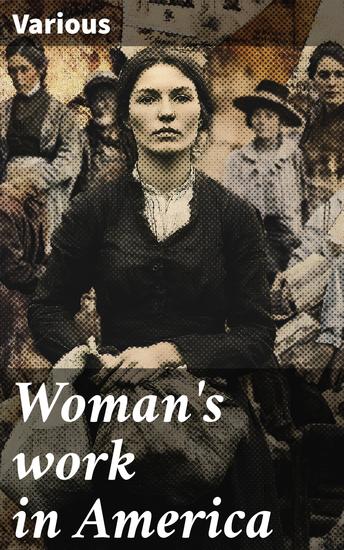
Woman's work in America - cover

Woman's work in America

Various Various

Publisher: Good Press

  • 0
  • 0
  • 0

Summary

Woman's Work in America provides an illuminating exploration of the pivotal roles that women have played in various sectors of American society. Through a compilation of essays, historical accounts, and sociological analyses, this volume offers a comprehensive overview of women's contributions, ranging from domestic labor to professional fields. Its literary style is both scholarly and engaging, weaving personal narratives with broader societal trends, highlighting women's resilience, ingenuity, and the socio-cultural barriers they navigated. Set against the backdrop of shifting gender norms and evolving societal expectations, the work challenges traditional notions of labor and gender roles in the American context. The collection is curated by various authors, each providing unique insights shaped by their individual backgrounds, research interests, and personal experiences. The contributors include historians, sociologists, and feminists who recognize the need to acknowledge the often-overlooked contributions of women throughout American history. Their collective commitment to amplifying women's voices and experiences stems from a desire to address historical omissions and promote gender equity in both academic discourse and public consciousness. This book is highly recommended for scholars, students, and general readers interested in understanding the intricate tapestry of women's contributions to American society. It serves not only as an academic resource but also as a powerful reminder of the ongoing struggle for recognition and equality, making it a crucial read for anyone invested in feminist studies or social history.
Available since: 03/02/2025.
Print length: 200 pages.
Other books that might interest you

  • Get to the Point! Second Edition - Simplify Sharpen and Sell Your Message - cover

    Get to the Point! Second Edition...

    Joel Schwartzberg

    • 0
    • 0
    • 0
    Every time you communicate, you're trying to move someone to feel, think, and act. You're trying to make a point. But very few communicators—regardless of their purpose or position—know their points, have true points, or even understand what a point is, rendering themselves pointless. 


    In this expanded second edition of the bestselling Get to the Point!, Joel Schwartzberg draws on his decades of experience as a strategic communications executive and public speaking coach to deliver a masterclass in high-impact communications for the digital age. 


    Using his trademark encouraging and often humorous voice, Schwartzberg helps you create impactful speeches and slide presentations, emails and work chats, and Zoom and in-person meeting communications. The book will also help you conquer public speaking jitters; leverage AI tools to support—not replace—effective communication; avoid common communication pitfalls; and much more. Whether you're a C-suite executive, salesperson, scientist, or student, Get to the Point! is a blueprint for evolving your written and spoken communications from informing to inspiring and pointless to powerful.
    Show book
  • Sex Beyond "Yes" - Pleasure and Agency for Everyone - cover

    Sex Beyond "Yes" - Pleasure and...

    Quill R. Kukla

    • 0
    • 0
    • 0
    Every discussion of sexual ethics revolves around consent, but is this notion enough to help us understand good sex? How does the dominance of consent help or prevent us from negotiating the complexities of intimacy and pleasure? 


    Georgetown professor Quill R Kukla argues that the idea that consent is the gatekeeper between the realms of good and bad sex does not give us the tools we need to navigate pleasure and intimacy. They claim that traditional discussions of consent make no room for the reality that we can have good sex even though we may get drunk or high, or become forgetful with age, or be limited by social pressures and power relationships. 


    Kukla explores the ambiguous realms in which sexual agency requires much more than the ability to just say "yes" or "no" to sex. They confront moments of discomfort: How does consent work for people with dementia? Or in sex work, where sexual contracts challenge our traditional conceptions of ethical sex? How can we express our agency when exploring new kinks, where our hesitations and ambivalence are part of the thrill? Challenging listeners to think beyond reductive concepts of consent, gender, and freedom, Sex Beyond "Yes" reframes the communication and social support we need to establish sexual relationships founded on genuine respect, open discourse, and unhindered joy.
    Show book
  • The Lost Family - How DNA Testing Is Upending Who We Are - cover

    The Lost Family - How DNA...

    Libby Copeland

    • 0
    • 1
    • 0
    “A fascinating exploration of the mysteries ignited by DNA genealogy testing—from the intensely personal and concrete to the existential and unsolvable.” —Tana French, New York Times–bestselling author  
     
    You swab your cheek or spit in a vial, then send it away to a lab somewhere. Weeks later you get a report that might tell you where your ancestors came from or if you carry certain genetic risks. Or, the report could reveal a long-buried family secret that upends your entire sense of identity. Soon a lark becomes an obsession, a relentless drive to find answers to questions at the core of your being, like “Who am I?” and “Where did I come from?” Welcome to the age of home genetic testing. 
     
    In The Lost Family, journalist Libby Copeland investigates what happens when we embark on a vast social experiment with little understanding of the ramifications. She explores the culture of genealogy buffs, the science of DNA, and the business of companies like Ancestry and 23andMe, all while tracing the story of one woman, her unusual results, and a relentless methodical drive for answers that becomes a thoroughly modern genetic detective story. Gripping and masterfully told, The Lost Family is a spectacular book on a big, timely subject. 
     
    “An urgently necessary, powerful book that addresses one of the most complex social and bioethical issues of our time.” —Dani Shapiro, New York Times–bestselling author 
     
    “Before you spit in that vial, read this book.” —The New York Times Book Review 
     
    “Impeccably researched . . . up-to-the-minute science meets the philosophy of identity in a poignant, engaging debut.” —Kirkus Reviews (starred review)
    Show book
  • Japan Discovered - A Guide to Culture Traditions Society and Etiquette — From Zen Gardens and Cherry Blossoms to the Hidden Logic Ancient Rituals and Modern Paradoxes That Define Japan - cover

    Japan Discovered - A Guide to...

    Annie Atlas

    • 0
    • 0
    • 0
    Most books about Japan will tell you what to see. This one tells you what you're actually looking at.


    Japan runs on a set of invisible rules — social, philosophical, historical — that most visitors never learn exist. The silence in a boardroom means something has gone wrong. The vending machine on a mountain trail makes perfect sense once you understand the culture. The word for a feeling you've had your whole life but never had a name for. Japan Discovered is the guide that explains it all.


    The ancient belief that household tools develop a soul after a hundred years of use still quietly shapes how objects are treated in modern Japanese homes. Millions of Japanese families eat fried chicken every Christmas Eve — a tradition that says more about how Japan absorbs outside influences and makes them entirely its own than any guidebook chapter on "Japanese culture" ever could.


    The book covers the philosophy of wabi-sabi and what it reveals about the Japanese relationship with imperfection and time. It covers tatemae and honne — the gap between public face and private truth that shapes every professional and personal interaction in the country. It covers the shokunin tradition of craft mastery and what it genuinely feels like to navigate a society never designed with outsiders in mind.


    Inside, you will also find:
    
    Essential Japanese phrases with full pronunciation guides
    Cultural concepts — wabi-sabi, amae, gaman, omotenashi — explained in plain English
    A curated reading, film, and music list for going deeper
    A practical packing and etiquette guide for first-time visitors


    For the reader who wants to understand a place, not just pass through it.
    Show book
  • How Does Intuition Work? - cover

    How Does Intuition Work?

    Introbooks Team

    • 0
    • 0
    • 0
    Intuition is a phenomenon that offers people the ability to know something instinctively without adopting analytical thought, striking a balance between human mind's conscious and unconscious components, as well as between intuition and intent. Human disconcert is founded on centuries of social bias with the notion of focusing on intuition.  
    In the age of big data, it might seem like a subterfuge or inadequate process to rely on intuition what others consider spirit, instinct, a sixth sense, or a gut feeling. But according to a study of high-level executives, most business pioneers take advantage of their experiences and feelings when coping with challenges. And despite appearances, intuition is not an unconventional term specifically reserved for the realm of self-elating emotion. In reality, there is a neurological foundation for it. 
    When one understands intuition oriented science and how ideas can be affected, he can decide more readily when it is better to go with the gut feeling and when it is better to look at available data. 
    Show book
  • What to the Slave is the Fourth of July? - cover

    What to the Slave is the Fourth...

    Frederic Douglass

    • 0
    • 0
    • 0
    In 1852, Frederick Douglass, former slave and, by then, a leading figure in the abolitionist movement was asked by the Rochester Ladies' Anti-Slavery Association to address the group for their July 4th celebration at Corinthian Hall in Rochester, New York.Delivered, in fact, on the 5th of July, the speech caused an immediate sensation and swiftly became a seminal rallying cry of the abolitionist movement in America. The audience in Rochester included none other than President Millard Fillmore (along with a group of politicians from Washington) as well as some of the most important leaders of the abolitionist movement at the time.Through the years, Douglass' powerful words have only grown in stature, resonance and importance. His timeless message and elegant prose have made this speech - here presented in its unabridged, original format - one of the greatest orations in history.
    Show book