Join us on a literary world trip!
Add this book to bookshelf
Grey
Write a new comment Default profile 50px
Grey
Subscribe to read the full book or read the first pages for free!
All characters reduced
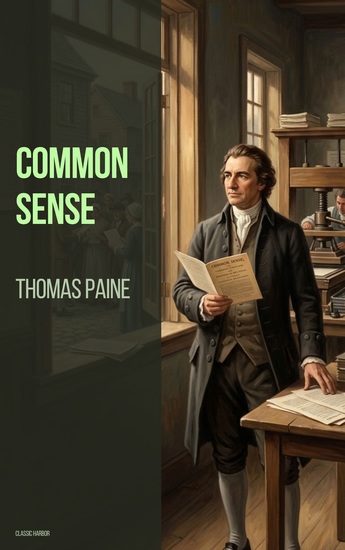
Common Sense - cover

Common Sense

Thomas Paine

Publisher: Classic Harbor

  • 0
  • 0
  • 0

Summary

Discover the powerful argument that helped challenge monarchy and inspire support for American independence.

Thomas Paine's Common Sense was published in 1776 at a critical moment in the American colonial struggle against British rule.

Written in direct and accessible language, Paine argues against hereditary monarchy and colonial dependence while presenting a case for self-government and independence.

Its straightforward style helped bring complex political ideas to a broad audience and made the pamphlet an influential contribution to the American revolutionary movement.

Read Thomas Paine's historic call for independence and explore one of the most influential political writings of the American Revolution.
Available since: 10/07/2026.
Print length: 66 pages.

Other books that might interest you

  • To Be Loved - humorous and heartwarming short stories - cover

    To Be Loved - humorous and...

    Stefania Hartley

    • 0
    • 0
    • 0
    Amanda’s name means “to be loved” and she’s taken it as her duty to make herself lovable, but it’s hard work. 
    Has Tanino really abandoned Melina at home to freeze? 
    Mark hasn’t seen Nora for thirty years and, since then, he’s lost a leg and all his hair. If he wasn’t enough for her then, can he be now? 
    What happens if the dating app’s algorithms go haywire? 
    Ten humorous and heart-warming short stories about love—found, kept, reconquered—at all ages. The perfect winter warmer for your coffee break or as a bedtime listen.
    Show book
  • Bush Meat - cover

    Bush Meat

    Mandy Sutter

    • 0
    • 0
    • 0
    For Sarah's family, memories of early Sixties Aba in south-eastern Nigeria are scorched onto their hearts. A days-old burial mound exposed as an 'exploded diagram' of bones picked clean by beasts. Adaku the Barbary duck with a 'melted face', who was conscripted into friendship by six-year-old Sarah in the first of a lifetime's unlikely alliances, forged by necessity and relocation. The narcotic puff let out from the freezer in the meat-man's shack off the Ikot Ekpene road, where Maureen, Sarah's lonely mother, gave up aspirations to be a 'proper oil company wife' to Jim, and risked buying 'bush meat'. The dry 'snakeskin' bark of the old iroko tree on the bend of the town's river, under whose shade Jim sought sanctuary from people, and whose 'two long white catkins the tree one day bestowed onto his head like confetti.'
    Back home, Jim swaps adventure and agency for woodwork and more whisky. Maureen, denying her love of Igbo crafts and cloth, considers reinventing herself as an Oxfam shop assistant. In the days before her grandmother's funeral, Sarah finds the platitudes of her father evasive compared to the wisdom and ritual taught by servant Chidike while burying the household monkey. Sarah's hard-won Nigerian barter goods, a silver thumb-ring and a dare taken to eat fried-fat market 'snack', become devalued. At Aba's Sancta Maria, unaccustomed food was a cone of hot roast groundnuts paid for by a penny with a hole. In Britain, 'unaccustomed' means milk with a 'thickened band of yellow'. Now, the currency is a dare Sarah first honours, then refuses.
    As people of that time and place are scattered like those bleached bones, Aba acts as centripetal force on their imagination. Today's city was a small town the like of which Tim Winton gnaws at from different angles in The Turning. Mandy Sutter's approach is similarly innovative. Her themes are substitution, racism, and whether the spirit can ever survive transaction.
    Show book

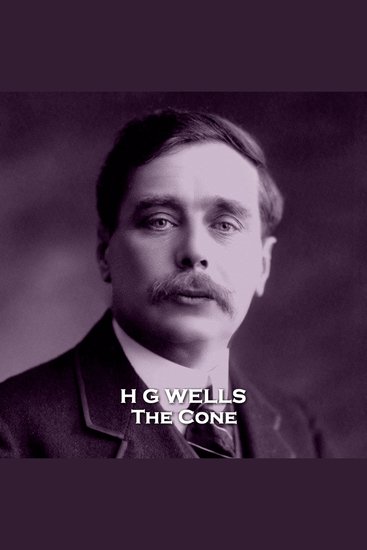
  • The Cone - From their pens to your ears genius in every story - cover

    The Cone - From their pens to...

    HG Wells

    • 0
    • 0
    • 0
    Herbert George Wells was born on September 21st, 1866 at Atlas House, 46 High Street, Bromley, Kent. He was the youngest of four siblings and his family affectionately knew him as ‘Bertie’.  
    The first few years of his childhood were spent fairly quietly, and Wells didn’t display much literary interest until, in 1874, he accidentally broke his leg and was left to recover in bed, largely entertained by the library books his father regularly brought him. Through these Wells found he could escape the boredom and misery of his bed and convalescence by exploring the new worlds he encountered in these books.  
    From these humble beginnings began a career that was, after several delays, to be seen as one of the most brilliant of modern English writers.    
    Able to write comfortably in a number of genres he was especially applauded for his science fiction works such as The Time Machine and War of the Worlds but his forays into the social conditions of the times, with classics such as Kipps, were almost as commercially successful.  His short stories are miniature masterpieces many of which bring new and incredible ideas of science fiction to the edge of present day science fact.  Wells also received four nominations for the Nobel Prize in Literature 
    Despite a strong and lasting second marriage his affairs with other women also brought the complications of fathering other children.  His writings and work against fascism, as well as the promotion of socialism, brought him into increasing doubts with and opposition to religion.  His writings on what the world could be in works, such as A Modern Utopia, are thought provoking as well as being plausible, especially when viewed from the distressing times they were written in. 
    His diabetic condition pushed him to create what is now the largest Diabetes charity in the United Kingdom.  Wells even found the time to run twice for Parliament. 
    It was a long, distinguished and powerfully successful career by the time he died, aged 79, on August 13th, 1946.
    Show book
  • The Sycophant - cover

    The Sycophant

    Jacki Barr

    • 0
    • 0
    • 0
    When the ties of friendship bind too tightly, what do you do?
    Show book
  • From Madrid to Heaven - cover

    From Madrid to Heaven

    Leslie Croxford

    • 0
    • 0
    • 0
    Characters in From Madid to Heaven unexpectedly find themselves in impossible circumstances. In fourteen short stories, set between Iberia and North Africa, they come nevertheless to face the strange possibility that when nothing is possible, everything may suddenly be possible.
    Show book
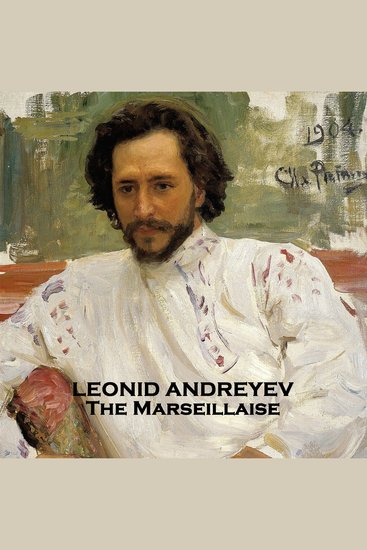
  • The Marseillaise - From their pens to your ears genius in every story - cover

    The Marseillaise - From their...

    Leonid Andreyev

    • 0
    • 0
    • 0
    Leonid Nikolaievich Andreyev was born on 21st August in Oryol, Russia to a middle-class family of Polish, Ukranian and Finnish ancestry. 
    He studied law in Moscow before working as a police-court reporter for a daily newspaper.  His literary efforts at this time were confined to poetry and those he did try to get published were all rejected.  
    In 1898 his first short story ‘Bargamot and Garaska’, published in the ‘Kurier’ newspaper caught the attention and friendship of Maxim Gorky.  Andreyev now discarded any other career path apart from that of author. 
    His first collection of short stories appeared in 1901 and sold over a quarter of a million copies.  He was a sensation. Using his interest in psychology and psychiatry gave him an almost unrivalled ability to delve into the human psyche and create astonishing characters. 
    During the first Russian revolution Andreyev was a staunch defender of democratic ideals and many of his stories reflected the heated mood of the times. With the 1905 Revolution’s failure his work became pessimistic and despairing. By the beginning of the following decade he began losing his audience to new literary movements such as the Futurists. 
    He published little after 1914 except political writings, instead working as the literary editor of the ‘Russian Will’ newspaper.  When the Bolsheviks took power he sensed catastrophe was coming and moved to Finland where he spent his last years in poverty distraught at the outcome of the Revolution. 
    Leonid Andreyev died of heart failure on 12th September 1919 at the age of 48 in Mustamäki, Finland. 
    His classic story ‘Lazarus’ brilliantly tells the story of Christ’s disciple, forced to wander the earth for all time is both chilling and heart-breaking in its Russian setting.
    Show book