Begleiten Sie uns auf eine literarische Weltreise!
Buch zum Bücherregal hinzufügen
Grey
Einen neuen Kommentar schreiben Default profile 50px
Grey
Jetzt das ganze Buch im Abo oder die ersten Seiten gratis lesen!
All characters reduced
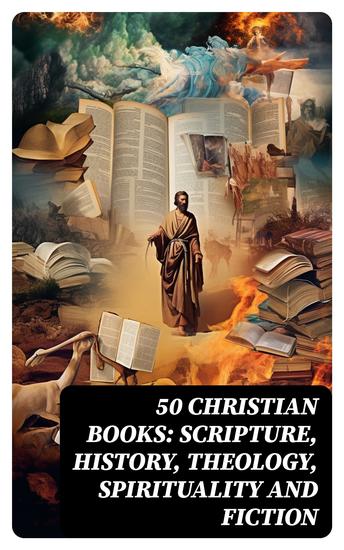
50 Christian Books: Scripture History Theology Spirituality and Fiction - cover

50 Christian Books: Scripture History Theology Spirituality and Fiction

Johann Wolfgang von Goethe, Martin Luther, Henryk Sienkiewicz, Henry van Dyke, David Hume, James Allen, Ralph Waldo Emerson, Andrew Murray, John Bunyan, Grace Livingston Hill, Thomas Paine, Voltaire, Lew Wallace, John Milton, Charles M. Sheldon, Ludwig Feuerbach, G. K. Chesterton, Friedrich Nietzsche, Thomas à Kempis, Leo Tolstoy, Fyodor Dostoevsky, Charles Spurgeon, Prentice Mulford, Ávila St. Teresa of, Saint Augustine, Florence Scovell Shinn, Dante, H. Emilie Cady, Gregory of Nyssa, Pope Gregory I, Alexandria Athanasius of, Basil the Great, John of Damascus, Thomas Aquinas, Brother Lawrence, Arthur Pink

Übersetzer George Eliot, Thomas Carlyle, Constance Garnett, Philip Schaff, Jeremiah Curtin, Alexander Walker, Benedict Zimmerman, William Benham, Helen Zimmern, Thomas Common, James Donaldson, Grignon R. S., John Wycliffe, Alexander Roberts, Andrew Rutherfurd

Verlag: DigiCat

  • 0
  • 0
  • 0

Beschreibung

50 Christian Books: Scripture, History, Theology, Spirituality and Fiction is a sweeping anthology that encapsulates the broad and vibrant tapestry of Christian literature across centuries. This unique collection combines various literary styles—from theological discourse to stirring fiction and contemplative spirituality—embodying the rich diversity that defines Christian thought and writing. Each piece stands on its own, contributing significantly to nuanced discussions and reflections on the profound themes of faith, morality, and the human experience. The anthology's standout works, inviting contemplation and dialogue, are reflective of the enduring influence of the included texts on Christian literature and global thought. This anthology showcases an impressive lineup of contributors whose backgrounds span a wide range of historical, cultural, and philosophical contexts. Featuring thinkers like Thomas à Kempis and St. Teresa of Ávila alongside literary giants such as Dostoevsky and Tolstoy, the collection echoes the interplay between philosophy, scripture, and narrative. Each author's unique perspective invites readers to explore how historical movements like the Reformation or the Enlightenment are intricately woven into the fabric of Christian discourse, offering a multifaceted view of faith's evolution and enduring relevance. For scholars, theologians, and enthusiasts, this anthology is an invaluable resource, providing a comprehensive exploration of Christianity's literary and philosophical landscapes. It offers an unparalleled opportunity to engage with a breadth of voices, each contributing a distinct facet to the ongoing dialogue about belief, existence, and spirituality. Through this collection, readers are invited to deepen their understanding and appreciation of the numerous styles and themes that have collectively shaped Christianity's rich literary tradition.
Verfügbar seit: 15.11.2023.
Drucklänge: 29299 Seiten.

Weitere Bücher, die Sie mögen werden

  • Christian Relics and the Arma Christi: The History of the Medieval Search for Relics Related to the Passion of Christ - cover

    Christian Relics and the Arma...

    Editors Charles River

    • 0
    • 0
    • 0
    Holy relics can be found in many different religions, whether Christian, pagan, Hindu, or Buddhist. A relic is defined as something directly associated with a revered saint, teacher, ancestor, or some miraculous manifestation of deity in the material world. A relic and a reliquary are two types of sacramental tools. A reliquary is a container or box for a relic, allowing it to be displayed to the public and thus transfer its powers to magical and liturgical works. There is another definition of a relic: anything that would be a miraculous manifestation of a deity in the material world. In Christianity, there are countless numbers of relics, most of them being associated with Jesus Christ. 
    In the early years of Christianity, it was forbidden to move and share the remains of saints and martyrs, and they were protected so that their final resting places, such as catacombs and cemeteries, remained intact. The earliest recorded Christian relics, specifically the bones and ashes of martyrs, date from the 2nd century. 200 years later, St. Ambrose and others set out to dig up the corpses and honor them. At that time, it was considered that every holy body could be dismembered and divided among the faithful to worship it. The remains of corpses sometimes came into someone else's hands as a gift, and sometimes they were stolen. At one point, the demand for holy bodies was such that bodyguards were assigned to dying saints to prevent their bodies from being dismembered after death. 
    The veneration of the relics of saints was so common among the faithful because they believed saints in Heaven interceded for believers on Earth. As a result, numerous healings and miracles were attributed to the relics, and many stories and myths about miracles arose from these beliefs. By word of mouth, the stories spread among the faithful, and finally, they were recorded in books.
    Zum Buch
  • Truthfulness - The Unvarnished Reality - cover

    Truthfulness - The Unvarnished...

    Esther Jameson

    • 0
    • 0
    • 0
    Truth is often regarded as a simple concept—something either is or it isn’t. Yet, when examined more closely, truth reveals itself to be one of the most profound and complex forces in human existence. It transcends the surface of facts and ventures into realms shaped by perception, experience, culture, and belief. Understanding the nature of truth requires more than a definition; it demands a deep exploration of how we relate to reality itself. 
    At its core, truth is commonly defined as that which aligns with fact or reality. However, facts can be interpreted differently depending on one’s background, intentions, and emotional state. Objective truth refers to things that remain constant regardless of personal opinions—scientific laws, historical events, and physical evidence fall into this category. Subjective truth, on the other hand, is shaped by personal perspective. It’s the kind of truth we feel rather than prove: our experiences, emotions, and beliefs about the world. Both forms are valid in their own domains, but problems often arise when subjective truth is presented as universally objective. 
    Culture also plays a significant role in shaping our understanding of truth. In some societies, truth is seen as communal—a shared agreement among people, traditions, or religious teachings. In others, truth is fiercely individual, something one must discover for oneself. This cultural lens can influence what people consider acceptable or unacceptable, right or wrong, honest or deceptive. What might be considered an innocent omission in one culture could be seen as a serious lie in another.
    Zum Buch
  • Sophie's Monster Goes to Shul - cover

    Sophie's Monster Goes to Shul

    Sandy Asher

    • 0
    • 0
    • 0
    "Why are you crying?" Sophie asks the imaginary monster in her closet. "You're not afraid of me anymore," the monster says. "No one else can see or hear me. I need a new job." He follows Sophie to breakfast, out to Bubbe and Zayde's car, and to the shul. At synagogue, Bubbe helps lead the service. "She's kvelling," Sophie says to the monster. "I want to kvell," he says, and they join in the singing. Then Sophie uses her imagination to write a story about her monster. Suddenly, he isn't scary anymore, and he's no longer sitting beside her. He's in the pages of her story and now everyone can see him.
    Zum Buch
  • Wisdom Builds Her House - cover

    Wisdom Builds Her House

    Carole Duff

    • 0
    • 0
    • 0
    Wisdom Builds Her House is the true story of a woman who comes face-to-face with her past when she reads the journal of her husband’s deceased daughter, a girl she never met. Curiosity leads to self-inquiry and haunting parallels between Carole and Gretchen: inexplicable disruptions from when they were five; mental illness episodes starting at sixteen; troubles in college; rejection in love—secrets hiding in their closets. While building a new house in the Blue Ridge Mountains with her husband, Carole reads the journals, which lead her to uncover the never-spoken truth about the violent crime from her childhood, all resulting in a crisis of faith.
    Zum Buch
  • Blizzard Brides - cover

    Blizzard Brides

    Christine Sterling

    • 0
    • 0
    • 0
    Welcome to Last Chance, Nebraska! 
    When the freak blizzard of 1878 kills most of the men in a small Nebraska town, what does it mean for the surviving women and children? 
    Realizing they need to find men of honor to help rebuild, the women place an advertisement in the Matrimonial Times. 
    Choosing a husband is more difficult than they thought, when there is an overwhelming response to the ad. 
    Will these Blizzard Brides find the second chance at love in a town called Last Chance? 
    This story is loosely based on the Blizzard of 1873 and the Schoolhouse Blizzard of 1888, where many men, women and children died in the unexpected storm. This book is a short story to introduce you to the town, the characters and the events that set up series.
    Zum Buch
  • God Is Here - Reimagining the Divine - cover

    God Is Here - Reimagining the...

    Toba Spitzer

    • 0
    • 0
    • 0
    Most of us are hungry for a system of meaning to make sense of our lives, yet traditional religion too often leaves those seeking spiritual sustenance unsatisfied. Rabbi Toba Spitzer understands this problem firsthand and knows that too often it is traditional ideas of the deity?he's too big, too impersonal, and too unbelievable?that get in the way. In God Is Here, Spitzer argues that whether we believe in God or fervently disbelieve, what we are actually disagreeing about is not God at all but a metaphor of a Big Powerful Person that limits our understanding and our spiritual lives. Going back to the earliest sources for Judaism as well as Christianity, Spitzer discovers in the Hebrew Bible a rich and varied palette of metaphors for the divine?including Water, Voice, Fire, Rock, Cloud, and even the process of Becoming. She addresses how we can access these ancient metaphors, as well as those drawn from rabbinic tradition and modern science, to experience holiness in our daily lives and to guide us in challenging times. Each chapter contains insights from the Bible and teachings from Judaism and other spiritual traditions, accompanied by suggestions for practice to bring alive each of the God metaphors. Rabbi Toba Spitzer has helped many people satisfy their spiritual hunger. With God Is Here, she will inspire you to find new and perhaps surprising ways of encountering the divine, right where you are.
    Zum Buch