Join us on a literary world trip!
Add this book to bookshelf
Grey
Write a new comment Default profile 50px
Grey
Subscribe to read the full book or read the first pages for free!
All characters reduced
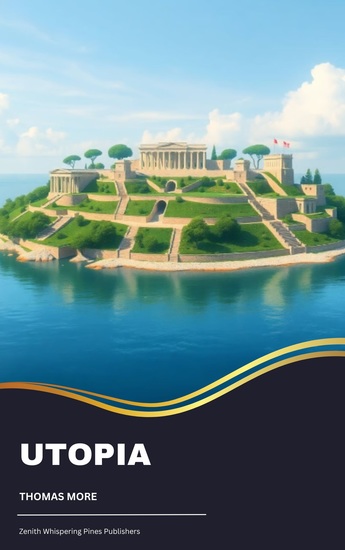
Utopia - cover

Utopia

Thomas Moore

Publisher: Zenith Whispering Pines Publishers

  • 0
  • 0
  • 0

Summary

Discover the Book That Defined an Entire Genre of Thought.

First published in 1516, Sir Thomas More's Utopia remains one of the most influential works of Western literature. Written as a playful yet biting social satire, the book introduces readers to a distant island nation where private property is abolished, religious tolerance is practiced, and every citizen works for the common good.

Through a fictional dialogue with the traveler Raphael Hythloday, More presents a radical alternative to the corruption and inequality of 16th-century Europe. While the title famously translates to "No Place," the questions More raises about justice, wealth distribution, and the role of the state continue to resonate in modern political debate.

This definitive edition offers the complete, unabridged text of this Renaissance masterpiece. A cornerstone of Humanist thought and political philosophy, Utopia is essential reading for anyone interested in the history of ideas or the eternal search for a perfect world.

Explore the foundation of social idealism. Buy "Utopia" today and challenge your perspective on society.
Available since: 12/17/2025.
Print length: 155 pages.

Other books that might interest you

  • Proximity Politics - How Distance Shapes Public Opinion and Political Behaviors - cover

    Proximity Politics - How...

    Jeronimo Cortina

    • 0
    • 0
    • 0
    Republicans who live closer to the U.S.-Mexico border are less likely to support constructing a wall than those who live farther away. After a mass shooting, gun sales and permit applications skyrocket in nearby communities. Experiencing an extreme weather event like a hurricane or flood can encourage someone to attribute climate change to human activity. Why do we react so differently to faraway events and ones that take place on our doorsteps, and what does this reveal about our political landscape? 
     
    Proximity Politics is an examination of the role of distance in shaping attitudes, behaviors, and understandings of the world. Jeronimo Cortina documents the crucial ways space and place influence public opinion. He demonstrates that the closer someone is to an event, social group, or policy, the likelier they are to have first-hand, specific, grounded knowledge of the subject. Conversely, distance leads to detachment, making it more likely that decontextualized or unreliable information and individual or group biases will prevail. Considering a range of case studies, Cortina unravels how spatial, emotional, temporal, social, and cultural distances affect public opinion. Bringing together quantitative and qualitative data, Proximity Politics shows that even in today's interconnected world, we are still profoundly influenced by what happens next door.
    Show book
  • State of the Union 1984 - cover

    State of the Union 1984

    Ronald Reagan

    • 0
    • 0
    • 0
    The 1984 State of the Union address, delivered January 25, 1984, praises “bipartisan cooperation” and says: “For a time we forgot the American dream isn't one of making government bigger; it's keeping faith with the mighty spirit of free people under God.” “Inflation has been beaten down from 12.4 to 3.2 percent…” “Real after-tax income increased 5 percent last year.” “We're seeing rededication to bedrock values of faith, family, work, neighborhood, peace, and freedom…” 
    Let us agree on goals to keep America free and secure. Our first goal is vigorous economic growth. “We can begin by limiting the size and scope of government.” The Grace Commission has 2500 recommendations to reduce wasteful spending. Also, the line-item veto which 43 of the 50 States, including California, grant their Governors is a powerful tool against wasteful spending. 
    Additional programs are proposed including a permanently manned space station. Tuition tax credits are recommended for parents who pay private school tuition to improve education by increasing competition among schools. School prayer and a law to protect unborn children from abortion are advocated, as are enterprise zones for high-unemployment areas. 
    Finally, peace is our great goal and highest aspiration. “The future is best decided by ballots, not bullets.” We will seek concerted action to combat terrorism, and work for “freer world trade, greater competition, and more open markets.” “A nuclear war cannot be won and must never be fought.”  
    Carl Sandburg said, “I see America in the crimson light of a rising sun fresh from the burning, creative hand of God… I see great days ahead for men and women of will and vision.'' 
    Audio recording courtesy of the Ronald Reagan Presidential Library. 
    AspenLeafMedia.com
    Show book
  • The Eurasian Century - Hot Wars Cold Wars and the Making of the Modern Century - cover

    The Eurasian Century - Hot Wars...

    Hal Brands

    • 0
    • 0
    • 0
    We often think of the modern era as the age of American power. In reality, we're living in a long, violent Eurasian century. That giant, resource-rich landmass possesses the bulk of the global population, industrial might, and potential military power. Eurasia is a strategic prize without equal—which is why the world has been roiled, reshaped, and nearly destroyed by clashes over the supercontinent. 


    Since the early twentieth century, autocratic powers have aspired for dominance by seizing commanding positions in the world's strategic heartland. Offshore sea powers, namely the United Kingdom and America, have sought to make the world safe for democracy by keeping Eurasia in balance. America's rivalries with China, Russia, and Iran are the next round in this geopolitical game. If this new authoritarian axis succeeds in enacting a radically revised international order, America and other democracies will be vulnerable and insecure. 


    Hal Brands argues that a better understanding of Eurasia's strategic geography can illuminate the contours of rivalry and conflict in today's world. The Eurasian Century explains how revolutions in technology and warfare, and the rise of toxic ideologies of conquest, made Eurasia the center of twentieth-century geopolitics—with pressing implications for the struggles that will define the twenty-first.
    Show book
  • On Courage - How to Be a Dissident in an Age of Fear - cover

    On Courage - How to Be a...

    Julia Angwin, Ami Fields-Meyer

    • 0
    • 0
    • 0
    READ BY RACHEL MADDOW 
    From a Pulitzer Prize-winning investigative journalist and a former White House senior advisor, a deeply reported manual about how anyone can defy an authoritarian – based on original interviews with more than 100 dissidents, activists, and theorists across the world. 
    The United States is only the latest country to face a leader who wields fear as a weapon, punishes political enemies, disappears people off the street, and undermines free and fair elections. Today nearly three out of four people on earth live under authoritarianism, the highest rate since the late 1970s. 
    But even under repressive conditions, each of us holds the power to help defeat autocrats. Based on their acclaimed The New Yorker essay “So You Want to Be a Dissident?,” veteran reporter Julia Angwin and political strategist Ami Fields-Meyer give us a captivating – and profoundly hopeful – guide to courage in an age of fear. 
    Meet a student from Hong Kong who risked everything for democracy. A mom in a working-class neighborhood of Caracas who broke with the political movement that raised her. Cairo twentysomethings who staged a gutsy stunt to help bring down a dictator. A mild-mannered immigrant fighting to save a landmark U.S. civil rights law. People throughout the United States and across five continents who faced serious risks for dissenting in their workplace, their community, or their country. On Courage is the story of how they did it anyway – and how you can do it, too. 
    Blending rich, previously untold narratives with history, spirituality, and movement research, Angwin and Fields-Meyer deliver a highly accessible book full of practical lessons – an inspiring resource for anyone, anywhere, who feel the walls of history closing in on them. On Courage is a roadmap to political courage and a powerful case for how taking personal risks can help save the free world. 
    Supplemental enhancement PDF accompanies the audiobook.
    Show book
  • David Trimble: Peacemaker - cover

    David Trimble: Peacemaker

    Stephen Walker

    • 1
    • 0
    • 0
    Nobel laureate, party leader, peacemaker, first minister and statesman – David Trimble had many roles. But what is the real story behind the man who made headlines and changed lives?
    In this definitive biography of Trimble's life and death, award-winning journalist Stephen Walker vividly details how a shy Belfast academic changed the political landscape of Northern Ireland.
    Written with the cooperation of his widow, Lady Trimble, and their grown-up children, Peacemaker offers unparalleled insights into the life of the first person to be elected first minister of Northern Ireland and the most significant unionist leader since the creation of Northern Ireland in 1921. From the beginning of his political career in the dark days of the Troubles, to bringing unionism and nationalism together to end decades of division and violence and secure peace, Trimble's personal journey mirrors the story of Northern Ireland itself.
    Drawing on over 100 fresh interviews, this is a colourful and personal account of the life of a key figure in Irish history and an essential companion to Stephen Walker's bestselling biography of John Hume.
    Show book
  • Drawing Lines - Why Conservatives Must Begin to Battle Fiercely in the Arena of Ideas - cover

    Drawing Lines - Why...

    Kira Davis

    • 0
    • 0
    • 0
    It is time to draw our lines in the sand as Christians and Conservatives by engaging in public conversations with truth and conviction. 


    Kira Davis has built a brand on reaching out to the other side, on giving people space to be wrong, the space to discuss, the space to tolerate. Unfortunately, the people controlling the public conversations right now will have none of it. We're seeing the lengths they will go to and the lies they let stand in service of crushing 50 percent of this nation. They seek unity through complete elimination of the other side. There are times for compromise and times to draw a line in the sand; the latter has arrived. It is time to draw our lines as Christians and Conservatives.
    Show book