¡Acompáñanos a viajar por el mundo de los libros!
Añadir este libro a la estantería
Grey
Escribe un nuevo comentario Default profile 50px
Grey
Suscríbete para leer el libro completo o lee las primeras páginas gratis.
All characters reduced
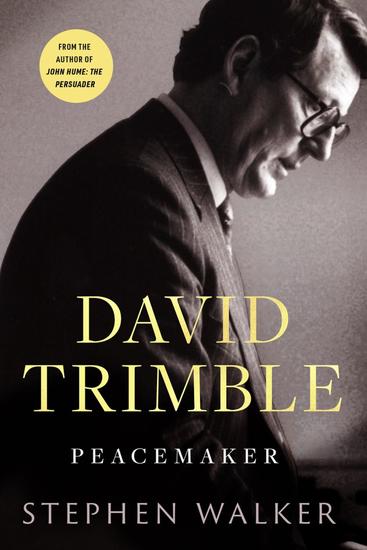
David Trimble: Peacemaker - cover

David Trimble: Peacemaker

Stephen Walker

Editorial: Gill Books

  • 1
  • 0
  • 0

Sinopsis

Nobel laureate, party leader, peacemaker, first minister and statesman – David Trimble had many roles. But what is the real story behind the man who made headlines and changed lives?
In this definitive biography of Trimble's life and death, award-winning journalist Stephen Walker vividly details how a shy Belfast academic changed the political landscape of Northern Ireland.
Written with the cooperation of his widow, Lady Trimble, and their grown-up children, Peacemaker offers unparalleled insights into the life of the first person to be elected first minister of Northern Ireland and the most significant unionist leader since the creation of Northern Ireland in 1921. From the beginning of his political career in the dark days of the Troubles, to bringing unionism and nationalism together to end decades of division and violence and secure peace, Trimble's personal journey mirrors the story of Northern Ireland itself.
Drawing on over 100 fresh interviews, this is a colourful and personal account of the life of a key figure in Irish history and an essential companion to Stephen Walker's bestselling biography of John Hume.
Disponible desde: 11/09/2025.
Longitud de impresión: 464 páginas.

Otros libros que te pueden interesar

  • The Civic Bargain - How Democracy Survives - cover

    The Civic Bargain - How...

    Josiah Ober, Brook Manville

    • 0
    • 0
    • 0
    A powerful case for democracy and how it can adapt and survive—if we want it to 


    Is democracy in trouble, perhaps even dying? Pundits say so, and polls show that most Americans believe that their country's system of governance is being "tested" or is "under attack." But is the future of democracy necessarily so dire? In The Civic Bargain, Brook Manville and Josiah Ober push back against the prevailing pessimism about the fate of democracy around the world. Instead of an epitaph for democracy, they offer a guide for democratic renewal, calling on citizens to recommit to a "civic bargain" with one another to guarantee civic rights of freedom, equality, and dignity. That bargain also requires them to fulfill the duties of democratic citizenship: governing themselves with no "boss" except one another, embracing compromise, treating each other as civic friends, and investing in civic education for each rising generation. 


    Manville and Ober trace the long progression toward self-government through four key moments in democracy's history: Classical Athens, Republican Rome, Great Britain's constitutional monarchy, and America's founding. Comparing what worked and what failed in each case, they draw out lessons for how modern democracies can survive and thrive.
    Ver libro
  • The Era of Revolution - 1775-1796 - cover

    The Era of Revolution - 1775-1796

    George Washington, Maximilian de...

    • 0
    • 0
    • 0
    Six speeches about freedom and revolution from the American, French and Irish revolutions.The first two speeches are from the American Revolutionary war (1775-1783). Patrick Henry’s “Give me Liberty or give me death” is recognized even today, two centuries since Henry spoke at the Second Virginia Convention to an audience including Thomas Jefferson and George Washington. The speech is credited with providing troops from Virginia for the revolutionary war.In the Newburgh Address, Washington and implores his army to put their faith in him. A mutiny was proposed because Congress has not paid them as promised. Washington needed to make clear to his generals that there was no option to surrender or turn away to unsettled lands, and that he was with them and on their side in the thick of both war and politics.Next is William Wilberforce’s Abolition Speech to the British parliament in 1789, the apex of a campaign that led to slavery being outlawed across the British Empire.Speeches from the French revolution then follow. First, there is the reaction from the aristocracy in England; a valediction from Edmund Burke, an MP in the British Parliament, on the beauty of Marie Antoinette and his sadness at her passing.Four speeches follow by Maximilien de Robespierre, a foundational member of the French Revolution, who laid down the political philosophy of liberty and the moral law over divinity and customary law. The speeches are filled with a passion for direct democracy and the rule of the people, not the elites.The volume ends with a more measured, but no less impassioned, address by the Irish lawyer and statesman John Curran. It was given in Curran’s defence of Archibald Rowan, who was sentenced to transportation to Australia for his treasonous activities fighting for Irish independence. While unsuccessful, this rallying cry for genuine self-determination and free speech captures the heart of the conflicts that defined the era.
    Ver libro
  • The State and Revolution - cover

    The State and Revolution

    Vladimir Lenin

    • 0
    • 0
    • 0
    The State and Revolution (1917), by Vladimir Lenin, describes the role of the State in society, the necessity of proletarian revolution, and the theoretic inadequacies of social democracy in achieving revolution to establish the dictatorship of the proletariat.
    Lenin began the composition of an early draft of State and Revolution while in exile in Switzerland in 1916, under the title "Marxism on the State".
    "Soviets", legislative bodies of workers and peasants were the de facto governments of Petrograd and many smaller cities. The Russian public was deeply upset with the continuation of Russia's involvement in World War One and the continued economic difficulties that it brought on. On November 7th The Congress of Soviets officially elected a coalition of Bolsheviks, Socialist Revolutionaries and Mensheviks to govern. Through the Red Guards, paramilitary organizations of revolutionary workers, sailors and soldiers; the Soviet government was able to storm The Winter Palace and officially abolishing the Provisional government. The revolution was not uniformly accepted among all Russians, resistance and disruption would occur routinely leading up to The Russian Civil War. A particular issue that Lenin covers in The State and Revolution was the right of nations to secession (The right to self determination); during the composition of this book The Mensheviks of Georgia declared independence soon after The Revolution forming The Democratic Republic of Georgia.
    Among other famous Marxists there were also: Georgi Plekhanov, Joseph Stalin, Leon Trotsky, Karl Marx, Friedrich Engels, Ernst Bloch, Pyotr Kropotkin, Jean-Paul Charles Aymard Sartre, Wilhelm Reich, Perry Anderson.
    Ver libro
  • Drawing Lines - Why Conservatives Must Begin to Battle Fiercely in the Arena of Ideas - cover

    Drawing Lines - Why...

    Kira Davis

    • 0
    • 0
    • 0
    It is time to draw our lines in the sand as Christians and Conservatives by engaging in public conversations with truth and conviction. 


    Kira Davis has built a brand on reaching out to the other side, on giving people space to be wrong, the space to discuss, the space to tolerate. Unfortunately, the people controlling the public conversations right now will have none of it. We're seeing the lengths they will go to and the lies they let stand in service of crushing 50 percent of this nation. They seek unity through complete elimination of the other side. There are times for compromise and times to draw a line in the sand; the latter has arrived. It is time to draw our lines as Christians and Conservatives.
    Ver libro
  • Fixing America - An Engineer’s Solution to our Social Cultural and Political Problems - cover

    Fixing America - An Engineer’s...

    William M Taggart IV

    • 0
    • 0
    • 0
    Have you been wondering about the big issues dominating the news? Is climate change a massive threat or not? What is really going on with immigration? More importantly, how did American politics become so divided and hostile?  What if we approached American social, cultural and political problems from a purely rational perspective? What if we focus on functional systems instead of division? Careful analysis of readily available data can help us discover patterns and uncover the real issues. An engineering perspective allows us to focus on what needs to be fixed rather than ideological divisions.  
       Finally, one of America's top engineers has brought these topics and others together in a thought-provoking book. This book is rooted in history, facts, and logic, and it lays out solutions to America's problems. A book focused to get Americans talking to one another again, so we can rise to the occasion and solve today's problems together.  
        William Taggart has over thirty years as a professional engineer in industry. He has travelled the world, building some of industry’s biggest projects and solving some of their thorniest problems. Now, he has applied analytical skills developed in industry, coupled with his natural inquisitiveness and thirst for creative solutions, to the problems of modern-day American politics. Seeking answers to questions many of us have been asking, he has focused his keen mind on researching these, and other big issues. He invites everyone to think about what America really needs.
    Ver libro
  • Common Sense - cover

    Common Sense

    Thomas Paine

    • 0
    • 0
    • 0
    The explosive essay that sparked a revolution.
    
    When Common Sense hit the streets in 1776, it ignited the American colonies like never before. With bold, plain-spoken language, Thomas Paine challenged the authority of the British monarchy and made the urgent case for American independence. More than just a political argument, this short but powerful work gave everyday people the words to demand freedom—and the courage to fight for it.
    
    Radical, rebellious, and razor-sharp, Common Sense remains a landmark of political writing. Its message still resonates today: real change begins when ordinary people dare to speak truth to power.
    Ver libro