Join us on a literary world trip!
Add this book to bookshelf
Grey
Write a new comment Default profile 50px
Grey
Subscribe to read the full book or read the first pages for free!
All characters reduced
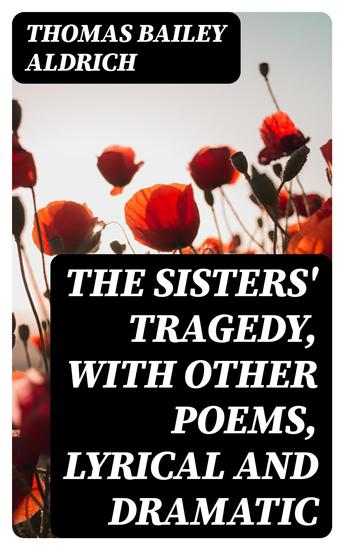
The Sisters' Tragedy with Other Poems Lyrical and Dramatic - cover

The Sisters' Tragedy with Other Poems Lyrical and Dramatic

Thomas Bailey Aldrich

Publisher: DigiCat

  • 0
  • 0
  • 0

Summary

In "The Sisters' Tragedy, with Other Poems, Lyrical and Dramatic," Thomas Bailey Aldrich masterfully weaves together a tapestry of emotional depth and narrative complexity through his lyrical and dramatic poetry. The titular poem, 'The Sisters' Tragedy,' explores harrowing themes of betrayal, loss, and the inexorable fate that binds its characters, showcasing Aldrich's adeptness at melding storytelling with lyrical beauty. The collection is notable for its vivid imagery, rhythmic elegance, and exploration of moral dilemmas, which place it firmly within the rich literary context of 19th-century American poetry, often characterized by its introspective nature and exploration of human experience. Thomas Bailey Aldrich, an influential figure in American literature, was known not only for his poetic genius but also for his connections with contemporaries such as James Russell Lowell and Mark Twain. His experiences as a literary editor and his keen observations of human nature undoubtedly shaped his approach to poetry. Aldrich's life, marked by personal tragedies and social engagement, provides a poignant backdrop against which his works resonate, particularly evident in the intricate emotional landscapes he conjures in his poetry. This collection is essential for readers who appreciate the delicate balance of beauty and sorrow in poetry. Aldrich's evocative language and profound themes invite readers to reflect on the nuances of human relationships and the tragedies that often accompany them. Engaging with this work not only enhances one's appreciation of Aldrich's craft but also offers a deeper understanding of the American literary tradition, making it a must-read for students and aficionados alike.
Available since: 09/16/2022.
Print length: 23 pages.

Other books that might interest you

  • Top 10 Poets – England The - The East - Five poems each from poets born in the English East - cover

    Top 10 Poets – England The - The...

    William Cowper, Amelia Opie,...

    • 0
    • 0
    • 0
    The language of Poetry is an art that most of us attempt at some point in our lives.  Although its commonplace exposure has been somewhat marginalised in today’s often fast-paced lives we all recognise good verse that can empathise with our thoughts or open us up to experience new things in new ways, to better understand and to enjoy the many strands of our lives. 
    But finding a starting point can be overwhelming, even off-putting, so in this series we offer up our Top 10 classic poets, who brim with talent and verse, on a range of subjects and themes that we can all enjoy. 
    For centuries England has always had a leading and admired reputation for its poets and poetry.  In this volume we explore those born in the East of England who created such revered, enduring and respected verse.
    Show book
  • All of Us - cover

    All of Us

    Francesca Martinez

    • 0
    • 0
    • 0
    'I'm not broken. I'm a unique spark of life. We all are.'
    Jess has a great life: a job she loves, a sharp sense of humour and a close group of friends.
    When austerity threatens the world she has worked hard to build, Jess makes a stand to protect those she holds most dear.
    Capturing the humour, sadness and joy of everyday life, Francesca Martinez's play All of Us is a passionate and timely look at the human cost of abandoning those who struggle to fit in.
    It premiered at the National Theatre, London, in August 2022, in a production directed by Ian Rickson, with an ensemble cast featuring Francesca Martinez in the role of Jess. It was shortlisted for the 2022 George Devine Award.
    Show book
  • USEFULNESS of HIPPOPOTAMUS THE - A Humorous Chapbook for Trying Times - cover

    USEFULNESS of HIPPOPOTAMUS THE -...

    Vincent J. Tomeo

    • 0
    • 0
    • 0
    I am staring at a blank piece of paper, wondering what to write. Where do I begin? My mind begins to wander-pleasant thoughts of Disney's Fantasia dance in my head. The dancing hippopotamus comes to mind, and this made me laugh. The result: I penned a poem on the hippopotamus from which a chapbook was born: The Usefulness of Hippopotamus: A Humorous Chapbook for Trying Times. 
    One cannot imagine a world without humor. Without humor, the world will be dark, cold, and a sad place, tragically lacking joy, cheerfulness, and laughter. 
    Humor is medicine. During rough times, humor will help lighten and lessen physical and mental anxiety. 
    In challenging times, I chose humor. During the Pandemic, I had to deal with my bladder cancer. In my struggle not to get depressed or dwell in negativity, to find solace, contentment, and peace, I chose to seek out beauty and laugh. 
    In search of happiness, the humor worked its charm, resulting in a treasure chest of joy. So, I wrote my chapbook, The Usefulness of Hippopotamus: A Humorous Chapbook for Trying Times and discovered humor even among the hippopotami! 
    You can, too. 
    Peace & flowers. Love & light. 
    Vincent J. Tomeo, Author/Poet
    Show book
  • Remotely Annoying - cover

    Remotely Annoying

    Larry Enright

    • 0
    • 0
    • 0
    This 1 hour, 3 actor, 3 scene comedy is meant to be enjoyed with friends around the dinner table after a good meal and plenty of libations.  
    The premise: The two main characters, Albert and Larry, are 80 year-old twins who have been picking at each other all their lives. They share an apartment, have just purchased a new TV, and are having some difficulty getting it to work. Sounds simple, but things go downhill fast from there and eventually off the cliff when the landlord arrives. The play has a lot of quick back-and-forth dialog so it reads like a comedy routine. It can be performed sitting around the table if someone is reading the stage directions. Actual age of actors is not important. 
    Minimum props required: TV remote, cell phone, two pieces of paper with Awww! and Clap! written on them, two foldout brochures of any kind to function as TV Quick Start Guide and headphone guide. The rest can be mimed. 
    If your plan is to perform it onstage, go for it. You have my blessing as long as you credit the work. Posting a review with a pic of the production would be possibly hilarious, but definitely cool. 
    ​​​​​​​Reviews: The Lansdowne Times might call Remotely Annoying the funniest thing since sliced bread, but nobody thinks sliced bread is funny and there is no Lansdowne Times. However, this play has been fully tested and approved by 8 brave souls who, shall they rest in peace, died laughing. 
    Show book
  • The Two Voices - An autobiographical poem written by Tennyson after his friend committed suicide - cover

    The Two Voices - An...

    Alfred Lord Tennyson

    • 0
    • 0
    • 0
    Alfred Tennyson was born on August 6th, 1809, in Somersby, Lincolnshire, the fourth of twelve children. 
    Most of Tennyson's early education was under the direction of his father, although he did spend four unhappy years at a nearby grammar school.  He also showed an early and burgeoning talent for writing; by the age of twelve he had written a 6,000-line epic poem.  
    In the 1820s, however, Tennyson’s father began to suffer frequent mental breakdowns exacerbated by his alcoholism. One brother had frequent violent quarrels with his father, a second would be confined to an insane asylum, and another was later an opium addict. 
    Tennyson left home in 1827 to join his brothers at Trinity College, Cambridge and with it escape from Somersby. At Trinity he was those who knew little of the problems that clouded his life. Although shy he was keen to make new friends; he was handsome, intelligent, humorous, and a gifted impersonator. 
    That same year, he and his brother Charles published Poems by Two Brothers. It attracted the attention of the “Apostles," a select undergraduate literary club led by Arthur Hallam. They provided friendship and confidence. Hallam and Tennyson became the best of friends. 
    The pair, in the summer of 1830, were involved in a ridiculous jaunt to take money and secret messages to revolutionaries plotting to overthrow the Spanish king. Tennyson's political enthusiasm was marginal compared to Hallam's, but he was glad to make his first trip abroad.  
    The landscape and atmosphere of the Pyrenees generated such wonderful poems as "Oenone," "The Lotus-Eaters;" inspired by a waterfall in the mountains; and "The Eagle;" invoked from the sight of the great hunters circling above them. The small village of Cauteretz and the surrounding valley became a location Tennyson would return to many times over the next sixty years. 
    In 1830, he published Poems, ‘Chiefly Lyrical’ and in 1832 a volume entitled ‘Poems’.  Tennyson, stung by the harshness of several reviews, would not publish again for nine years.  
    In the autumn of 1833, in what was meant as a gesture of gratitude and reconciliation to his father, Hallam accompanied him to the Continent. In Vienna Hallam died suddenly of apoplexy as a result of a congenital malformation of the brain.  
    Hallam’s death, together with that of his father and a myriad of anxieties, stem-ming mainly from the belief that his family were grimly attached to poverty, and fears that he might become a victim of epilepsy, madness, alcohol, and drugs, as others in his family had, or that he might die like Hallam, conspired to upset the delicate balance of Tennyson's emotions.  
    In 1836, he became engaged to Emily Sellwood. From their correspondence it is clear that she was very much in love with him. He seems to excessively worry about not having the financial means to marry.  He was also falling into trances, which he thought were connected with the epilepsy from which other family members suffered. To marry, he thought, would mean passing on the disease to any children he might father. He broke off the engagement. 
    During these years he used the dark feelings and events to write many of his finest works; "Ulysses," "Morte d'Arthur," "Tithonus," "Tiresias," and "Break, break, break."  
    In 1842 Tennyson’s Poems (in two volumes) was a tremendous critical and popular success.  
    In 1845 he was granted a government pension of £200 a year in recognition of his poetic achievements and his financial need.  Despite this financial support his doubts persisted.  
    Life for Tennyson was becoming increasingly productive and more lucrative.  By 1849 ‘The Princess’ had been published. He was now offered a large advance if he would assemble his elegies on Hallam into one complete poem.  
    Tennyson had now also resumed his relationship with Emily Sellwood and by the following year was talking again of marrying her. 
    In the Spring of 1850 the Poet Laureate William Wordsworth died and a new Laureate was
    Show book
  • The Night Before - Beautiful poem from a Pulitzer prize winner - cover

    The Night Before - Beautiful...

    Edward Arlington Robinson

    • 0
    • 0
    • 0
    Edwin Arlington Robinson was born on the 22nd December 1869 in Tide in Lincoln County, Maine.  
    His childhood was described by him as ‘stark and unhappy’.  His name was drawn out of a hat from a fellow vacationer from Arlington Massachusetts when fellow holiday makers decided that his parents had waited long enough at 6 months to name him.  It was a name he despised and reflects the station to which his parents had placed him; their great hope at his birth were that he was a girl to complement their two sons. 
    His pessimistic mood carried him to adulthood and a doomed encounter with Emma Loehen Shepherd who constantly encouraged his poetry.  Edwin was thought too young to be her companion and so his elder, middle brother, Herman was assigned to her.  It was a great blow to Edwin and during their marriage on February 12th, 1890, he stayed home and wrote ‘Cortege’ 
    In the fall of 1891 Edwin entered Harvard, taking classes in English, French and Shakespeare.  He felt at ease with the Ivy League and made great efforts to be published in one of the Harvard literary journals.  Indeed, the Harvard Advocate published ‘Ballade of a Ship’ but then his career appeared to stall.  His father died and although he returned to Harvard for a second year it was to be his last but also the start of some life-long friendships. 
    In 1893 he returned to Gardiner Maine as the man of the household.  Herman by this time had become an alcoholic, having suffered business failures, and was now to become estranged from Emma. 
    Edwin began farming whilst he wrote and quickly developed a close relationship with Emma who had now moved back to Gardiner after Herman’s death with her children. 
    Although he proposed twice, he was rejected and in consequence moved to New York to start afresh. 
    But it was a salutary experience. Although surrounded by artists he had little money and life was difficult. 
    In 1896 he published his own book, ‘The Torrent and the Night Before’, paying 100 dollars for 500 copies.  Edwin wanted it to be a surprise for his Mother, but days before its arrival she died of diphtheria. 
    His second volume, ‘The Children of the Night’, had a wider circulation.  At the behest of President Roosevelt, whose son was an avid admirer, he was given a job in 1905 at the New York Customs Office although it appears his real job was “to help American letters”. 
    Either way his success began to widen and his influence proper.  During the 1920s he won the Pulitzer Prize for Poetry on three separate occasions. In 1922 for ‘Collected Poems’ again in 1925 for ‘The Man Who Died Twice’ and finally in 1928 for ‘Tristram’. 
    During the last twenty years of his life he became a regular summer resident at the MacDowell Colony in New Hampshire, where he became the object of fascination by several women.  But he never married. 
    Edwin Arlington Robinson died of cancer on the 6th April 1935 in the New York Hospital in New York. He was 65.
    Show book