Join us on a literary world trip!
Add this book to bookshelf
Grey
Write a new comment Default profile 50px
Grey
Subscribe to read the full book or read the first pages for free!
All characters reduced
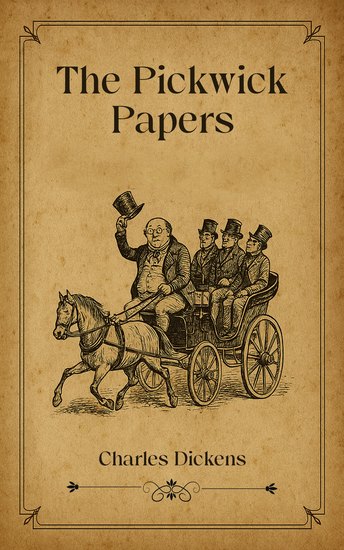
The Pickwick Papers - cover

The Pickwick Papers

Charles Dickens

Publisher: CLXBX

  • 0
  • 0
  • 0

Summary

The Pickwick Papers is the novel that launched Charles Dickens's literary career and remains one of his most joyful and entertaining works. Bursting with humor, warmth, and vivid observation, the book offers a lively portrait of English life in the early Victorian era.

The story follows the genial and good-natured Samuel Pickwick, founder of the Pickwick Club, and his fellow members as they travel through the English countryside in search of knowledge, adventure, and amusement. Along the way, they encounter an unforgettable array of characters—eccentric lawyers, boastful soldiers, sharp-tongued widows, and ordinary people whose quirks and struggles are rendered with affectionate satire.

At the heart of the novel is Dickens's keen eye for human nature. Through comic misadventures, misunderstandings, and courtroom farces, the book gently critiques social pretensions, legal absurdities, and institutional hypocrisy. The introduction of the clever and loyal servant Sam Weller adds depth and wit, creating one of the most beloved partnerships in English literature.

The Pickwick Papers is a celebration of friendship, curiosity, and good humor. Lighthearted yet insightful, it captures the spirit of a society in transition while delighting readers with its timeless comedy and rich storytelling. Endlessly readable and irresistibly charming, the novel stands as a classic introduction to Dickens's enduring genius.
Available since: 02/05/2026.
Print length: 1096 pages.

Other books that might interest you

  • Little Dinner in an Hour A (Unabridged) - cover

    Little Dinner in an Hour A...

    Charles Dickens

    • 0
    • 0
    • 0
    Charles Dickens was a writer and social critic who created some of the world's best-known fictional characters and is regarded as the greatest novelist of the Victorian era. His works enjoyed unprecedented popularity during his lifetime, and by the twentieth century critics and scholars had recognised him as a literary genius. His novels and short stories enjoy lasting popularity.
    A LITTLE DINNER IN AN HOUR: It fell out on a day in this last autumn, that I had to go down from London to a place of seaside resort, on an hour's business, accompanied by my esteemed friend Bullfinch. Let the place of seaside resort be, for the nonce, called Namelesston.
    Show book
  • Count of Monte Cristo The - Volume 4 (Unabridged) - cover

    Count of Monte Cristo The -...

    Alexandre Dumas

    • 0
    • 0
    • 0
    Thrown in prison for a crime he has not committed, Edmond Dantes is confined to the grim fortress of If. There he learns of a great hoard of treasure hidden on the Isle of Monte Cristo and he becomes determined not only to escape, but also to unearth the treasure and use it to plot the destruction of the three men responsible for his incarceration. Dumas' epic tale of suffering and retribution, inspired by a real-life case of wrongful imprisonment, was a huge popular success when it was first serialized in the 1840s.
    VOLUME 4: Two days after, a considerable crowd was assembled, towards ten o'clock in the morning, around the door of M. de Villefort's house, and a long file of mourning-coaches and private carriages extended along the Faubourg Saint-Honoré and the Rue de la Pépinière.
    Show book
  • Between the Acts - cover

    Between the Acts

    Virginia Woolf

    • 0
    • 0
    • 0
    "Scraps, orts and fragments."
    
    Set on a June day in 1939 at a country house in the English heartland, Between the Acts captures a community suspended in time. As the residents of Pointz Hall gather for the annual village pageant, the distant drone of warplanes serves as a chilling reminder of the world outside. Virginia Woolf's final novel is a brilliant, rhythmic exploration of the spaces between—between the scenes of a play, between individual lives, and between the eras of history.
    
    The Canvas of Consciousness: Woolf weaves a tapestry of voices, from the frustrated artist Miss La Trobe to the estranged couple Giles and Isa Oliver. Through her signature stream-of-consciousness style, she examines how art attempts to unify a fragmented society. The pageant itself becomes a mirror held up to England's past, questioning whether history is a coherent story or merely a collection of fleeting moments.
    
    A Final, Poetic Testament: Completed shortly before her death, this novel represents Woolf at her most daring and rhythmic. It is a work of extraordinary sensory detail, where the buzzing of a fly or the rustle of a program carries profound weight. Between the Acts is a poignant meditation on the endurance of the creative spirit and the fragile beauty of life in the face of uncertainty.
    
    Step into the interval where life and art collide. Purchase "Between the Acts" today and experience the final vision of a modernist pioneer.
    Show book
  • Night Walks (Unabridged) - cover

    Night Walks (Unabridged)

    Charles Dickens

    • 0
    • 0
    • 0
    Charles Dickens was a writer and social critic who created some of the world's best-known fictional characters and is regarded as the greatest novelist of the Victorian era. His works enjoyed unprecedented popularity during his lifetime, and by the twentieth century critics and scholars had recognised him as a literary genius. His novels and short stories enjoy lasting popularity.
    NIGHT WALKS: Some years ago, a temporary inability to sleep, referable to a distressing impression, caused me to walk about the streets all night, for a series of several nights.
    Show book
  • Cain - From their pens to your ears genius in every story - cover

    Cain - From their pens to your...

    Alexander Kuprin

    • 0
    • 0
    • 0
    Alexander Kuprin was born in Narovchat, Penza in Russia on 7th September 1870. 
    At 3 his Father died and he and mother moved to Moscow. By 10 he was enrolled at the Second Moscow Military High School and there his interest in literature began. The Alexander Military Academy followed and two years later he was a sub-lieutenant and posted to an Infantry Regiment for a further four years. 
    Despite his duties he was a now a keen writer and published his first short story at this time. His military duties also garnered him experiences for his breakthrough work ‘The Duel’.  Leaving the military he left for Kiev to work for local newspapers.  He continued to publish both stories and novels and by 1901 he was in St Petersburg becoming part of a group that included Chekhov, Ivan Bunin, Maxim Gorky and Leonid Andreyev.  
    In the years that followed further controversial works and acclaim followed.  His comments on the regime meant he was also put under secret police surveillance.   
    As World War I erupted, Kuprin opened a military hospital but was then given command of an infantry company in Finland. He was soon discharged on grounds of ill health.  
    The October Revolution saw him praise Lenin, but he warned that the Bolsheviks threatened Russian culture and might cause further widespread suffering to the peasants.  As Civil War raged he took his family to Helsinki and then on to Paris. 
    Exile saw his talents decline further and his succumbing to alcoholism. He became lonely and withdrawn. The family's poverty increased his malaise.   
    In May 1937, the Kuprin’s returned to Moscow.  He now saw his work published but wrote almost nothing new.  In 1938 his health rapidly deteriorated.  Already suffering from a kidney problems and sclerosis, he had now developed cancer of the oesophagus.  
    Alexander Kuprin died on 25th August 1938.
    Show book
  • On Getting a Home (Unabridged) - cover

    On Getting a Home (Unabridged)

    Booker T. Washington

    • 0
    • 0
    • 0
    Booker Taliaferro Washington (April 5, 1856 - November 14, 1915) was an American educator, author, orator, and adviser to several presidents of the United States. Between 1890 and 1915, Washington was the dominant leader in the African American community and of the contemporary black elite. Washington was from the last generation of black American leaders born into slavery and became the leading voice of the former slaves and their descendants. They were newly oppressed in the South by disenfranchisement and the Jim Crow discriminatory laws enacted in the post-Reconstruction Southern states in the late 19th and early 20th centuries.
    ON GETTING A HOME: Every coloured man owes it to himself, and to his children as well, to secure a home just as soon as possible. No matter how small the plot of ground may be, or how humble the dwelling placed on it, something that can be called a home should be secured without delay.
    Show book