Join us on a literary world trip!
Add this book to bookshelf
Grey
Write a new comment Default profile 50px
Grey
Subscribe to read the full book or read the first pages for free!
All characters reduced
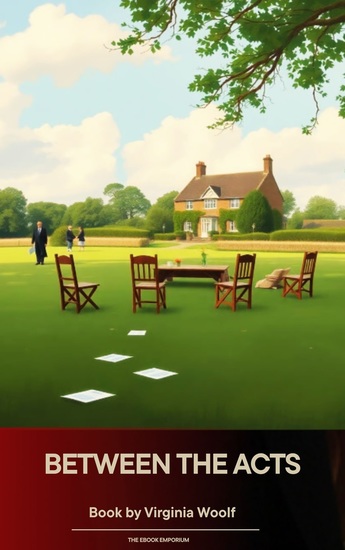
Between the Acts - cover

Between the Acts

Virginia Woolf

Publisher: The Ebook Emporium

  • 0
  • 0
  • 0

Summary

"Scraps, orts and fragments."

Set on a June day in 1939 at a country house in the English heartland, Between the Acts captures a community suspended in time. As the residents of Pointz Hall gather for the annual village pageant, the distant drone of warplanes serves as a chilling reminder of the world outside. Virginia Woolf's final novel is a brilliant, rhythmic exploration of the spaces between—between the scenes of a play, between individual lives, and between the eras of history.

The Canvas of Consciousness: Woolf weaves a tapestry of voices, from the frustrated artist Miss La Trobe to the estranged couple Giles and Isa Oliver. Through her signature stream-of-consciousness style, she examines how art attempts to unify a fragmented society. The pageant itself becomes a mirror held up to England's past, questioning whether history is a coherent story or merely a collection of fleeting moments.

A Final, Poetic Testament: Completed shortly before her death, this novel represents Woolf at her most daring and rhythmic. It is a work of extraordinary sensory detail, where the buzzing of a fly or the rustle of a program carries profound weight. Between the Acts is a poignant meditation on the endurance of the creative spirit and the fragile beauty of life in the face of uncertainty.

Step into the interval where life and art collide. Purchase "Between the Acts" today and experience the final vision of a modernist pioneer.
Available since: 01/02/2026.
Print length: 72 pages.

Other books that might interest you

  • Joan of Naples - cover

    Joan of Naples

    Alexandre Dumas

    • 0
    • 0
    • 0
    "Joan of Naples" by Alexandre Dumas is a dramatic historical novel exploring the tumultuous life of Queen Joan I of Naples. A figure of both admiration and scandal, Joan navigates political intrigue, betrayal, and personal passion in a kingdom rife with conflict. Her reign is marked by struggles for power, accusations of murder, and alliances that blur the lines between loyalty and manipulation. Dumas vividly portrays her resilience amid courtly conspiracies and shifting allegiances, while delving into themes of love, justice, and the burdens of leadership. Set against the rich tapestry of medieval Italy, this gripping tale blends romance, tragedy, and ambition, offering a poignant reflection on the complexities of ruling as a woman in a ruthless world.
    Show book
  • Thuvia Maid of Mars - cover

    Thuvia Maid of Mars

    Edgar Rice Burroughs

    • 0
    • 0
    • 0
    In Edgar Rice Burroughs' "Thuvia, Maid of Mars," adventure ignites on the red planet as Carthoris of Helium embarks on a daring quest to rescue the captivating Thuvia, princess of Ptarth. Abducted amidst a backdrop of interplanetary intrigue, Thuvia's fate intertwines with ancient Martian conflicts and powerful forces. This thrilling tale of heroism and romance plunges readers into the vibrant, perilous world of Barsoom, where courage and love defy all odds.
    Show book
  • Schoolgirl - cover

    Schoolgirl

    Osamu Dazai, Allison Markin Powell

    • 0
    • 0
    • 0
    Essentially the start of Dazai's career, Schoolgirl gained notoriety for its ironic and inventive use of language. Now it illuminates the prevalent social structures of a lost time, as well as the struggle of the individual against them–a theme that occupied Dazai's life both personally and professionally. This new translation preserves the playful language of the original and offers the reader a new window into the mind of one of the greatest Japanese authors of the 20th century.
    Show book
  • Gentle Breathing - From their pens to your ears genius in every story - cover

    Gentle Breathing - From their...

    Ivan Bunin

    • 0
    • 0
    • 0
    Ivan Alekseyevich Bunin was born on 22nd October 1870 in Voronezh province, in the South-West of the Russian Empire. 
    His early life was plagued by his Father’s gambling habits which caused his education to be erratic and the family to lose most of their wealth. 
    Bunin published his first poem in 1887 in St Petersburg and later in Oryol he worked for the local paper and became its editor, handily allowing him to publish his own poems and short stories.  There he met and married Varvara Pashchenko.  Ivan Bunin's debut book of poetry ‘Poems (1887–1891)’ was published in 1891. 
    This poetry and his translation of Longfellow garnered him his first Pushkin Prize.  Now he switched to writing prose and his novella ‘Antonov Apples’ is regarded as his first masterpiece.  Many more would follow. 
    The October Revolution of 1905 found Bunin in the Crimea.  Scenes of ‘class struggle’ he saw more as the oppressed people's craving for anarchy and destruction. 
    In November 1906 he began a passionate affair with Vera Muromtseva, within a few months they were touring through Egypt and Palestine.  ‘The Bird's Shadow’ collection was the result.   
    His second Pushkin Prize came in 1909 for Poems (1903–1906) and further translations.  He was now elected to the prestigious Russian Academy. 
    More widespread fame came in 1910 with ‘The Village’, a controversial and bleak portrayal of Russian country life.  Travel too beckoned them back to the Middle East, Ceylon (now Sri Lanka) and for winters in Capri with their friend Maxim Gorky.  
    That friendship suddenly ended in April 1917 as the revolution began to ferment in war-ravaged Russia.  After the Bolsheviks took power and the upheavals continued, he decided to leave Russia, finally achieving that in early 1920.  
    It would take some time to heal the wounds and stress he had been under and for his writing to begin again.  Settled in France, Bunin published many of his previous works and collections of novellas.  He also made regular contributions to the Russian emigre press.  
    Although reluctant to become involved in politics, Bunin was now feted as both a writer and the figurehead of non-Bolshevik Russian values and traditions.  In 1933 he became the first Russian to be awarded the Nobel Prize for Literature ‘for following through and developing with chastity and artfulness the traditions of Russian classic prose.’  
    In 1938 Bunin began working on the celebrated cycle of nostalgic, and erotically themed stories known Dark Avenues (or Dark Alleys).  
    As World War II broke out he chose to remain in Grasse spending the war at his remote Villa Jeanette, high in the mountains.  
    Ivan Bunin was a staunch anti-Nazi, and often, under difficult conditions, sheltered fugitives after Vichy was occupied by the Germans.  He wrote but did not publish during these years until on August 23rd the Nazi’s fled Grasse without a fight.  The next day the Americans came.  
    In May 1945 he returned to Paris and, apart from convalescing at times in Juan-les-Pins, he stayed for the rest of his life. 
    After 1948, with his health deteriorating, Bunin concentrated upon writing his memoirs and a book on Chekhov.  His last years were overshadowed by bitterness and despair at the situation in Russia and the treatment of its peoples.  He was suffering now from asthma, bronchitis and chronic pneumonia. 
    Ivan Alekseyevich Bunin died in a Paris attic flat on 8th November 1953.  Heart failure, cardiac asthma and pulmonary sclerosis were given as the causes of death.  He was 83.
    Show book
  • Olalla - cover

    Olalla

    Robert Louis Stevenson

    • 0
    • 0
    • 0
    "Olalla" is a short story by the Scottish novelist, poet, essayist, and travel writer Robert Louis Stevenson. It was first published in the Christmas 1885 issue of The Court and Society Review, then re-published in 1887 as part of the collection The Merry Men and Other Tales and Fables. It is set in Spain during the Peninsular War. 
     
    The story is based on a dream that Stevenson had and in his 1888 essay "A Chapter on Dreams" he describes the difficulties he had in fitting his vision into a narrative framework. Stevenson wrote the story at the same time as he was proofing "Strange Case of Dr. Jekyll and Mr. Hyde" (published 1886).
    Show book
  • 25+ The World's Greatest Short Stories Vol 2 - Roger Malvin's Burial Notes From The Underground The Mark On The Wall Heart Of Darkness and other - cover

    25+ The World's Greatest Short...

    Washington Irving, Edgar Allan...

    • 0
    • 0
    • 0
    Contents:
     • Washington Irving: Rip Van Winkle
    • Edgar Allan Poe: The Murders In The Rue Morgue
    • Fyodor Dostoevsky: Notes From The Underground
    • Franz Kafka: The Metamorphosis
    • Charles Dickens: The Chimes
    • Ivan Turgenev: Mumu
    • Francis Scott Fitzgerald: The Curious Case Of Benjamin Button
    • Joseph Conrad: Heart Of Darkness
    • Ambrose Bierce: Chickamauga
    • Arthur Conan Doyle: A Study In Scarlet
    • H. P. Lovecraft: At the Mountains of Madness
    • Nathaniel Hawthorne: Roger Malvin's Burial
    • Guy de Maupassant: Necklace
    • Leo Tolstoy: God Sees The Truth, But Waits
    • Anton Chekhov: The Lottery Ticket
    • Virginia Woolf: The Mark On The Wall
    • Katherine Mansfield: The Garden Party
    • H.G. Wells: The Star
    • Stendhal: Vanina Vanini
    • Honoré De Balzac: The Unknown Masterpiece
    • Mark Twain: The Celebrated Jumping Frog of Calaveras County
    • Aldous Huxley: Crome Yellow
    • Ernest Hemingway: Up In Michigan
    • Nikolay Gogol: A May Night
    • O. Henry: The Ransom Of Red Chief
    • Jack London: To Build a Fire
    Show book