Join us on a literary world trip!
Add this book to bookshelf
Grey
Write a new comment Default profile 50px
Grey
Subscribe to read the full book or read the first pages for free!
All characters reduced
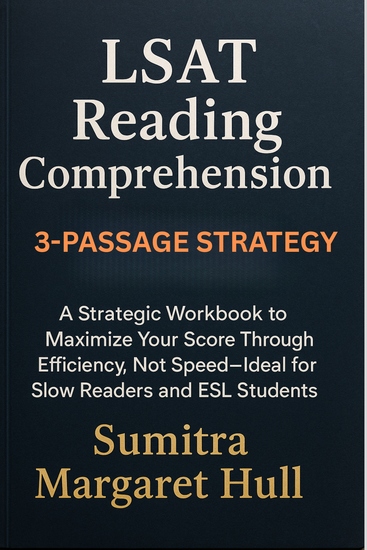
LSAT Reading Comprehension 3-Passage Strategy - A Strategic Workbook to Maximize Your Score Through Efficiency Not Speed—Ideal for Slow Readers and ESL Students - cover

LSAT Reading Comprehension 3-Passage Strategy - A Strategic Workbook to Maximize Your Score Through Efficiency Not Speed—Ideal for Slow Readers and ESL Students

Sumitra Margaret Hull

Publisher: Jstone Publishing

  • 0
  • 0
  • 0

Summary

LSAT Reading Comprehension: 3-Passage Strategy
 
A Strategic Workbook to Maximize Your Score Through Efficiency, Not Speed—Ideal for Slow Readers and ESL Students
 
Transform your approach to LSAT Reading Comprehension with a revolutionary strategy designed specifically for test-takers who need more time to process complex academic texts. This comprehensive workbook challenges the myth that you must read faster to succeed and instead focuses on maximizing accuracy through strategic efficiency.
 
Stop trying to finish everything. Start maximizing your score.
 
This systematic methodology introduces the game-changing 3-Passage Strategy, allowing you to achieve competitive scores by focusing on three passages instead of rushing through four. Learn to redefine success on the RC section through strategic triage, structural reading techniques, and targeted question attack methods.
 
What You'll Master:
 
Strategic passage evaluation and time management techniques
 
"Low-Resolution" reading methods that capture essential structure while ignoring distracting details
 
Systematic question categorization and attack strategies
 
Process of elimination mastery for trap answer identification
 
Academic vocabulary and complex syntax decoding
 
Anxiety management and optimal pacing development
 
Perfect for:
 
Students who identify as slow readers
 
ESL students navigating complex academic English
 
Test-takers seeking strategic alternatives to speed reading
 
Anyone struggling with RC time management
 
Progressive Training System: From untimed accuracy building to full-section implementation, this workbook provides a complete step-by-step training program. The innovative "Step-Down Method" gradually introduces time pressure while maintaining accuracy, helping you find your optimal pace without sacrificing comprehension.
 
Evidence-Based Techniques: Every strategy is grounded in cognitive science research on reading comprehension, working memory, and test anxiety. This isn't about shortcuts—it's about working smarter within your natural reading capabilities.
 
Includes:
 
Detailed methodology explanations with real examples
 
Progressive drill sets for skill building
 
Full section implementation strategies
 
Emergency techniques for difficult passages
 
Comprehensive review checklists
 
Stop fighting your reading speed. Start leveraging your analytical strengths. This workbook proves that accuracy and strategy trump speed every time.
Available since: 09/12/2025.
Print length: 158 pages.
Other books that might interest you

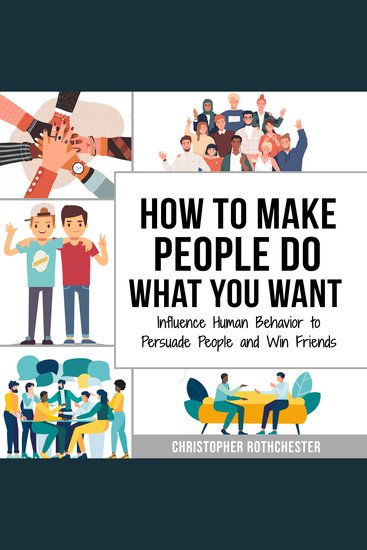
  • How to make people do what you want & How to change your mind - cover

    How to make people do what you...

    Christopher Rothchester

    • 0
    • 0
    • 0
    How to Make People Do What You Want 
    Do you want to learn how to appeal to people, be happier, healthier, and freer? How to Make People Do What You Want will get you started on that wonderful path. Modern life distracts us from what's really important, causing us to forget who we really are. None of us were born with fears, depression, or nervousness, no, something in our lives along the line pushes us into a downward spiral, careening into problems left and right. 
    The solutions to these problems may be staring us straight in the face, but unless we try, we'll never figure it out and reach our full potential. For some, dealing with people can be very stressful, but it doesn't have to be! The hangups and baggage that weigh us down need to be set aside, we need to become free. 
    Many kind, caring, and intelligent people repel potential friends, employers, and even future spouses because they're not socially perceptive, they don't understand how to attract friends, and they don't understand what impression their words, actions, and behaviors may give to others. 
    This skill is vital to learn because not one of us is an island, we can try to live by ourselves, but we make life so much more rich, easy, joyous, simple, and relaxed when we work together with friends to reach a common goal. Life doesn't have to be so difficult, the repetitive, boring, stressful, and unpleasant life you probably live is not a necessity—it's up to you, it's your choice. Choose wisely. Doing and learning new things will inherently require us to make changes, big changes, and this will feel uncomfortable.
    Show book
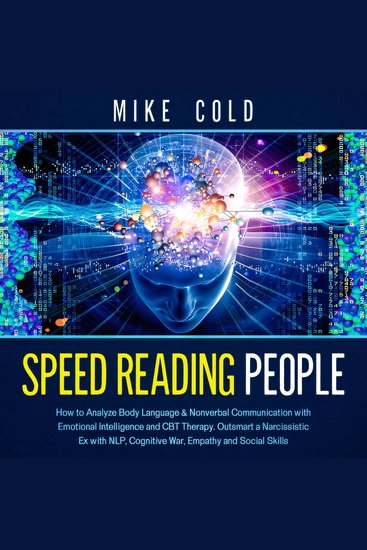
  • Speed Reading People - How to Analyze Body Language & Nonverbal Communication with Emotional Intelligence and CBT Therapy Outsmart a Narcissistic Ex with NLP Cognitive War Empathy and Social Skills - cover

    Speed Reading People - How to...

    Mike Cold

    • 0
    • 0
    • 0
    Do you ever feel like you're constantly on guard, unsure of people's true intentions? Have you ever been in a situation where you felt used, manipulated, or simply couldn't understand why someone said one thing but their body language screamed another? 
    Imagine being able to confidently navigate social interactions, spot a manipulator a mile away, and build genuine connections with the people around you. This book equips you with powerful techniques from cognitive behavioral therapy (CBT) and emotional intelligence (EQ) to decode body language and unmask hidden agendas.Here's what you'll discover: 
    ● The Secrets of Nonverbal Communication 
    ● The 4 Pillars of Emotional Intelligence 
    ● Cognitive Behavioral Therapy for Reading People 
    ● The Manipulator's Profile 
    ● Unveiling Your Vulnerability 
    ● Building a Shield Against Manipulation 
    ● Mastering Body Language 
    ● Developing Social Skills 
    ● Self-Improvement Tips for SuccessThis book is for you if: 
    ● You're tired of being walked all over in your personal or professional life 
    ● You want to build stronger, more meaningful relationships but feel constantly drained by social interactions 
    ● You desire to excel in your career and personal life but feel held back by your inability to read people accurately 
    ● You're interested in developing your emotional intelligence and taking control of your social life 
    Whether you're a complete beginner or looking to refine your existing skills, this book provides a clear, step-by-step approach to mastering the art of reading people and body language. Don't wait any longer! Don't miss out on this chance to finally understand people's true intentions.Stop being used and manipulated! Buy now and learn to identify manipulators before they take advantage of you!
    Show book
  • Gender Euphoria - Stories of joy from trans non-binary and intersex writers - cover

    Gender Euphoria - Stories of joy...

    Laura Kate Dale

    • 0
    • 0
    • 0
    GENDER EUPHORIA: a powerful feeling of happiness experienced as a result of moving away from one's birth-assigned gender. So often the stories shared by trans people about their transition center on gender dysphoria: a feeling of deep discomfort with their birth-assigned gender, and a powerful catalyst for coming out or transitioning. But for many non-cisgender people, it's gender euphoria that pushes forward their transition: the joy the first time a parent calls them by their new chosen name, the first time they have the confidence to cut their hair short, the first time they truly embrace themself. 


    In this groundbreaking anthology, nineteen trans, non-binary, agender, gender-fluid, and intersex writers share their experiences of gender euphoria: an agender dominatrix being called "Daddy," an Arab trans man getting his first tattoos, a trans woman embracing her inner fighter. What they have in common are their feelings of elation, pride, confidence, freedom and ecstasy as a direct result of coming out as non-cisgender, and how coming to terms with their gender has brought unimaginable joy into their lives.
    Show book
  • Mysterious Losses of the USS Thresher and USS Scorpion The: The History of the Only American Nuclear Submarines Lost at Sea - cover

    Mysterious Losses of the USS...

    Editors Charles River

    • 0
    • 0
    • 0
    In April 1963, one of the most advanced U.S. hunter-killer nuclear submarines and the 129 men onboard vanished while on a routine voyage. The USS Thresher was one of the country’s most advanced ships, but it had the misfortune of becoming the first American nuclear submarine to be lost at sea, prompting obvious questions over what had happened. Had it accidentally collided with a Soviet ship? Was it destroyed by a new and secret Soviet weapon? Was it secretly captured and taken back to the Soviet Union to reveal its secrets? 
    For those who choose to make the careers as submariners, there is no more beloved service. That is, one hopes, how it was for the 99 men who were serving on the USS Scorpion on May 22, 1968, the fateful day the submarine is believed to have sank. It appears that the crew members died quickly, but however it happened, the grief experienced by their family members dragged on for decades, exacerbated both by the Navy’s lack of information about the submarine’s final moments and the government’s unwillingness to share what little knowledge it had. 
    It is easy in hindsight to criticize the military for its secrecy, but it must be remembered that the Scorpion disappeared at the height of the Cold War, and therefore, little could be said publicly about its fate. Coincidentally, 3 other nuclear submarines suffered mysterious sinkings the same year, and the Cold War adversaries were interested in locating them and gleaning any secrets or technology that they could from the other side’s bad luck. Indeed, it was only after the fall of the Soviet Union that the truth could be told, bringing closure to family members and a dark lesson in espionage to the American people.
    Show book
  • Canaanites - The Ancient History of the People Who Inhabited Israel - cover

    Canaanites - The Ancient History...

    Kelly Mass

    • 0
    • 0
    • 0
    During the late 2nd millennium BC, Canaan was a Semitic-speaking civilization located in the Ancient Near East. The region held significant geopolitical importance, especially during the Late Bronze Age Amarna Period in the 14th century BC, when it became a crossroads for major empires. The Egyptian, Hittite, Mitanni, and Assyrian Empires all had areas of interest that converged or overlapped in Canaan, making it a key territory for trade, warfare, and cultural exchange. Much of our understanding of Canaan comes from archaeological excavations at sites such as Tel Hazor, Tel Megiddo, En Esur, and Gezer, where remnants of ancient Canaanite life have been uncovered. 
    In biblical texts, the term "Canaan" frequently appears to refer to the broader geographical region known as the Levant, particularly the Southern Levant. This area includes several territories that are central to the Bible’s narrative, such as the Land of Israel, Philistia, and Phoenicia. The Canaanites were the indigenous peoples of this region, and their diverse societies included both settled agricultural communities and nomadic-pastoral groups.
    Show book
  • Eternal capitalist trickery - cover

    Eternal capitalist trickery

    Anonymous

    • 0
    • 0
    • 0
    The concentration of power and wealth in the hands of a small predatory class, repeated crises, the inability of politicians to influence the course of events, worsening inequalities and the end of growth are the hallmarks of today's capitalism.  Since the fall of communism, capitalism has had no competitors. Will it die one day? Not in the short term: the system is stronger than governments, its worst scoundrels enjoy widespread impunity, and while economists have little or no understanding of how it works, no clear alternative is emerging. Above all, no one seems to be seriously considering a fundamental reform of modern financial capitalism. Curiously, a century earlier, this same situation had been analyzed by Nikolai Dimitrievich Kondratieff, a famous economist and committed player in the Russian Revolution of 1917. Kondratieff was executed by Stalin in 1938 for having scientifically demonstrated the eternity of capitalism. Would he have the same opinion about capitalism today?
    Show book