Join us on a literary world trip!
Add this book to bookshelf
Grey
Write a new comment Default profile 50px
Grey
Subscribe to read the full book or read the first pages for free!
All characters reduced
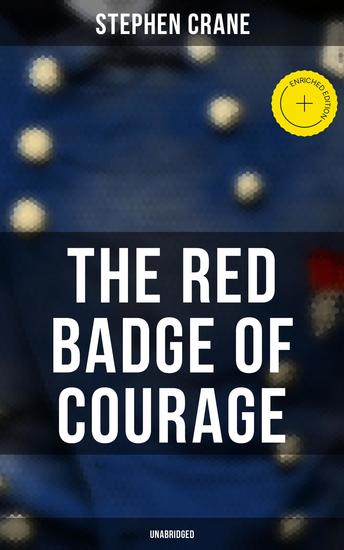
The Red Badge of Courage (Unabridged) - Enriched edition - cover

The Red Badge of Courage (Unabridged) - Enriched edition

Stephen Crane

Publisher: Musaicum Books

  • 0
  • 0
  • 0

Summary

Stephen Crane's 'The Red Badge of Courage' is a classic American Civil War novel that delves deep into the psyche of a young soldier grappling with fear, cowardice, and bravery on the battlefield. Written in a realist style, Crane vividly portrays the horrors of war and the internal struggle of the protagonist as he seeks to prove his manhood. The novel's raw and unfiltered depiction of the realities of combat makes it a timeless masterpiece in American literature, influencing future war novels and movies. Crane's use of vivid imagery and nuanced character development sets 'The Red Badge of Courage' apart from other war novels of its time, cementing its status as a must-read for literary enthusiasts. Stephen Crane, known for his journalistic background and firsthand experience as a war correspondent, brings a unique perspective to the novel, drawing from his observations and research to authentically portray the Civil War era. His immersive storytelling and attention to detail make 'The Red Badge of Courage' a powerful and thought-provoking exploration of courage in the face of adversity. I highly recommend this unabridged version of 'The Red Badge of Courage' to readers seeking a profound and insightful look into the human condition amidst the chaos of war.

In this enriched edition, we have carefully created added value for your reading experience:
- A succinct Introduction situates the work's timeless appeal and themes.
- The Synopsis outlines the central plot, highlighting key developments without spoiling critical twists.
- A detailed Historical Context immerses you in the era's events and influences that shaped the writing.
- An Author Biography reveals milestones in the author's life, illuminating the personal insights behind the text.
- A thorough Analysis dissects symbols, motifs, and character arcs to unearth underlying meanings.
- Reflection questions prompt you to engage personally with the work's messages, connecting them to modern life.
- Hand‐picked Memorable Quotes shine a spotlight on moments of literary brilliance.
- Interactive footnotes clarify unusual references, historical allusions, and archaic phrases for an effortless, more informed read.
Available since: 11/02/2018.
Print length: 139 pages.

Other books that might interest you

  • Aloysha the Pot - From their pens to your ears genius in every story - cover

    Aloysha the Pot - From their...

    Leo Tolstoy

    • 0
    • 0
    • 0
    Leo Tolstoy was born in 1828 in the Russian province of Tula to a wealthy noble family. As a child, he had private tutors but he showed little interest in any formal education. When he went to the University of Kazan in 1843 to study oriental languages and law, he left without completing his courses.  Life now was relaxed and idle but with some writing also taking place.  Gambling debts forced an abrupt change of path and he joined the army to fight in the Crimean War.  He was commended for his bravery and promoted but was appalled at the brutality and loss of life.  He recorded these and other earlier experiences in his diaries which formed the basis of several of his works. 
    In 1852 ‘Childhood’ was published to immediate success and was followed by ‘Boyhood’ and ‘Youth’. 
    His experience in the army and the horrors he witnessed resulted in ‘The Cossacks’ in 1862 and the trilogy ‘Sevastopol Tales’. After the war he travelled around Europe, visiting London and Paris and meeting such luminaries as Victor Hugo and Charles Darwin.  
    It was now that Tolstoy began his masterpiece, ‘War and Peace’. Published in 1869 it was an epic work that changed literature. He quickly followed this with ‘Anna Karenina’.  
    These successes made Tolstoy rich and helped him accomplish many of his dreams but also brought problems as he grappled with his faith and the lot of the oppressed poor. These revolutionary views became so popular that the authorities now kept him under surveillance.  
    He led a life of asceticism and vegetarianism and put his socialist ideals into practice by establishing numerous schools for the poor and food programmes. He also believed in giving away his wealth, which caused much discord with his wife.  
    His writing continued to bring forth classics such as ‘The Death of Ivan Ilyich’ and many brilliant and incisive short stories such as ‘How Much Land Does A Man Need’.  
    In 1901 Tolstoy was excommunicated from the Church and controversially deselected for the Nobel Prize for Literature. 
    Whilst undertaking a pilgrimage by train in October 1910 with his daughter Aleksandra he caught pneumonia in the nearby town of Astapovo.  Leo Tolstoy died on November 9th, 1910, he was 82.
    Show book
  • The House of the Seven Gables - cover

    The House of the Seven Gables

    Nathaniel Hawthorne

    • 0
    • 0
    • 0
    The House of the Seven Gables: A Romance is a Gothic novel written beginning in mid-1850 by American author Nathaniel Hawthorne and published in April 1851 by Ticknor and Fields of Boston. The novel follows a New England family and their ancestral home. In the book, Hawthorne explores themes of guilt, retribution, and atonement, and colors the tale with suggestions of the supernatural and witchcraft. 
    Show book
  • The Club of Queer Trades - cover

    The Club of Queer Trades

    G. K. Chesterton

    • 0
    • 0
    • 0
      
    Welcome to the whimsical world of "The Club of Queer Trades"! 
    In this collection of tales, G.K. Chesterton invites you to join a secret society unlike any other. Published in 1905, these stories weave a tapestry of mystery, humour, and imagination, showcasing Chesterton's unparalleled wit and flair for the unconventional. 
    At the heart of this collection lies the notion of "queer trades" – professions so unique and eccentric that they defy conventional classification. From an organisation which specialises in injecting adventure and fantasy into humdrum lives, to a company whose sole purpose is to detain people, each story introduces us to characters whose occupations challenge our perceptions and expectations. 
    Head Stories Audio presents " The Club of Queer Trades" by G.K Chesterton, narrated by Simon Hester. With original music.
    Show book
  • Mardi - cover

    Mardi

    Herman Melville

    • 0
    • 0
    • 0
    Mardi is Herman Melville's bold and imaginative novel that blends adventure, romance, philosophy, and satire into a vast allegorical journey across the Pacific. One of Melville's most ambitious and unconventional works, the novel moves beyond realism into a dreamlike exploration of ideas, identity, and human longing.
    
    The story begins with a dramatic escape from a whaling ship, as the narrator and his companion flee into the open sea. Their flight leads them to the mysterious archipelago of Mardi, a fantastical realm composed of countless islands, each embodying distinct cultures, beliefs, and political systems. As the narrator journeys from island to island, the narrative transforms into a sweeping meditation on love, truth, power, and the nature of civilization.
    
    At the emotional center of the novel is the narrator's obsessive search for Yillah, a beautiful and elusive woman who becomes a symbol of idealized love and spiritual longing. This quest propels him deeper into Mardi's surreal landscapes, where poetic reflection, philosophical debate, and sharp social criticism intertwine.
    
    Melville uses the imaginative freedom of the setting to satirize religion, monarchy, democracy, and intellectual dogma, while also probing the limits of reason and the burden of human desire. His lush, experimental prose challenges conventional storytelling, inviting readers into a world where meaning is fluid and interpretation essential.
    
    Visionary, demanding, and deeply original, Mardi stands as a key work in Melville's development as a writer. It is a novel for adventurous readers—an expansive allegory that rewards patience with its intellectual depth and poetic ambition.
    Show book
  • Strange Case of Dr Jekyll and Mr Hyde - cover

    Strange Case of Dr Jekyll and Mr...

    Robert Louis Stevenson

    • 0
    • 0
    • 0
    "Man is not truly one, but truly two."
    
    In the fog-shrouded streets of Victorian London, the respected and brilliant Dr. Henry Jekyll has made a terrifying discovery. Believing that every human soul is a battleground between good and evil, he develops a chemical potion to separate the two. But the experiment goes horribly wrong. Out of the laboratory emerges Edward Hyde—a man of pure, unadulterated malice who prowls the night committing acts of unspeakable violence. As Hyde's influence grows, the boundary between the two men begins to dissolve, leading to a desperate race for control and a shocking final revelation that changed the face of horror fiction forever.
    
    A Masterpiece of Suspense: Told through the eyes of the lawyer Gabriel Utterson, the story unfolds like a Victorian detective novel. Stevenson expertly builds dread through the "mystery of the door" and the unsettling physical descriptions of Hyde, whom people find "deformed" without being able to specify how—a brilliant psychological touch that suggests his evil is felt rather than seen.
    
    The Birth of Psychological Horror: Long before modern psychiatry, Stevenson explored the "repressed" desires of the Victorian gentleman. The tragedy of Dr. Jekyll isn't just his transformation into a monster, but his addiction to the freedom that being a monster provides. It is a searing critique of a society that demands outward perfection while ignoring the shadows within.
    
    Why It Endures: The phrase "Jekyll and Hyde" has entered our daily language for a reason. This novella remains a terrifyingly relevant look at the masks we wear and the consequences of trying to split our own nature. It is a fast-paced, atmospheric, and profoundly philosophical journey into the heart of human darkness.
    
    Face the monster in the mirror. Purchase "Strange Case of Dr Jekyll and Mr Hyde" today.
    Show book
  • The Pilgrim's Progress - cover

    The Pilgrim's Progress

    John Bunyan

    • 0
    • 0
    • 0
    The Pilgrim's Progress from This World to That Which Is to Come is a Christian allegory written by John Bunyan. First published in 1678, it is considered one of the most significant works of English literature and Protestant theology.  
    The story follows Christian, a character representing everyman, as he journeys from the City of Destruction to the Celestial City, which symbolizes Heaven. Burdened by the awareness of his sins, depicted by a physical weight on his back, Christian seeks salvation. He is guided by Evangelist, who directs him to the Wicket Gate. Along his journey, Christian encounters various allegorical characters who either assist or impede his progress. Christian, an everyman character, journeys from the City of Destruction to the Celestial City (representing Heaven). Burdened by the knowledge of his sin (represented by a physical burden on his back), Christian seeks salvation. He is guided by Evangelist, who directs him to the Wicket-gate. Along his path, Christian encounters various allegorical characters who either help or hinder his progress.
    Show book