Join us on a literary world trip!
Add this book to bookshelf
Grey
Write a new comment Default profile 50px
Grey
Subscribe to read the full book or read the first pages for free!
All characters reduced
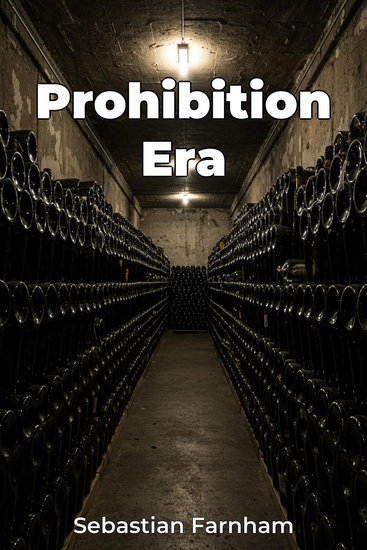
Prohibition Era - cover

Prohibition Era

Sebastian Farnham

Translator A AI

Publisher: Publifye

  • 0
  • 0
  • 0

Summary

The "Prohibition Era" in the United States, a period defined by the 18th Amendment and the Volstead Act, aimed to eliminate alcohol consumption but instead fostered unintended consequences. This book delves into the complex history, exploring how the temperance movement's idealistic goals clashed with the realities of organized crime and economic instability. Readers will gain insights into the rise of infamous figures who capitalized on the black market created by prohibition, and the economic repercussions that included significant losses in tax revenue.

 
The book examines the political factors that eventually led to the 21st Amendment, repealing prohibition. It systematically analyzes the era, beginning with the origins of the temperance movement and progressing through the surge in lawlessness and the economic impact, providing a balanced approach by acknowledging the movement's initial intentions while critically assessing the policy's ultimate failures. The analysis is supported by diverse sources, including government documents and statistical data, to offer a comprehensive understanding.

 
Ultimately, the book underscores the importance of considering potential negative outcomes when implementing sweeping social reforms. By understanding the political and social factors that shaped this unique period in American history, readers can draw valuable lessons applicable to contemporary debates about government regulation and individual liberties.
Available since: 03/19/2025.
Print length: 54 pages.

Other books that might interest you

  • The Present Professor - Authenticity and Transformational Teaching - cover

    The Present Professor -...

    Elizabeth A. Norell

    • 0
    • 0
    • 0
    In a world where stress is unavoidable—where political turmoil, pandemic fallout, and personal challenges touch everyone—this book offers guidance for cutting through the emotional static that can hold teachers back. A specialist in pedagogical strategies with extensive classroom experience, Elizabeth A. Norell explains how an educator's presence, or authenticity, can be critical to creating transformational spaces for students. And presence, she argues, means uncovering and understanding one's own internal struggles and buried insecurities—stresses often left unconfronted in an academic culture that values knowing over feeling. Presenting the research on how and why such inner work unlocks transformational learning, The Present Professor equips educators with the tools for crafting a more authentic presence in their teaching work. 


    At a time of crisis in higher education, as teachers struggle to find new ways to relate to, think about, and instruct students, this book holds a key. Implementing more inclusive pedagogies, Norell suggests, requires sorting out our own identities. In short, if we want to create spaces where students have the confidence, comfort, and psychological safety to learn and grow, we have to create spaces where we do, too. The Present Professor is dedicated to that proposition, and to helping educators build that transformational space.
    Show book
  • Dictating the Agenda - The Authoritarian Resurgence in World Politics - cover

    Dictating the Agenda - The...

    alexander cooley, Alexander...

    • 0
    • 0
    • 0
    Following the end of the Cold War, the world experienced a remarkable wave of democratization. Over the next two decades, numerous authoritarian regimes transitioned to democracies, and it seemed that authoritarianism as a political model was fading. But as recent events have shown, things have clearly changed. 


    In Dictating the Agenda, authors Alexander Cooley and Alexander Dukalskis reveal how today's authoritarian states are actively countering liberal ideas and advocacy surrounding human rights and democracy across various global governance domains. The transformed global context has unlocked for authoritarian states the possibility to contend with Western liberal soft power in new, traditionally "non-political" ways. Cooley and Dukalskis ultimately advance a theory of authoritarian snapback, the process in which non-democratic states limit the transnational resonance of liberal ideas at home and advance anti-liberal norms and ideas into the global public sphere. 


    Drawing from a range of evidence, this book doesn't just reveal the limits of the liberal influence taken for granted across the world. It offers a novel theory of how authoritarian governments figured out how to exploit and repurpose the same actors, tools, and norms that once exclusively promoted and sustained US-backed liberalism.
    Show book
  • Classic Rock & Rock Radio Commercials - Jefferson Airplace & The Moody Blues - cover

    Classic Rock & Rock Radio...

    Jefferson Airplane, The Moody Blues

    • 0
    • 0
    • 0
    Formed in 1965, Jefferson Airplane was an American rock band based in San Francisco, California, that became one of the pioneering bands of psychedelic rock. Their 1967 break-out album Surrealistic Pillow includes two songs, "Somebody to Love" and "White Rabbit", that are among Rolling Stone's "500 Greatest Songs of All Time". The October 1966 to February 1970 lineup of Jefferson Airplane, consisting of Marty Balin (vocals), Paul Kantner (guitar, vocals), Grace Slick (vocals), Jorma Kaukonen (lead guitar, vocals), Jack Casady (bass), and Spencer Dryden (drums), was inducted into the Rock and Roll Hall of Fame in 1996. The Moody Blues were an English rock band formed in Birmingham in 1964. During the band's "classic era" into the early 1970s, the lineup included keyboardist Mike Pinder, multi-instrumentalist Ray Thomas, drummer Graeme Edge, guitarist Justin Hayward, and bassist John Lodge. Their second album, Days of Future Passed, which was released in 1967, was a fusion of rock with classical music which established the band as pioneers in the development of art rock and progressive rock. The band has sold 70 million albums worldwide, which includes 18 platinum and gold LPs. They were inducted into the Rock and Roll Hall of Fame in 2018. This fascinating audio program includes actual radio commercials from the 1960s for each of the bands.
    Show book
  • American Poetry - A Very Short Introduction - cover

    American Poetry - A Very Short...

    David Caplan

    • 0
    • 0
    • 0
    With lively writing and illuminating examples, David Caplan argues that two characteristics mark the vast, contentious literature. On the one hand, several of America's major poets and critics claim that America needs a poetry equal to the country's distinctiveness. They advocate for novelty and for a break with what is perceived to be outmoded and foreign. On the other hand, American poetry welcomes techniques, styles, and traditions that originate from far beyond its borders. The force of these two competing characteristics, American poetry's emphasis on its uniqueness and its transnationalism, drives both individual accomplishment and the broader field. These two characteristic features energize American poetry, quickening its development into a great national literature that continues to inspire poets in the contemporary moment. 


    American Poetry: A Very Short Introduction moves through history and honors the poets' artistry by paying close attention to the verse forms, meters, and styles they employ. Examples range from Anne Bradstreet, writing a century before the United States was founded, to the poets of the Black Lives Matter movement. This concise examination of American poetry enriches our understanding of both the literature's distinctive achievement and the place of its most important writers within it.
    Show book
  • Nawab Kapoor Singh - Kapoor Singh Da Balpan - cover

    Nawab Kapoor Singh - Kapoor...

    Baba Prem Singh Hoti Mardaan

    • 0
    • 0
    • 0
    Book:Nawab Kapoor Singh  
    Written by : Baba Prem Singh Hoti Mardaan 
    The book "Nawab Kapoor Singh" by Baba Prem Singh Hoti Mardaan tells the inspiring story of Nawab Kapoor Singh (1697-1753), a brave warrior and servant of the Khalsa Panth. His life was during a time of great struggle for the Khalsa Panth, when Sikhs faced many challenges and sacrifices. 
    Nawab Kapoor Singh played a key role in saving the Khalsa from difficult situations. With his wise leadership, he led the Sikhs through tough times, making them strong and independent. In just about 32 years, the Sikhs went from having no place to stand in Punjab to becoming self-reliant and powerful across the country. 
    You can order it from Sikh Siyasat and get it delivered anywhere in the world.
    Show book
  • A Rare Recording of John Wanamaker Telling a Leo Tolstoy Anecdote - cover

    A Rare Recording of John...

    John Wanamaker

    • 0
    • 0
    • 0
    Unable to make the 1908 Pennsylvania German Society's annual gathering due to illness, their president-- businessman, religious leader, and politician, John Wanamaker--sent in a message he recorded "through this wonderful invention of Mr. Edison on the Edison phonograph." This recording recalls an anecdote of Leo Tolstoy's, in which the Russian writer stopped at the roadside and asked a farmer who was ploughing, "Friend, what would you do today if you knew positively you would die tomorrow?" 
     
    John Wanamaker (July 11, 1838 - December 12, 1922), born in Philadelphia, was a religious, civic, and political figure, as well as, founder of one of the first American department stores. He was considered a proponent of advertising and a "pioneer in marketing." In addition, Wanamaker served as U.S. Postmaster General from 1889 to 1893 during the term of U.S. President Benjamin Harrison.
    Show book