Join us on a literary world trip!
Add this book to bookshelf
Grey
Write a new comment Default profile 50px
Grey
Subscribe to read the full book or read the first pages for free!
All characters reduced
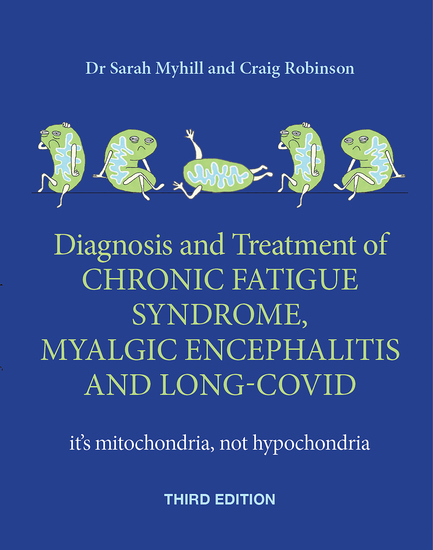
Diagnosis and treatment of Chronic Fatigue Syndrome Myalgic Encephalitis and Long Covid THIRD EDITION - it's mitochondria not hypochondria - cover

Diagnosis and treatment of Chronic Fatigue Syndrome Myalgic Encephalitis and Long Covid THIRD EDITION - it's mitochondria not hypochondria

Sarah Myhill, Craig Robinson

Publisher: Hammersmith Health Books

  • 0
  • 0
  • 0

Summary

Since the publication of its first edition in April 2014, Dr Myhill's guide to understanding and overcoming CFS/ME has become a must-read for sufferers from this poorly understood condition. As one example of the nearly 300 5-star reviewers on Amazon says: 'Extremely useful, well written, concepts well explained, absolutely great investment of money and time in reading it.' In the seven years since the second edition was published (January 2017) both new research and new clinical findings have thrown further light onto a condition that for sufferers is life-stopping but for many doctors is 'all in the mind'. Most recently, the UK's NICE guidelines have been updated and Long Covid has changed mainstream perceptions of post-viral fatigue, while Dr Myhill has looked further beyond mainstream medicine into often-ignored more traditional treatments including methylene blue and DMSO. Dr Myhill, supported by expert patient Craig Robinson, has fully rewritten and updated her book to include new insights throughout and new chapters on the PK diet, photodynamic therapy, micro-immunotherapy, ME and Long Covid, and the politics of CFS and ME.
Available since: 02/28/2024.
Print length: 360 pages.

Other books that might interest you

  • Empathy - Developing Deep Understanding and Compassion in Relationships - cover

    Empathy - Developing Deep...

    Coral Nunez

    • 0
    • 0
    • 0
    Empathy is one of the most profound and transformative qualities that we can cultivate in our lives. It allows us to connect with others on a deep emotional level, fostering understanding, compassion, and trust. In a world where individualism and surface-level interactions often dominate, empathy offers a refreshing and essential antidote. It enables us to not only understand the perspectives of others but also to feel their emotions and respond with care and support. This deep emotional connection is the cornerstone of strong, healthy relationships, whether in personal, professional, or social contexts. 
      
    In this book, we will explore the nature of empathy, its importance in building meaningful connections, and practical ways to develop and nurture it in our everyday lives. We will examine the different facets of empathy, including cognitive empathy—the ability to understand another's thoughts and viewpoints—and emotional empathy, which allows us to feel the emotions of others. By recognizing and cultivating both of these forms of empathy, we can better navigate the complexities of human relationships and respond more effectively to the needs of others.
    Show book
  • Summary & Analysis - Those Who Save Us - Based On The Book By Jenna Blum - cover

    Summary & Analysis - Those Who...

    Golden Books Publishing

    • 0
    • 0
    • 0
    SUMMARY & ANALYSIS 
      
    THOSE WHO SAVE US 
    BASED ON THE BOOK BY JENNA BLUM 
      
    SUMMARY WRITTEN BY: GOLDEN BOOKS PUBLISHING 
      
    CONTENT 
    A Funeral and a Daughter's Discomfort 
    Anna in Weimar, 1939-1940: The Dog and the Doctor 
    Disarray and Discovery 
    The Reality of the Concentration Camp 
    The Nazi Dinner Guests 
    Anna's Escape 
    Trudy's Search for Answers 
    The German Project 
    Confronting the Past 
    General Analysis 
      
    ABOUT THE ORIGINAL BOOK 
    "Those Who Save Us," by Jenna Blum, tells the story of Trudy, a professor researching German women during the Nazi era, and her mother, Anna, who lived through that time and carries many secrets. The novel explores the long-lasting impact of trauma and the difficulty of confronting the past. The narrative focuses on Anna's morally ambiguous choices made during World War II to protect herself and her daughter, Trudie. Trudy's "German Project" becomes a personal journey as she tries to understand her mother’s silence and the hidden truths of their family's history. The story examines how memory, silence, and the weight of history influence the lives of both mother and daughter.
    Show book
  • Fuel Your Fire: The Science of Motivation and Momentum - cover

    Fuel Your Fire: The Science of...

    Noah Robinson

    • 0
    • 0
    • 0
    "Fuel Your Fire: The Science of Motivation and Momentum" by Noah Robinson is a comprehensive exploration of what drives us to achieve and how to maintain that drive over time. Blending psychological insights with practical strategies, this book delves into the core elements that spark intrinsic motivation and keep momentum alive. Readers will discover how to set meaningful goals, build enduring habits, embrace a growth mindset, harness positive emotions, leverage social connections, utilize technology effectively, master self-control, find passion in their professional lives, and integrate these principles for sustained success. Whether you're aiming for personal growth or professional advancement, this guide offers actionable advice to ignite your inner drive and propel you toward your aspirations.
    Show book
  • Useless Facts About Life That Will Lull You to Sleep - cover

    Useless Facts About Life That...

    Trivial Facts

    • 0
    • 0
    • 0
    Are you tired of counting sheep? Want a fun, quirky way to drift into a peaceful slumber? Useless Facts About Life That Will Lull You to Sleep is the perfect audiobook for those who love the strange and unexpected, with a calming twist. 
    Packed with bizarre, humorous, and utterly useless facts, this sleep hypnosis guide will entertain you while gently guiding you into a deep, restful sleep. From strange historical tidbits to mind-boggling trivia, you’ll learn things you never knew you needed to know—all while relaxing and letting go of the day's stress. 
    The beauty of this audiobook lies in its unique blend of distraction and relaxation. The lighthearted facts are just interesting enough to pull your attention away from the usual worries and anxieties, allowing you to drift into sleep with a smile on your face. And with each fact, you’ll find your mind slowing down, making it easier to let go and unwind. 
    Press play, relax, and enjoy a fun journey of strange knowledge before falling into the most peaceful sleep you’ve had in ages. Useless Facts About Life That Will Lull You to Sleep is your perfect bedtime companion for a restful night.
    Show book
  • Control through Dependency - Creating a Dependency to Maintain Control - cover

    Control through Dependency -...

    Cito Harder

    • 0
    • 0
    • 0
    Dependency is one of the most powerful tools of control, shaping the way individuals behave, think, and perceive their own agency. When someone is made to rely heavily on another person, organization, or system, their ability to make independent choices becomes severely restricted. This loss of autonomy often leads to a dynamic where the dependent individual feels trapped, unable to break free due to financial, emotional, or social limitations. Understanding how dependency is used as a control mechanism is essential for recognizing when it is being manipulated for someone else’s gain. 
    At its core, dependency-based control thrives on restricting access to critical resources. These resources can be financial, such as when a controlling partner withholds money or employment opportunities to keep the other person reliant on them. It can also be emotional, as seen in relationships where one person conditions love and approval on the other’s compliance. In extreme cases, entire organizations or governments create a structured form of reliance, making individuals believe that they cannot survive without their continued support. 
    A key component of dependency control is fostering a sense of learned helplessness. When people are repeatedly placed in situations where they feel incapable of acting on their own, they begin to believe that they are inherently powerless. Over time, this mindset erodes self-confidence and discourages any attempt to challenge the controlling force. Those who manipulate dependency often reinforce this belief by convincing individuals that the outside world is dangerous, that they are not competent enough to succeed alone, or that their well-being is entirely dependent on maintaining the current relationship or system.
    Show book
  • How to Hack Your Vagus Nerve - Exercises to Dramatically Reduce Inflammation Anxiety and Trauma With Vagal Stimulation - cover

    How to Hack Your Vagus Nerve -...

    Angelina Power

    • 0
    • 0
    • 0
    The vagus nerve is the most important nerve you probably didn’t know you had. 
    The vagus nerve is a long meandering bundle of motor and sensory fibers that links the brain stem to the heart, lungs, and gut. It also branches out to touch and interact with the liver, spleen, gallbladder, ureter, female fertility organs, neck, ears, tongue, and kidneys. 
    Dr Justin Hoffman, a Santa Rosa, California, licensed naturopathic medical physician, says: 
    “Without the vagus nerve, key functions that keep us alive would not be maintained.” 
    Nationally recognized sports nutritionist, strength, and conditioning coach Brandon Mentore elaborates: 
    “The vagus nerve is extremely critical to your overall health and is intimately tied in with multiple organs and systems of the body.” 
    Vagus nerve dysfunction can result in a whole host of problems including obesity, bradycardia (abnormally slow heartbeat), difficulty swallowing, gastrointestinal diseases, fainting, mood disorders, B12 deficiency, chronic inflammation, impaired cough, and seizures. 
    Meanwhile, the vagus nerve stimulation has been shown to improve conditions such as: 
    - Anxiety disorder 
    - Heart disease 
    - Tinnitus 
    - Obesity 
    - Alcohol addiction 
    - Migraines 
    - Alzheimer’s 
    - Leaky gut 
    - Bad blood circulation 
    - Mood disorder 
    - CancerWhether you are feeling anxiety or depression, you can use tools to engage your social nervous system to re-establish higher order nervous system functions.
    Show book