Join us on a literary world trip!
Add this book to bookshelf
Grey
Write a new comment Default profile 50px
Grey
Subscribe to read the full book or read the first pages for free!
All characters reduced
The Battle of Gettysburg 1863 - cover

The Battle of Gettysburg 1863

Samuel Adams Drake

Publisher: DigiCat

  • 0
  • 0
  • 0

Summary

In "The Battle of Gettysburg, 1863," Samuel Adams Drake provides a meticulous account of one of the most significant clashes in the American Civil War. Combining vivid narrative with analytical insights, Drake employs a journalistic style that immerses the reader in the tumultuous events spanning July 1 to July 3, 1863. His comprehensive synthesis of on-the-ground reports, soldier diaries, and official documents enables a multifaceted exploration of the battle's strategies, human experiences, and pivotal consequences within the broader conflict. As a primary historical source, this work not only elucidates military maneuvers but also captures the profound human costs of war, presenting a nuanced portrait of courage and tragedy against the backdrop of emerging national identity. Samuel Adams Drake was well-versed in American history and had an author's knack for storytelling, shaped by both his experiences and academic pursuits. Born in 1833, he was deeply interested in the Civil War, which profoundly affected the American landscape. Drake's previous works on the Revolutionary War and his extensive travels across battlefield sites provided him with a deep understanding of the historical narratives he sought to convey, which likely inspired this concentrated study of Gettysburg. This compelling examination of the Battle of Gettysburg is essential for history enthusiasts, scholars, and casual readers alike. Drake's evocative prose, rich in detail and authenticity, makes the book not just a recount of military strategy but a tribute to the spirit of those who fought. A recommended read for anyone wishing to understand the complexities of Civil War history and its lasting impact on the United States.
Available since: 09/16/2022.
Print length: 87 pages.

Other books that might interest you

  • The Souls of Black Folk - cover

    The Souls of Black Folk

    W. E. B. Du Bois

    • 0
    • 0
    • 0
    In The Souls of Black Folk, W. E. B. Du Bois presents a powerful, introspective look at the African American experience in the post-Reconstruction South.
    
    Through a series of essays, Du Bois explores the psychological impact of racism, the struggle for equality, and the concept of "double consciousness"—the tension of being Black in a society that marginalizes you. A seminal work in American history and literature, this book challenges the notion of a "post-racial" world, urging readers to confront the deep-rooted injustices that continue to shape the lives of Black Americans.
    Show book
  • Dark Psychology and Manipulation - Using the Art of Persuasion you can Influence and Control Anybody in Just Ten Minutes Discover NLP and Emotional Influence Secrets (2022 Guide for Beginners) - cover

    Dark Psychology and Manipulation...

    Cedric Poole

    • 0
    • 0
    • 0
    Warning: if you are content and do not want to learn the truth, do not continue reading. 
    The truth often hurts and puts you at a crossroads. 
    When you become aware, you have two options: continue to reap the same outcomes or take charge of the situation and alter it. 
    The fact is that we are ALL manipulable, some more than others. The salesperson who persuaded you to buy his goods was not lucky; he most likely learned the art of persuasion. 
    With the help of this guidebook, you may finally take control of your life and be the one to lead others in the direction you want to go. 
    Do you like to be an active participant in circumstances rather than being subjugated to them? On the other hand, you'll learn how to fight yourself against various forms of manipulation and thrive in relationships and at work. 
    Specifically, you'll learn:To avoid falling into the trap of manipulators, learn their quirks.The seven persuasive principlesBody language is used to encode any nonverbal communication.The subtle manipulation tactics you need to know to protect yourself.The persuasive strategy for getting anything you desire 
    ... And a lot more 
    Human relationships are as vital as they are delicate: when you enter into them, you have to know precisely what to do, how to do it, and what the outcome of your actions will be. Unfortunately, if you lack the necessary understanding, you will have to prepare to surrender. 
    Are you willing to investigate the systems that cause you to give in to any demand? The truth is there at your fingertips: just add the guide to your cart and enjoy the ride.
    Show book
  • To See Ourselves - A Personal History of Scotland Since 1950 - cover

    To See Ourselves - A Personal...

    Alistair Moffat

    • 0
    • 0
    • 0
    Since 1945 the world has changed at breakneck speed, and life in post-war Scotland is now entirely different from what it was like when Alistair Moffat grew up in the quiet Border town of Kelso in the 1950s. At that time the rhythms and practicalities of daily life which had remained constant for many generations were about to change in the most unimaginable ways.
    This is a book about these changes – many of which have been dizzying and disorientating – and how they have affected each and every one of us in all parts of the country. The main themes, such as housing, healthcare, sport, the media, the arts and entertainment, urban and country life, our relationship with the environment, politics, religion and education, are all viewed through the lens of personal experience. Alistair's own recollections of big events and small, together with other eyewitness accounts, bring these decades alive in a way that no ordinary history can with a directness and poignancy that underlines how much has been gained – and how much lost.
    Show book
  • Rashtrakuta Empire - Military Prowess and Architectural Marvels - cover

    Rashtrakuta Empire - Military...

    Rolf Hedger

    • 0
    • 0
    • 0
    The Rashtrakutas were one of the most powerful dynasties in Indian history, ruling vast territories across the Deccan and beyond. Their origins, however, remain a subject of debate among historians due to conflicting inscriptions and interpretations. Some sources trace their roots to the Kannada-speaking regions, while others suggest connections to northern India. Despite the uncertainty, it is widely accepted that the Rashtrakutas emerged as a prominent force in the Deccan by the 8th century. 
    The dynasty first gained prominence under the rule of Dantidurga, who established Rashtrakuta authority by overthrowing the Chalukyas of Badami. However, evidence suggests that the Rashtrakutas had been a significant regional power even before his reign. The earliest references to the name "Rashtrakuta" appear in inscriptions from the 6th and 7th centuries, indicating that they were already influential feudatories before rising to imperial status. Some scholars believe they originally served as administrators or military governors under the Chalukyas before asserting their independence. 
    The question of the dynasty’s ethnic and linguistic identity has long been debated. Some sources claim that they were of Kannada origin, citing inscriptions and literary works composed in the Kannada language under their patronage. Others argue that they may have had northern Indian roots, pointing to their interactions with Rajput and Gurjara clans. Regardless of their precise origins, the Rashtrakutas embraced the cultural diversity of the Deccan, ruling over a population that spoke multiple languages, including Kannada, Sanskrit, and Marathi.
    Show book
  • Rewire Your Anxious Brain - Proven Techniques to Calm Your Mind Overcome Worry and Find Lasting Peace - cover

    Rewire Your Anxious Brain -...

    Dr. Emily Calmwood

    • 0
    • 0
    • 0
    Is modern anxiety hijacking your life? Reclaim your calm with proven, science-backed techniques! 
    In today's hyper-connected world, anxiety feels relentless. Rewire Your Anxious Brain by Dr. Emily Calmwood, a researcher and fellow anxiety sufferer, offers a practical, evidence-based path to lasting peace. 
    This book dives deep into the science of anxiety, demystifying its roots and equipping you with actionable strategies from Cognitive Behavioral Therapy (CBT) and mindfulness. Learn to identify your anxiety signals, challenge negative thoughts, and master relaxation techniques to calm your mind and body. Discover how to build resilience and take control, not just survive, but thrive. 
    Perfect for anyone overwhelmed by worry and seeking real, lasting solutions, this book is your guide to rewiring your brain for a calmer, more centered life. 
    Start your journey to a peaceful mind – get your copy of Rewire Your Anxious Brain today! 
     
    Show book
  • Inheriting the Ancient Near East after Alexander the Great: The Rise and Fall of the Seleucid Empire and the Ptolemaic Kingdom - cover

    Inheriting the Ancient Near East...

    Editors Charles River

    • 0
    • 0
    • 0
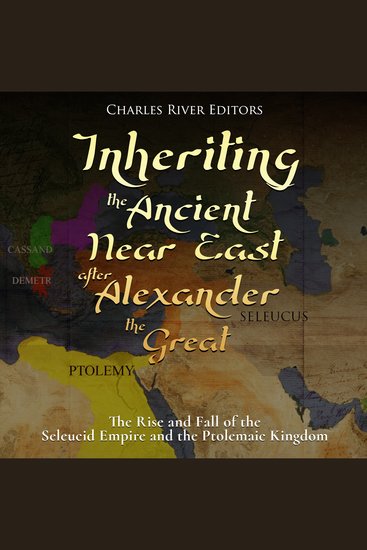
    On his deathbed, some historians claim that when he was pressed to name a successor, Alexander the Great muttered that his empire should go “to the strongest”. Other sources claim that he passed his signet ring to his general Perdiccas, thereby naming him successor, but whatever his choices were or may have been, they were ignored. Alexander’s generals, all of them with the loyalty of their own corps at their backs, would tear each other apart in a vicious internal struggle that lasted almost half a century before four factions emerged victorious: Macedonia, the Seleucid Empire in the east, the Kingdom of Pergamon in Asia Minor, and the Ptolemaic dynasty in Egypt. During the course of these wars, Alexander’s only heir, the posthumously born Alexander IV, was murdered, extinguishing his bloodline for ever.  
    	For a time, the Seleucids commanded the largest empire in the world as it stretched from the high plains and deserts of what is now Afghanistan in the east to parts of the Levant and Asia Minor in the west. The empire’s early kings were strong and shrewd and committed to the ideas of Hellenism as much as holding power and expanding the realm of their empire, but later rulers did not prove as capable. In time, the Seleucid royal house often descended into orgies of violence which were driven by ambitious men and women.   
    	Although Alexander never lived to rule over Egypt, one of his generals, Ptolemy I, did, and it was he who established the last great pharaonic dynasty in Egypt, known as the Ptolemaic Dynasty. Despite the infighting among them, one thing Alexander’s generals did agree upon was their Hellenistic culture. Most famously, Ptolemy’s line firmly established the Hellenistic culture of the Greeks while ruling over Egypt, and by marrying within their family line, the Ptolemaic pharaohs kept their Hellenistic heritage until the very end of Ptolemy’s line, which died with Cleopatra in 30 BC.
    Show book