Join us on a literary world trip!
Add this book to bookshelf
Grey
Write a new comment Default profile 50px
Grey
Subscribe to read the full book or read the first pages for free!
All characters reduced
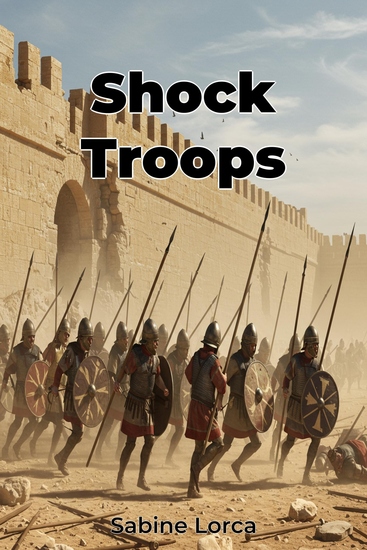
Shock Troops - cover

Shock Troops

Sabine Lorca

Translator A AI

Publisher: Publifye

  • 0
  • 0
  • 0

Summary

Shock Troops explores the evolution and impact of elite military units designed to break enemy lines. It analyzes how tactical deployment of concentrated force, combined with a warrior ethos emphasizing aggression, creates units capable of achieving breakthroughs that conventional forces cannot. The book reveals how shock troops, from ancient phalanxes to modern special forces, have adapted to changing battlefield conditions. Interestingly, their effectiveness relies not just on brute strength, but also on identifying and exploiting vulnerabilities in enemy defenses. 

 
The book progresses by first outlining the core principles of shock warfare and then moves into specific eras and conflicts, examining case studies of both successful and unsuccessful shock troop operations. It emphasizes that the strategic implications of employing shock troops can lead to decisive victories. What sets this book apart is its holistic approach, viewing shock troops as complex systems within dynamic environments, drawing from history, tactical theory, and behavioral science.
Available since: 03/29/2025.
Print length: 71 pages.

Other books that might interest you

  • German Invasions of France during the World Wars The: The History of Germany’s Campaigns in World War I and World War II - cover

    German Invasions of France...

    Editors Charles River

    • 0
    • 0
    • 0
    If trench warfare was an inevitability during the war, it is only because the events leading up to the First Battle of the Marne were quite different. The armies at the beginning of the war moved quickly through the land, but the First Battle of the Marne devolved into a bloody pitched battle that led to the construction of trenches after the Germans retreated, blocked in their pursuit of Paris. When the aftermath disintegrated into a war between trenches, some Germans thought they had the upper hand since they were occupying French territory, but with fewer soldiers than the combined Allied nations and fewer resources and supplies, it was possibly only a matter of time before they were ultimately defeated. The commander of the German armies, General Helmuth von Moltke, allegedly said to Kaiser Wilhelm II immediately after the First Battle of the Marne, "Your Majesty, we have lost the war." 
    One of the most famous people in the world came to tour the city of Paris for the first time on June 28, 1940. Over the next three hours, he rode through the city’s streets, stopping to tour L’Opéra Paris. He rode down the Champs-Élysées toward the Trocadero and the Eiffel Tower, where he had his picture taken. After passing through the Arc de Triomphe, he toured the Pantheon and old medieval churches, though he did not manage to see the Louvre or the Palace of Justice. Heading back to the airport, he told his staff, “It was the dream of my life to be permitted to see Paris. I cannot say how happy I am to have that dream fulfilled today.” Four years after his tour, Adolf Hitler would order the city’s garrison commander, General Dietrich von Choltitz, to destroy Paris, warning his subordinate that the city "must not fall into the enemy's hand except lying in complete debris." 
    Show book
  • Lincoln & Churchill - Statesmen at War - cover

    Lincoln & Churchill - Statesmen...

    Lewis E Lehrman

    • 0
    • 0
    • 0
    “With penetrating insight, Lehrman unfolds the contrasts and similarities between these two leaders . . . I savored every page of this magnificent work.”—Doris Kearns Goodwin, #1 New York Times-bestselling author of Team of Rivals: The Political Genius of Abraham Lincoln  Winner of the Abraham Lincoln Institute of Washington’s 2019 book prize Lewis E. Lehrman, a renowned historian and National Humanities Medal winner, gives new perspective on two of the greatest English-speaking statesmen—and their remarkable leadership in wars of national survival. Abraham Lincoln and Winston Churchill, as commanders in chief, led their nations to victory—Lincoln in the Civil War, Churchill in World War II. They became revered leaders—statesmen for all time. Yet these two world-famous war leaders have never been seriously compared at book length. Acclaimed historian Lewis Lehrman, in his pathbreaking comparison of both statesmen, finds that Lincoln and Churchill—with very different upbringings and contrasting personalities—led their war efforts, to some extent, in similar ways. As supreme war lords, they were guided not only by principles of honor, duty, and freedom, but also by the practical wisdom to know when, where, and how to apply these principles. Even their writings and speeches were swords in battle. Gifted literary stylists, both men relied on the written and spoken word to steel their citizens throughout desperate and prolonged wars. And both statesmen unexpectedly left office near the end of their wars—Lincoln by the bullet, Churchill by the ballot. They made mistakes, which Lehrman considers carefully. But the author emphasizes that, despite setbacks, they never gave up. “Deeply researched and elegantly written. . . . a valuable contribution to our knowledge of the past. By expertly conjoining two great leaders in a single volume, he has enhanced our understanding of both.” ―The Wall Street Journal  Includes illustrations and photographs
    Show book
  • James Watt: A short biography - 5 Minutes: Short on time - long on info! - cover

    James Watt: A short biography -...

    5 Minutes, 5 Minute Biographies,...

    • 0
    • 0
    • 0
    James Watt, inventor and entrepreneur: Life and work in a short biography! Everything you need to know, brief and concise. Infotainment, education and entertainment at its best!
    Show book
  • Dark Psychology - Mind Tricks Brainwashing Persuasion and Influence Explained - cover

    Dark Psychology - Mind Tricks...

    Wesley Felt

    • 0
    • 0
    • 0
    This book consists of three titles, which are the following: 
    1 - Dark Psychology: Understanding Seduction, Convictions, Persuasion, and Abuse 
    2 - Dark Psychology: Body Language and Human Psychology at Its Best and Its Worst 
    3 - Dark Psychology: Lies, Deception, Seduction, Brainwashing, and Conspiracies 
    Topics will include dark psychological themes such as manipulation, marketing tactics, sexual abuse, human trafficking, lies, deception, relationship problems, jealousy, emotions, mind control, and much, much more.
    Show book
  • Global Puppet Masters - Examining the Decahedron of Ultimate World Influence - cover

    Global Puppet Masters -...

    John Harpoon

    • 0
    • 0
    • 0
    In the modern world, understanding the foundations of global influence is essential to comprehend how power operates on the world stage. Power, in this context, refers to the ability of an actor—be it a nation-state, corporation, or non-governmental organization—to shape outcomes and direct events. Global influence manifests through various mechanisms, from economic leverage to cultural dominance, from military might to technological advancement. These power structures are not static; they evolve and adapt, shifting with changing political landscapes, societal developments, and technological innovations. To better understand these complexities, it is vital to define and explore the different types of power that govern global interactions. 
    The concept of power can be categorized into three primary types: hard power, soft power, and smart power. Hard power is the use of force or coercion, such as military action or economic sanctions, to achieve a desired outcome. It is often associated with traditional methods of exerting influence. Soft power, on the other hand, involves shaping preferences and values through non-coercive means, such as diplomacy, cultural exports, or the appeal of ideologies. Smart power combines both hard and soft power, strategically applying each to achieve desired objectives in a rapidly changing world. 
    The Decahedron Model is introduced as a comprehensive framework for analyzing global influence. This model identifies ten pillars of power that work together to create a complex web of interconnected global forces. These pillars include political, economic, military, technological, media, cultural, environmental, psychological, strategic, and financial influence. The Decahedron’s unique approach emphasizes that these pillars do not operate in isolation; rather, they interact and reinforce one another, creating a dynamic system where shifts in one pillar can lead to ripple effects throughout the entire global system.
    Show book
  • Soviet Union The: The History and Legacy of the USSR from World War I to the End of the Cold War - cover

    Soviet Union The: The History...

    Editors Charles River

    • 0
    • 0
    • 0
    For 30 years, much of the West looked on with disdain as the Bolsheviks took power in Russia and created and consolidated the Soviet Union. As bad as Vladimir Lenin seemed in the early 20th century, Joseph Stalin was so much worse that Churchill later remarked of Lenin, “Their worst misfortune was his birth... their next worst his death.” Before World War II, Stalin consolidated his position by frequently purging party leaders (most famously Leon Trotsky) and Red Army leaders, executing hundreds of thousands of people at the least. And in one of history’s greatest textbook examples of the idea that the enemy of my enemy is my friend, Stalin’s Soviet Union allied with Britain and the United States to defeat Hitler in Europe during World War II.  
    	Stalin ruled with an iron fist for nearly 30 years before his death in 1953, which may or may not have been murder, just as Stalin was preparing to conduct another purge. With his death, Soviet strongman and long-time Stalinist Nikita Khrushchev (1894-1971), who had managed to stay a step ahead of Stalin’s purges if only because he participated in them, became the Soviet premier. Meanwhile, little is remembered in the public imagination about Brezhnev in comparison to Mikhail Gorbachev, Vladimir Lenin, or Joseph Stalin, despite the fact Brezhnev ruled the USSR from 1964-1982, longer than any Soviet leader other than Stalin.  
    	After going through three elderly leaders in three years, Mikhail Gorbachev was chosen as the new General Secretary at the relatively youg age of 54 in March 1985. Gorbachev hoped to build the Soviet economy to relieve the persistent shortages of consumer goods it faced, which were caused by enormous military spending of the Soviet Union. Gorbachev tried to introduce some economic reforms, but they were blocked by communist hardliners. Gorbachev then came to the belief that the Soviet economy could not improved without political reform as well.
    Show book