Join us on a literary world trip!
Add this book to bookshelf
Grey
Write a new comment Default profile 50px
Grey
Subscribe to read the full book or read the first pages for free!
All characters reduced
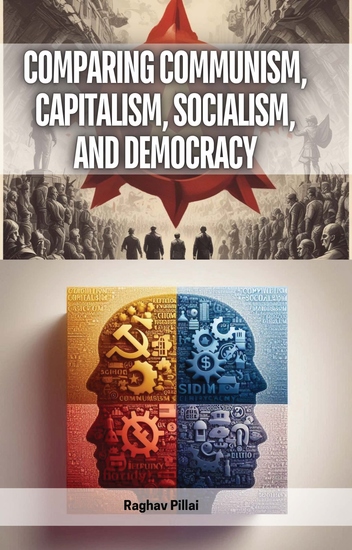
Comparing Communism Capitalism Socialism and Democracy - cover

Comparing Communism Capitalism Socialism and Democracy

Raghav Pillai

Publisher: Educohack Press

  • 0
  • 0
  • 0

Summary

"Comparing Communism, Capitalism, Socialism, and Democracy" navigates the intricate tapestry of global governance and economic systems. This enlightening book dissects four fundamental ideologies that have shaped human history. Going beyond surface-level definitions, it delves into the historical evolution, key principles, and distinctions that define each ideology. 

Whether you are a seasoned scholar, curious student, or an individual seeking a profound understanding of the world's socio-political landscape, this book provides a roadmap to unravel communism, capitalism, socialism, and democracy.

Uncover the roots of each ideology, tracing their origins from pivotal historical moments. Explore the economic paradigms, understanding how they shape wealth distribution, production, and resource allocation. Examine governance models, from centralized planning to democratic governance, and their impact on citizen participation and political stability. Delve into societal dimensions, evaluating how these ideologies foster inclusivity, address disparities, and preserve cultural identity. Analyze the contemporary relevance of each ideology, considering their adaptability to global challenges and their impact on international relations.

"Comparing Communism, Capitalism, Socialism, and Democracy" serves as an indispensable guide for anyone seeking clarity in political and economic ideologies. It offers a reader-friendly yet comprehensive exploration, equipping individuals with knowledge to critically engage with diverse ideologies shaping our global society.
Available since: 02/20/2025.
Print length: 230 pages.

Other books that might interest you

  • Urbanization and Its Impact - Understanding City Growth - cover

    Urbanization and Its Impact -...

    Lyric Vale

    • 0
    • 0
    • 0
    Urbanization refers to the process by which an increasing proportion of a population comes to reside in urban areas, often transforming rural landscapes into bustling cities. It is a complex and multidimensional phenomenon that encompasses social, economic, cultural, and environmental changes. The rapid expansion of urban areas is one of the most defining features of modern society, reflecting humanity's growing tendency to cluster in cities for opportunities, convenience, and better access to resources. 
    Historically, urbanization began with the establishment of early agricultural settlements, which served as hubs for trade and governance. Over time, these settlements grew into cities as advancements in technology, transportation, and infrastructure facilitated their expansion. The Industrial Revolution, in particular, marked a pivotal moment in the history of urbanization, drawing large numbers of people into urban centers in search of work and prosperity. Today, urbanization continues at an unprecedented pace, driven by industrial growth, globalization, and population migration from rural to urban regions. 
    The scope of urbanization extends far beyond the mere growth of cities. It profoundly influences nearly every aspect of human life, from economic development to social interactions and environmental sustainability. Economically, cities serve as engines of growth, innovation, and creativity, offering concentrated markets, skilled labor, and access to advanced infrastructure. Socially, urban areas often promote cultural exchange and diversity, creating spaces where people from different backgrounds can interact and collaborate. However, this growth also comes with challenges, such as overcrowding, inequality, and the strain on public services and infrastructure.
    Show book
  • D-DAY - The Epic Story of the Allied Invasion of Normandy - cover

    D-DAY - The Epic Story of the...

    Days of History

    • 0
    • 0
    • 0
    D-DAY: The Epic Story of the Allied Invasion of Normandy is a gripping and compelling book that takes you on a journey through one of the most significant moments in history. This book is a comprehensive account of the events that took place on June 6, 1944, and the days leading up to it. 
    It tells the stories of the brave soldiers who fought and died on the beaches of Normandy and the civilians whose lives were forever changed by this historic day. 
    Not your typical history book. It goes beyond the textbook account and delves deep into the experiences of those who were there. This book paints a vivid picture of what it was like to be on the front lines of this pivotal moment in history. 
    In this book, you will learn about the planning and preparation that went into the largest seaborne invasion in history. You will gain insight into the strategy and tactics used by the Allied forces, as well as the obstacles they faced on the ground. 
    Whether you are a history buff or simply interested in learning more about one of the most important moments in modern history, This book is a must-read. 
    This book is a tribute to the bravery and sacrifice of the soldiers who fought and died for their country and a reminder of the human cost of war. 
    Don't miss out! Order your copy today and be transported back to a time when the fate of the world hung in the balance.
    Show book
  • The Ancient Mayan Civilization - The enthralling History of the Maya from the pre-classic to the post-classic era - cover

    The Ancient Mayan Civilization -...

    History Retold

    • 0
    • 0
    • 0
    Discover the enthralling story of the Maya, from their emergence in the Pre-Classic period to their decline in the Post-Classic period. 
    This book is an essential guide for anyone interested in learning about the Expansion, Growth, and Decline of the Maya civilization. 
     • Uncover the fascinating history of the Maya, from their emergence in the Pre-Classic period to their eventual decline in the Post-Classic period. 
     • Explore the Expansion, Growth, and Decline of the Maya civilization, and understand the factors that contributed to their ultimate downfall. 
    • Learn about the culture, beliefs, and customs of the Maya, and how they have shaped the world we live in today. 
    Don't miss out. Pick up your copy of today and discover the secrets of the Maya!
    Show book
  • The Influence of Ancient Egypt on Modern Culture - cover

    The Influence of Ancient Egypt...

    Omar Khalil

    • 0
    • 0
    • 0
    The fascination with Ancient Egypt’s visual and structural aesthetics has significantly influenced Western art and architecture, especially during the 18th and 19th centuries. Known as the Egyptian Revival, this movement emerged as part of a broader romantic and neoclassical interest in ancient civilizations. Following Napoleon's campaign in Egypt and the publication of Description de l'Égypte, Europe became enamored with Egyptian motifs, leading to their incorporation into a wide range of architectural projects. 
    One of the most recognizable contributions of Egyptian Revival architecture is the use of obelisks and pyramid forms in public spaces and memorials. These iconic shapes, once central to Egyptian religious and ceremonial design, were reinterpreted in cemeteries, government buildings, and monuments across Europe and the United States. The Washington Monument in the U.S., for instance, is a clear example of how Egyptian form was adapted to convey power and permanence. 
    In interior design and decorative arts, Egyptian Revival made a mark through bold geometric patterns, lotus flower motifs, and symbolic elements like the sun disk and winged scarab. Furniture, wallpaper, jewelry, and textiles adopted these styles, evoking the mystery and majesty of the Nile. This decorative trend became especially popular after the discovery of King Tutankhamun’s tomb in 1922, which triggered a new wave of Egyptomania in the early 20th century.
    Show book
  • Screw Meditation! - How to switch off a busy brain be more productive and enjoy life! - cover

    Screw Meditation! - How to...

    Sue Belton

    • 0
    • 0
    • 0
    Sue Belton is an award-winning leadership coach, bestselling author and speaker who specializes in coaching senior corporate leaders worldwide. Her clients are successful, smart, ambitious and high-achieving professionals in demanding leadership roles. Invariably, they are always ‘on’, working 60-80 hour weeks... plus evenings, plus weekends, plus holidays... Their demanding work schedules create a busy brain that they just cannot switch off. 
    Screw Meditation! is an invaluable guide written especially for busy, time-poor professionals who want to switch off a busy brain and have tried everything – specifically meditation and mindfulness – without much success. Screw Meditation! explains why. 
    Sue Belton uncovers the link between working long hours, poor time management, cognitive impairment, biological factors, and emotional Drivers, that all result in poor productivity and performance issues and keep a brain… busy! 
    She explains why the vicious cycle of hard work and busy-ness can keep a smart professional stuck with no time to step back and be more strategic. She also explains how this leads to more debilitating issues such as imposter syndrome, poor health, and burnout. 
    Screw Meditation! gives you six hacks that have been road-tested on leaders worldwide, and gives you the proven tools to manage your time, tasks and team… with a clear strategy for switching off a busy brain. 
    meditation; mindfulness; self talk; time management; productivity; burnout; Imposter Syndrome; cognitive impairment; brain function; emotional drivers; Transactional Analysis; NLP; CBT; stress; adrenal fatigue; cortisol fatigue; perceived ability to cope; executive stress; senior leader burn out
    Show book
  • Great Conquerors - Biographies of William the Conqueror Alexander the Great and Napoleon Bonaparte - cover

    Great Conquerors - Biographies...

    Kelly Mass

    • 0
    • 0
    • 0
    This is a compilation of 3 different titles, which are about the following topics: 
    1: The Greek general and king, Alexander the Great, is a name you might have heard before. Although his historical journey varies greatly from the stories and rumors about him, he did accomplish many victories in Asia and Europe in his conquest to rule the world. 
    In this guide, we will go over his appearance, his character, his many battles, his clever military strategies, and the regions he conquered. His vast empire stretched farther than much else had before his time. But eventually, it became divided, and the throne was being fought over. This was one of the things that shows us how much of a difference he made as a ruler in his empire. 
    2: Undoubtedly, Napoleon, the French revolutionist and emperor has left his mark on European history. His vast empire stretched all over the continent, his unique image and posture have been emulated by many, and his infamous defeat in Russia was a precursor of the defeat Hitler experienced for similar reasons. 
    When we take a time machine to the end of the 18th century and the beginning of the 19th century, how can we better understand the culture and ideas of those times? How did someone from the relatively tiny island of Corsica become such an iconic figure in history? 
    3: William the First, who was also called William the Conqueror and in some cases William the Bastard, was the first Norman emperor of England, ruling from 1066 till his death in 1087. Around this time, many wars and battles were waged over the kingdom and distribution of territories in Europe. France, the Anglo-Saxons, and Scandinavian troops were engaged in raids, struggles, and battles to claim their lands and gains.
    Show book