

Join us on a literary world trip!
Add this book to bookshelf
Grey
Write a new comment Default profile 50px
Grey
Subscribe to read the full book or read the first pages for free!
All characters reduced
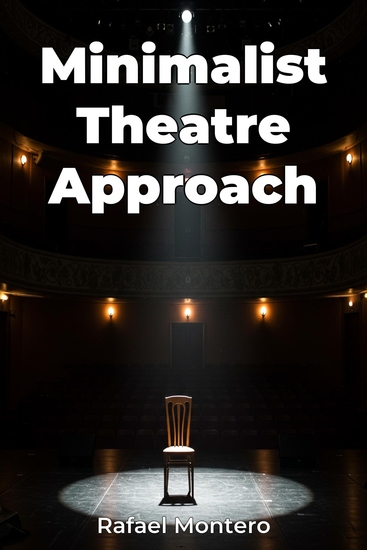
Minimalist Theatre Approach - cover

Minimalist Theatre Approach

Rafael Montero

Translator A Ai

Publisher: Publifye

  • 0
  • 0
  • 0

Summary

Minimalist Theatre Approach explores the power of simplicity in dramatic arts, advocating for a theatre stripped of excess to amplify emotional impact. It delves into the philosophy and practical application of minimalism in performance, challenging conventional, often overproduced, theatrical approaches. Minimalism moves beyond just simple staging. For example, minimalist costuming utilizes neutral, functional attire, keeping the focus on the character and narrative. The book argues that restraint enhances the core message, fostering deeper connections between performers and audiences.

 
The book presents its investigation across three key areas: minimalist staging, costuming, and thematic focus, each building upon the other. Through minimalist staging, the book explores how sparse sets and symbolic props impact mood. It uses case studies, production notes, and interviews with contemporary theatre practitioners to support its arguments. The book offers a comprehensive guide for directors, designers, and performers interested in embracing a minimalist approach to theatre production.
Available since: 05/05/2025.
Print length: 67 pages.

Other books that might interest you

  • On the Canal - The Marines of L-3-5 on Guadalcanal 1942 - cover

    On the Canal - The Marines of...

    Ore J Marion, Thomas Cuddihy,...

    • 0
    • 0
    • 0
    A gripping true story of the WWII Guadalcanal Campaign—told with no-holds-barred honesty and humor by a Marine who was there. In August of 1942, Allied forces led by U.S. Marines came ashore on Guadalcanal, launching the first major land offensive against Imperial Japan. M. Sgt. Ore J. Marion of L Company, 3rd Battalion, 5th Regiment was among them. Here, Marion and other men of L-3-5 share a personal account of their experiences over the course of this grueling and protracted campaign.  The stories contained in these pages are harrowing, profane, heartbreaking, irreverent, and deeply human. As with many personal accounts, some memories recorded here are at odds with the official accounts in Washington’s archives. Rather than presenting a clean and consistent narrative, On the Canal reflects the messy business of warfare and human memory.
    Show book
  • Wolfgang Amadeus Mozart: A short biography - 5 Minutes: Short on time - long on info! - cover

    Wolfgang Amadeus Mozart: A short...

    5 Minutes, 5 Minute Biographies,...

    • 0
    • 0
    • 0
    Wolfgang Amadeus Mozart, legendary Austrian composer: Life and works in a short biography! Everything you need to know, brief and concise. Infotainment, education and entertainment at its best!
    Show book
  • The Arthurian Legends - The Epic Tales of King Arthur and His Knights - cover

    The Arthurian Legends - The Epic...

    Julia Blacksmith

    • 0
    • 0
    • 0
    The Arthurian legends have captivated audiences for centuries, blending history, myth, and romance into a timeless narrative. At the heart of these tales stands King Arthur, the noble ruler of Camelot, surrounded by his valiant knights, wise counsel, and a destiny shaped by magic and fate. These stories, filled with chivalry, heroism, and tragedy, have evolved over time, transforming from medieval folklore into one of the most enduring mythological traditions in the Western world. Whether viewed as a historical figure or a fictional hero, Arthur’s legend continues to inspire literature, art, and modern storytelling.  
      
    The roots of the Arthurian legends can be traced back to early medieval Britain, a period marked by conflict and shifting power. The earliest references to Arthur appear in Welsh and Celtic traditions, portraying him as a warrior who defended his land against invading forces. As these stories spread, they were enriched by medieval chroniclers such as Geoffrey of Monmouth, whose twelfth-century work *Historia Regum Britanniae* established Arthur as a grandiose king with a mythical kingdom. French and English writers expanded the legend, introducing characters like Lancelot, Guinevere, and the Holy Grail, further shaping the narrative into the form known today.  
      
    The debate over whether King Arthur was a real historical figure or merely a legendary construct has fascinated scholars for centuries. Some believe that Arthur may have been based on a real Brittonic war leader who fought against Saxon invasions in the fifth or sixth century. However, definitive historical evidence remains elusive. What is clear is that Arthurian stories took on a life of their own, infused with elements of medieval knighthood, Christian symbolism, and mythical enchantment. Arthur became more than just a king—he became an ideal, embodying the virtues of justice, bravery, and sacrifice. 
    Show book
  • Four Russian Writers: Life Lessons and Storytelling Secrets - "Unlock the wisdom of Four Russian Writers! Experience captivating lessons that elevate your storytelling prowess" - cover

    Four Russian Writers: Life...

    Asherby Fosdick

    • 0
    • 0
    • 0
    Four Russian Writers: Life Lessons and Storytelling Secrets 
    ⭐⭐ A Simplified Guide with Insights Included ⭐⭐ 
    Are you eager to enhance your storytelling abilities and uncover valuable life lessons from some of the greatest Russian writers? 
    Searching for a comprehensive guide that encompasses all the essential elements to master the art of storytelling and learn from these literary giants? 
    Your quest ends here! 
    This guide acts as your ultimate resource for enriching your understanding, applying your newfound skills, and engaging in practical exercises. With our insights, you're poised for success. 
    Updated for the latest storytelling techniques and insights. 
    Key features of this insightful guide: 
    - In-depth explorations of storytelling techniques influenced by four iconic Russian authors. 
    - Clear explanations of life lessons drawn from their works. 
    - Effective strategies for applying storytelling techniques in your own writing. 
    What sets our guide apart is its thorough coverage, which is vital for your learning journey. Concepts are not just lightly touched upon; they are examined in depth. 
    Please note, this guide is an independent resource and not affiliated with any official literary institution. 
    Crafted with a logical structure and accessible language, our guide guarantees seamless transitions between topics. Say goodbye to complex jargon and embrace straightforward, precise, and engaging content. 
    So, why wait? Click the BUY NOW button, secure your guide, and embark on your journey to mastering storytelling through the insights of four remarkable Russian writers!
    Show book
  • Conquer Digital SAT - "Elevate your Digital SAT prep with dynamic audio lessons for unbeatable test success!" - cover

    Conquer Digital SAT - "Elevate...

    Ronan Vexley

    • 0
    • 0
    • 0
    Conquer Digital SAT 
    ⭐⭐ Simplified Guide & Explanations Included ⭐⭐ 
    Are you ready to advance in your career and enhance your knowledge by successfully acing the Digital SAT?  
    Searching for a complete guide that covers all the essentials to excel in the Digital SAT? 
    Your quest ends here! 
    This guide is your ultimate resource for deepening your understanding, honing your skills, and engaging in practical exercises. With this preparation, you are set for success. 
    Updated for the Digital SAT 2025 Exam Structure. 
    Key features of this enhanced guide: 
    - In-depth insights about the Digital SAT Certification for 2025 
    - Comprehensive breakdown of strategies to unlock your potential and achieve success through strategic preparation 
    - Effective techniques for exam preparation and tackling challenging questions 
    Our guide stands out with its extensive coverage, which is crucial for your success on the exam. Concepts are not just skimmed over; they are explored in detail with clarity. 
    Please be aware that this guide is an independent resource and not affiliated with any official Digital SAT entity. 
    Crafted with a logical structure and straightforward language, our Digital SAT Guide for 2025 guarantees seamless transitions between topics. Say goodbye to complex jargon and welcome clear, precise, and technically accurate content. 
    So, why hesitate? Click the BUY NOW button, secure your guide, and embark on your journey to succeeding in the Digital SAT 2025! 
    Get ready to conquer the Digital SAT!
    Show book
  • Archaic Humans: The History of the Different Prehistoric Species in the Genus Homo - cover

    Archaic Humans: The History of...

    Editors Charles River

    • 0
    • 0
    • 0
    The evolutionary path from the original primates to modern man is a long one and has taken many twists and turns, but naturally, as the fossil record grows, scientists gain a more complete understanding of our own mental and physical history in terms of genetics and anatomy. However, the correct order and relationships of the various specimen types are difficult to pin down. Many representative samples have been found in such minute amounts as to not preclude anomalies. They have been discovered in various stages of wear. Modern features did not occur simultaneously or uniformly, taking millions of years to become manifest in later types. Up to the present day’s Homo sapiens, examples of the main types have been hybrids of older and more modern features. 
    	One of the earliest species of the genus Homo to be discovered is Homo habilis, which basically means “handy man.” The name comes from the belief at the time of its discovery that this species was the first to start using stone tools. The first fossils to be uncovered in Olduvai Gorge were from the same stratigraphic layer as simple stone tools. Fossils of the crania and postcranial skeleton for this species have been found in both eastern and southern Africa and date to around 2.5–1.6 million years ago.  
    	Features of Homo erectus suggest an evolution toward modern humans, and the features which separate Homo erectus from the other Homo species are found in the skull. The size of the brain was approximately 900 cc, making it larger than the brain size of Homo habilis. Homo erectus would not have the largest brain capacity of the Homo genus during its existence, with the emergence of Homo heidelbergensis approximately 800,000 years ago. The larger brain size may not matter much when the size of the brain is considered with the size of the body, which also increased. 
    Show book
