Join us on a literary world trip!
Add this book to bookshelf
Grey
Write a new comment Default profile 50px
Grey
Subscribe to read the full book or read the first pages for free!
All characters reduced
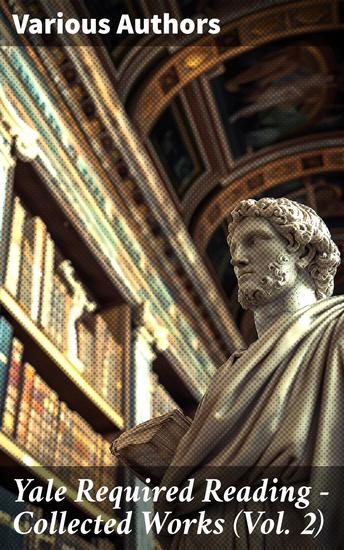
Yale Required Reading - Collected Works (Vol 2) - The Rise and Fall of Rome: The Greatest Works of the Roman Classical Literature - cover

Yale Required Reading - Collected Works (Vol 2) - The Rise and Fall of Rome: The Greatest Works of the Roman Classical Literature

Lucius Annaeus Seneca, Julius Caesar, Boethius, Horace, Plutarch Plutarch, Apuleius, Virgil Virgil, Persius, Terence, Ammianus Marcellinus, Sallust, Juvenal, Lucan, Suetonius, Tibullus Tibullus, Tacitus Tacitus, Petronius, Cornelius Nepos, Lucretius Lucretius, Martial, Catullus, Cicero Cicero, Claudian, Pliny the Younger, Saint Augustine of Hippo, Plautus, Ennius, Propertius, The Metamorphoses, Augustus, Quintilian

Translator Alfred John Church, Paul Nixon, J. S. J.S.Watson, Christopher Smart, William Rose, James Rhodes, Lewis Evans, John William Mackail, William Jackson Brodribb, W. A. McDevitte, W. S. Bohn, Henry Thomas Riley, William Ellery Leonard, Frederick Charles Tindal Bosanquet, E. Jones, Robinson Ellis, Harold Edgeworth Butler, Theodore Chickering Williams, John Selby Watson, Frederick W. Shipley, William Charles Firebaugh, Maurice Platnauer

Publisher: Good Press

  • 0
  • 0
  • 0

Summary

Yale Required Reading - Collected Works (Vol. 2) offers a rich tapestry of Roman literary genius, encompassing a wide array of themes such as politics, philosophy, and human nature, portrayed through diverse literary styles including epic poetry, historical narratives, and philosophical treatises. This collection vividly highlights the profound influence of classical Roman thought, showcasing works that range from emotionally charged satires to the stoic reflections of human experience. The anthology presents an unrivaled mosaic of voices, integrating standout pieces that explore the grandeur of empires, the subtleties of power, and the enduring quest for meaning, all without leaning too heavily on any single work or author. Contributing luminaries such as Seneca, Cicero, and Virgil, among others, bring their unique perspectives to this compendium, representing the zenith of Roman intellectual and literary heritage. The varied backgrounds of these literary giants'Äîspanning statesmen, poets, philosophers, and historians'Äîcollectively imbue the anthology with a timeless appeal and relevance. Aligning with the currents of Stoicism, Epicureanism, and Roman virtue, these authors craft a multi-faceted dialogue that captivates and educates on the cultural and historical intricacies of an ancient world, whose legacy continues to resonate. This volume is an indispensable resource for readers seeking to immerse themselves in the quintessential works that have shaped Western thought and literature. It presents a unique opportunity to engage with multiple viewpoints, each contributing to a deeper understanding of the complex and dynamic tapestry of Roman society. Devote time to this anthology not only for its educational value but also for the compelling exploration of universal human themes, bridging the ancient with the contemporary, and inviting dialogue across the ages.
Available since: 12/27/2023.
Print length: 7732 pages.

Other books that might interest you

  • Becoming Autism Friendly - A small town's journey towards autism awareness acceptance and inclusion - cover

    Becoming Autism Friendly - A...

    Rosalyn Roy

    • 0
    • 0
    • 0
    In an obscure town on the edge of the North Atlantic, two women formed a community group that developed simple, practical changes to make sports, education and medical care more inclusive and accessible for children with autism and other sensory disorders. Initially envisioned as a small support group for families and caregivers, Autism Involves Me (AIM) slowly transformed the entire Southwest coast of Newfoundland and Labrador. Its volunteers raised autism awareness, launched Canada's first autism-friendly hotel, developed strategic small business partnerships, and taught schools and even a local hospital how to better meet the every day needs of people on the autism spectrum or living with other sensory issues. 
    Because of their pioneering efforts, AIM has become a world leader in adaption and inclusion, and prompted media recognition of Channel-Port aux Basques as the most autism-friendly town in Canada. AIM's work is not only inspiring, it also serves as a practical community model for others to follow. 
    This guidebook recounts the experiences of volunteers and families, and also offers practical advice and key insights that prove including people with disabilities does not have to be difficult or expensive.
    Show book
  • But you don't look autistic at all - cover

    But you don't look autistic at all

    Bianca Toeps

    • 0
    • 0
    • 0
    Autism – that’s being able to count matches really fast and knowing that 7 August 1984 was a Tuesday, right? Well, no. In this book, Bianca Toeps explains in great detail what life is like when you’re autistic.She does this by looking at what science says about autism (and why some theories can go straight in the bin), but also by telling her own story and interviewing other autistics. Bianca talks in a refreshing and sometimes hilarious way about different situations autistic people encounter in daily life. She has some useful tips for non-autistic people too: what you should do if someone prefers not to look you in the eye, why it is sometimes better to communicate by email, and, most important of all, why it is not a compliment if you say: “But you don’t look autistic at all!”
    Show book
  • The Byzantine Empire - Eastern Legacy - cover

    The Byzantine Empire - Eastern...

    Harris Ropes

    • 0
    • 0
    • 0
    The origins of the Byzantine Empire are deeply rooted in the legacy of the Roman Empire. As the Roman Empire grew increasingly difficult to manage due to its vast size, Emperor Diocletian initiated a division in the late 3rd century CE, separating the empire into Eastern and Western regions. This decision, though initially administrative, laid the groundwork for what would become two distinct political and cultural entities. While the Western Roman Empire succumbed to barbarian invasions and internal instability, the Eastern Roman Empire endured, evolving into what we now recognize as the Byzantine Empire. 
    One of the most pivotal moments in the birth of Byzantium came in 330 CE, when Emperor Constantine the Great established a new capital on the site of the ancient city of Byzantium. Renamed Constantinople, meaning "City of Constantine," it was strategically located on the Bosporus Strait, bridging Europe and Asia. This location was not only advantageous for trade but also easier to defend from invasions. Constantinople quickly rose to prominence as a center of politics, culture, and commerce, outshining Rome itself in influence and prestige. The city’s grandeur, with its towering walls and monumental architecture, symbolized the strength and ambition of the new Eastern Empire. 
    The early years of the Byzantine Empire were marked by both challenges and triumphs. While the Western Roman Empire fell in 476 CE, the Eastern Empire continued to thrive, preserving Roman laws, administrative systems, and military traditions. However, the Byzantines were not merely Roman in continuation—they adapted and transformed their identity over time. Greek became the dominant language, replacing Latin in most official and cultural contexts, and Orthodox Christianity emerged as a defining feature of Byzantine life.
    Show book
  • Ossman & Steel's Classic Household Guide to Appalachian Folk Healing - A Collection of Old-Time Remedies Charms and Spells - cover

    Ossman & Steel's Classic...

    Jake Richards

    • 0
    • 0
    • 0
    A long-treasured but forgotten classic of folk healing, with an introduction and commentary by the author of Backwoods Witchcraft and Doctoring the Devil.Ossman & Steel’s Guide to Health or Household Instructor (its original title) is a collection of spells, remedies, and charms. The book draws from the old Pennsylvania Dutch and German powwow healing practices that in turn helped shape Appalachian folk healing, conjure, rootwork, and many folk healing traditions in America. Jake Richards, author of Backwoods Witchcraft and Doctoring the Devil, puts these remedies in context, with practical advice for modern-day “backwoods” healers interested to use them today. The first part contains spells and charms for healing wounds, styes, broken bones, maladies, and illnesses of all sorts. The second part includes other folk remedies using ingredients based on sympathetic reasoning, including sulfuric acid, gunpowder, or other substances for swelling, toothache, headache, and so on. These remedies are presented here for historic interest, to help better understand how folk medicine evolved in America. It is Jake Richard’s hope that reintroducing this work will reestablish its position as a useful household helper in the library of every witch or country healer.
    Show book
  • A Cult of One - cover

    A Cult of One

    Richard Grannon

    • 0
    • 0
    • 0
    Are you truly taking care of yourself? Or are you too busy taking care of everyone else?So many of us find it easier to love other people than to love ourselves. We struggle to put our own needs first and have a hard time asking for what we want, let alone going after it. Instead, we attach ourselves to selfish people, trying over and over to win love from those who simply can’t offer it.If that sounds familiar, you may be the victim of narcissistic abuse. In A Cult of One, Richard Grannon exposes the insidious effects of narcissistic abuse and shares his own winding road to recognition and recovery. Through martial arts, mysticism, psychedelics, and psychology, spanning over four continents and forty-four years of life, Grannon discovered a systematic discipline for healing. Join him as he explains step by step—with courage, humor, and optimism—how to forge your own path to a better life.
    Show book
  • Securing Democracy - My Fight for Press Freedom and Justice in Bolsonaro's Brazil - cover

    Securing Democracy - My Fight...

    Glenn Greenwald

    • 0
    • 0
    • 0
    In 2019, award-winning journalist Glenn Greenwald writes in this gripping new book, "a series of events commenced that once again placed me at the heart of a sustained and explosive journalistic controversy." 


    New reporting by Greenwald and his team of Brazilian journalists brought to light stunning information about grave corruption, deceit, and wrongdoing by the most powerful political actors in Brazil, his home since 2005. 


    These stories, based on a massive trove of previously undisclosed telephone calls, audio, and text, came to light only months after the January 2019 inauguration of Brazil's far-right president, Jair Bolsonaro, an ally of President Trump. 


    The revelations "had an explosive impact on Brazilian politics" (The Guardian) and prompted serious rancor, including direct attacks by President Bolsonaro himself, and ultimately an attempt by the government to criminally prosecute Greenwald for his reporting. 


    Securing Democracy takes listeners on a fascinating ride through Brazilian politics as Greenwald, his husband, the left-wing Congressman David Miranda, and a powerful opposition movement courageously challenge political corruption, homophobia, and tyranny.
    Show book