Join us on a literary world trip!
Add this book to bookshelf
Grey
Write a new comment Default profile 50px
Grey
Subscribe to read the full book or read the first pages for free!
All characters reduced
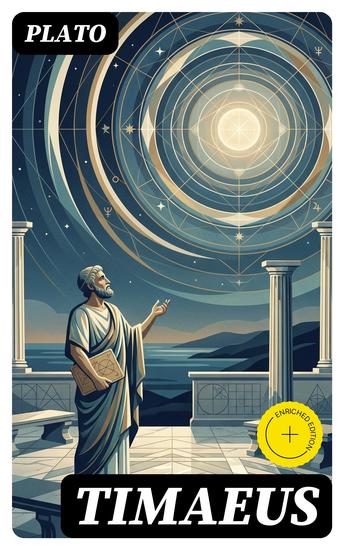
Timaeus - Enriched edition - cover

Timaeus - Enriched edition

Plato

Translator Benjamin Jowett

Publisher: DigiCat

  • 0
  • 0
  • 0

Summary

In "Timaeus," Plato presents a profound exploration of the cosmos, weaving together philosophical inquiry and natural science through the dialogue of Timaeus, Critias, and Socrates. At its core, the text delves into the nature of the universe, positing a world created by a divine craftsman and emphasizing the importance of mathematics in understanding reality. This work reflects Plato's innovative literary style, characterized by rich metaphors and allegorical narratives. Stylistically, it intertwines philosophical discourse with speculative cosmology, setting the stage for later developments in both metaphysics and natural philosophy. Plato, the eminent Athenian philosopher and student of Socrates, wrote "Timaeus" around 360 BCE, during a period that sought to reconcile myth with reason. His experiences in the tumultuous political landscape of Athens, coupled with the influence of Pythagorean thought, shaped his contemplation of the cosmos and the human condition. This work is not only a testament to his philosophical legacy but also reflects his intention to bridge the realms of science and spirituality. "Timaeus" is essential for anyone interested in the foundations of Western philosophy and science. It invites readers to engage in a deep intellectual journey that probes the essence of existence and the ordered beauty of the universe. Those seeking to understand the origins of philosophical discourse will find in Plato's text a timeless and illuminating source.

In this enriched edition, we have carefully created added value for your reading experience:
- A succinct Introduction situates the work's timeless appeal and themes.
- The Synopsis outlines the central plot, highlighting key developments without spoiling critical twists.
- A detailed Historical Context immerses you in the era's events and influences that shaped the writing.
- An Author Biography reveals milestones in the author's life, illuminating the personal insights behind the text.
- A thorough Analysis dissects symbols, motifs, and character arcs to unearth underlying meanings.
- Reflection questions prompt you to engage personally with the work's messages, connecting them to modern life.
- Hand‐picked Memorable Quotes shine a spotlight on moments of literary brilliance.
- Interactive footnotes clarify unusual references, historical allusions, and archaic phrases for an effortless, more informed read.
Available since: 05/28/2022.
Print length: 178 pages.

Other books that might interest you

  • The Complete Plato - cover

    The Complete Plato

    Plato

    • 0
    • 0
    • 0
    "The Safest General Characterization of the European Philosophical Tradition Is That It Consists of a Series of Footnotes to Plato."
    
    Plato did not just write philosophy; he invented the way the Western world thinks. As the prize pupil of Socrates and the teacher of Aristotle, Plato captured the birth of logic, ethics, and metaphysics in the form of dramatic, engaging dialogues. This comprehensive collection brings together his entire body of work, offering a timeless map for anyone seeking to understand justice, beauty, and the nature of reality itself.
    
    Inside this monumental collection, you will explore:
    
    The Socratic Method in Action: Experience the "Elenchus"—the art of the cross-examination—as Socrates systematically dismantles the assumptions of his peers to uncover deeper truths.
    
    The Theory of Forms: Delve into the radical idea that the physical world is merely a shadow of a higher, perfect reality, and learn how to train the mind to "see" beyond the surface.
    
    The Blueprint for the Just Society: Explore profound meditations on governance, the education of the "Philosopher King," and the delicate balance between individual freedom and social order.
    
    Ethics and the Human Soul: Engage with timeless inquiries into the nature of virtue, the immortality of the soul, and the pursuit of the "Good Life."
    
    Plato's writing remains as vital today as it was in the Academy of Athens. His dialogues are not dry lectures, but living debates that challenge the reader to participate in the search for wisdom. This volume is the essential cornerstone for any library of humanities, political science, and classical studies.
    
    Begin your journey toward the light. Buy "The Complete Plato" today and master the art of thinking.
    Show book
  • Formation of the United Nations The: The History of the Negotiations that Brought About the World’s Biggest International Organization - cover

    Formation of the United Nations...

    Charles River Editors

    • 0
    • 0
    • 0
    On November 29, 1943, as the Allies’ primary leaders met in Tehran, Roosevelt described to Stalin his idea for the organization that would become the United Nations. The American president suggested that the active arm of the organization be “the Four Policemen”: the U.S., USSR, UK, and China. Stalin agreed with much of the framework in principle, but asserted that China likely would not possess the strength after the war to assist. He also noted that the “Policemen” must hold a series of strong points, putting Germany and Japan at too much of a disadvantage to attempt military adventurism again. Roosevelt, eager to please his “friend,” agreed with everything Stalin said.  
    	That exchange might be considered the origin of the United Nations, one of the most famous bodies in the world, but the concept was already in existence in the form of its predecessor, the League of Nations. At the end of World War I, President Woodrow Wilson's pleas at the Paris Peace Conference relied on his Fourteen Points, which included the establishment of a League of Nations, but while his points were mostly popular amongst Americans and Europeans alike, leaders at the conference largely discarded them and favored different approaches. British leaders saw their singular aim as the maintenance of British colonial possessions. France, meanwhile, only wanted to ensure that Germany was weakened and unable to wage war again, and it too had colonial interests abroad that it hoped to maintain. Britain and France thus saw eye-to-eye, with both wanting a weaker Germany and both wanting to maintain their colonies. Wilson, however, wanted both countries to rid themselves of their colonies, and he wanted Germany to maintain its self-determination and right to self-defense. Wilson totally opposed the “war guilt” clause, which blamed the war on Germany.
    Show book
  • The Origin of Politics - How Evolution and Ideology Shape the Fate of Nations - cover

    The Origin of Politics - How...

    Nicholas Wade

    • 0
    • 0
    • 0
    Societies that ignore social disintegration and collapsing birth rates are putting their future in peril. So why are we ignoring the signs? 
    ?In The Origin Of Politics, Nicholas Wade explains how our political systems compete with a more ancient set of rules for organizing society—those developed by evolution. Modern ideologies are in constant tension with structures inherent in human social behavior, such as the family, the tribe, and male-dominated institutions.  
    This tension plays out in various ways. Sometimes nature prevails over politics, as in the proposal by Marx and Engels to eliminate the family, the basic unit of society. The founders of the kibbutz movement put this radical idea into practice, only to find that the conflict with human nature was unsustainable. In other cases, culture has successfully modified evolutionary behaviors, replacing polygamy with monogamy and dissolving the bonds of tribalism to make way for modern states.  
    But the evolutionary framework of human societies is not infinitely flexible. The nation-state, especially in the case of the United States, is prone to disintegration if disruptive ideologies are allowed to undermine the cohesive affinities that hold its disparate cultures together.  
    The worldwide decline in fertility in most countries except those in Africa signals a severe derangement in the behaviors evolution has devised for ensuring that a population will maintain itself. If the causes of this disruption cannot be understood and reversed, human societies will embark on an unsought path to extinction.  
    Other fraught issues in which human biology and politics conflict include the innate specializations of the sexes, the stratification of society by ability, and the mismatch between the inequalities of wealth-creating societies and the egalitarian ethic inherited from our hunter-gatherer ancestors. 
    We live in an iridescent bubble, the intoxicating richness of modern culture. Shielded from the natural world, we have lost our awareness of the evolutionary forces that still guide our motivations and shape the foundations of our societies. The Origin of Politics explores the risks of underestimating evolution’s fundamental role in human affairs. 
      
     
    Show book
  • God and the Brain - The Physiology of Spiritual Experience - cover

    God and the Brain - The...

    Andrew Newberg MD

    • 0
    • 0
    • 0
    Is it our biological destiny to seek the divine? Is faith in a higher power a survival trait? On God and the Brain, Dr. Andrew Newberg presents intriguing evidence that the human brain is a "believing machine"—and that our capacity for self-transcendence and spirituality helps drive our evolution as a species. 
    This pioneer of brain studies presents the first audio course on his groundbreaking research into the fascinating links between faith, neurobiology, and the mysteries of the psyche, including:  •  Why this emerging science enriches both the faithful and the skeptical  •  How prayer and meditation enhance your health—tips for tailoring a spiritual regimen that suits your individual needs  •  How the world's spiritual paths uniquely shape the brain and mind  •  The "myth-making brain"—the survival value of our storytelling and human imagination  •  The biology of forgiveness—why this critical spiritual skill is so important to your physical and psychological wellness 
    No matter what you believe—or don't believe—about God, the parts of your brain that manifest spiritual experience have a profound impact on your entire identity. With his balanced approach of spiritual wonder and scientific rigor, Dr. Andrew Newberg is a leader in exploring the uncharted territory where our human bodies overlap with our experience of the sacred. On God and the Brain, he shares core insights that will deepen your understanding of our most human gift—the experience of the divine. 
    Course objectives:  •  Describe how our spiritual beliefs and practices affect our physical and mental health  •  Compile a detailed account of the entire nervous system, the different areas of the brain and what they are responsible for, both physically and emotionally  •  Discuss the history of religion and how its importance and practices have shifted in the past century  •  Discuss the results of Newberg's studies of spirituality, and discuss why spirituality is hard to measure in a test-like hypothesis  •  Assess the basic ways in which spiritual practices differ from one another, and also how they share some common characteristics
    Show book
  • Motivated to Learn - How to motivate yourself for learning make starting to learn easier and keep motivation to learn - cover

    Motivated to Learn - How to...

    David Velthuis

    • 0
    • 0
    • 0
    Do you have a hard time motivating yourself to learn? Break through this barrier with simple and easy-to-use solutions for a more motivated lifestyle full of learning. 
    Does studying make you demotivated and bored? Do you dream of learning with ease? Do you want to make learning fun and effortless? I am David Velthuis, a student myself, and I struggled a lot to motivate myself when I was in University. I was addicted to video games and could not make myself study. Eventually, I needed to drop out of University. That is when I decided things needed to change. I stopped gaming, learned about motivation, started studying: my grades skyrocketed. And now I am here to help you motivate yourself to learn, before it is too late. 
    Motivated to Learn contains hands-on tips, strategies and exercises to boost your motivation. You’ll identify and remove barriers that hold you back from your unlimited learning potential. You’ll also learn how to make starting to learn easier, make and stick to a planning and keep your motivation to learn. 
    In Motivated to Learn, you’ll discover:How to find the perfect amount of study for youThe 5 ways to lower the barrier and make starting to learn easyThe truth about procrastinationThe 5 best planning tools and how to stick to themHow you can get excited to learn and make it fun againThe essential traits that make the perfect study partnerStrategies to create unlimited motivation and much, much more! 
    Even if you have no idea how motivation works, don’t worry this book contains easy-to-implement strategies which do not require any knowledge. And even if you failed to stick to all other motivational strategies before, this book shows how to stick with them and make a habit out of it. 
    Scroll up and buy Motivated to Learn to unleash your unlimited learning potential today!
    Show book
  • Sneak - Lesbian Shapeshifter Erotica - cover

    Sneak - Lesbian Shapeshifter...

    Giselle Renarde

    • 0
    • 0
    • 0
    A mouse shifter in a backwoods bordello falls for a cursed lady of the evening in this lesbian erotic romance. 
    Bess was born human in a backwoods brothel, but she's lived there as a mouse long enough to watch generations of girls come and go. Loralee’s the only one remaining to entertain cowboys who leave her with bruises and a fistful of cash. 
    Oh so many years ago, Bess sought Old Gertie's magic to avoid the fate Loralee now lives. Her little heart can't bear the torment those brutes impose on poor Loralee. She's got a plan to revisit her human form, but is Bess willing to come out of retirement in a career she never started?
    Show book