Join us on a literary world trip!
Add this book to bookshelf
Grey
Write a new comment Default profile 50px
Grey
Subscribe to read the full book or read the first pages for free!
All characters reduced
Meno - cover

Meno

Plato Plato

Publisher: Memorable Classics eBooks

  • 0
  • 0
  • 0

Summary

Meno by Plato Meno (/ˈmiːnoʊ/; Greek: Μένων, Ménōn) is a Socratic dialogue by Plato. Meno begins the dialogue by asking Socrates whether virtue is taught, acquired by practice, or comes by nature.

In order to determine whether virtue is teachable or not, Socrates tells Meno that they first need to determine what virtue is. When the characters speak of virtue, or rather arete, they refer to virtue in general, rather than particular virtues, such as justice or temperance. The first part of the work showcases Socratic dialectical style; Meno, unable to adequately define virtue, is reduced to confusion or aporia.

Socrates suggests that they seek an adequate definition for virtue together. In response, Meno suggests that it is impossible to seek what one does not know, because one will be unable to determine whether one has found it.

Socrates challenges Meno's argument, often called "Meno's Paradox" or the "Learner's Paradox," by introducing the theory of knowledge as recollection (anamnesis). As presented in the dialogue, the theory proposes that souls are immortal and know all things in a disembodied state; learning in the embodied is actually a process of recollecting that which the soul knew before it came into a body.

Socrates demonstrates recollection in action by posing a mathematical puzzle to one of Meno's slaves.Subsequently, Socrates and Meno return to the question of whether virtue is teachable, employing the method of hypothesis.

Near the end of the dialogue, Meno poses another famous puzzle, called "The Meno Problem" or "The Value Problem for Knowledge," which questions why knowledge is valued more highly than true belief. In response, Socrates provides a famous and somewhat enigmatic distinction between knowledge and true belief.
Available since: 06/01/2022.
Other books that might interest you

  • Constantinople - History of the Byzantine Empire’s Gigantic Capital - cover

    Constantinople - History of the...

    Kelly Mass

    • 0
    • 0
    • 0
    Constantinople, a city that witnessed the rise and fall of empires, served as the capital for three significant civilizations: the Roman/Byzantine Empire (330–1204 and 1261–1453), the Latin Empire (1204–1261), and the Ottoman Empire (1453–1922). Following the Turkish War of Independence, the capital was moved to Ankara, marking a new chapter in Turkish history. In 1930, the city was officially renamed Istanbul, which remains the Republic of Turkey’s largest city and financial center today. It is also the largest city in Europe. 
    In 324 AD, Emperor Constantine the Great made the fateful decision to transform the old city of Byzantium into a grand new capital, naming it "New Rome" and consecrating it on May 11, 330 AD. This strategic move solidified the city’s place in history, becoming the heart of the Eastern Roman Empire, later known as the Byzantine Empire. 
    Constantinople became a symbol of Orthodox Christianity, often referred to as the "cradle of Orthodox Christian civilization." The city's religious and cultural significance cannot be overstated; it was home to some of the most iconic architectural and religious sites in the Christian world. From the mid-fifth to the early-thirteenth century, Constantinople was Europe's largest, most affluent metropolis, a center of commerce, culture, and intellectual activity.
    Show book
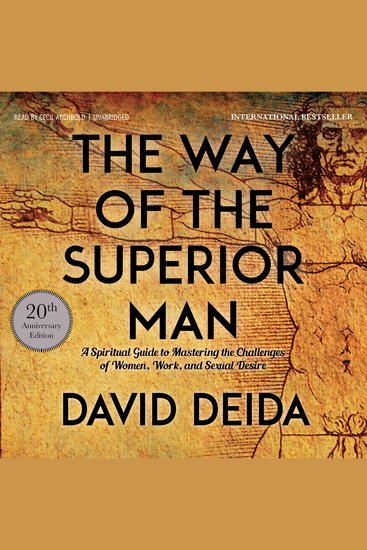
  • The Way of the Superior Man - A Spiritual Guide to Mastering the Challenges of Women Work and Sexual Desire (20th Anniversary Edition) - cover

    The Way of the Superior Man - A...

    David Deida

    • 0
    • 0
    • 0
    In the decades since the initial publication of The Way of the Superior Man, society has changed significantly. Issues of gender and sexuality long confined to secrecy have become part of everyday conversation, and rigid ideas about our societal roles have begun to dissolve.And yet, perhaps now more than at any time, men of all ages still “tussle with the challenges of women, work, and sexual desire.” In this unabridged audiobook of the classic guide to masculine spirituality, David Deida encourages men and women to lean into the conversation and offer their most valuable assets to the world—their authentic heart and depth of presence.More relevant than ever, The Way of the Superior Man offers a view of a more conscious and embodied masculinity. “It is time to evolve beyond the macho jerk ideal, all spine and no heart,” writes Deida. “It is also time to evolve beyond the sensitive and caring wimp ideal, all heart and no spine.”Including a new preface written in celebration of the book’s 20th anniversary, The Way of the Superior Man presents the next generation of with the opportunity to grapple with fear, cultivate trust in the moment, and put forth the best versions of themselves in an ever-changing world.Read by Cecil Archbold.
    Show book
  • The Secret Life of Leinster House - What you really need to know about how the country is run - cover

    The Secret Life of Leinster...

    Gavan Reilly

    • 0
    • 0
    • 0
    What is it like to run for election? How do public representatives deal with the cut-throat competition from their rivals – and their own running mates? What's the Dáil bar really like? And how, given the demands of the 24-hour news cycle, does any meaningful work get done?
    Political correspondent Gavan Reilly turns his keen analytical eye to the machinations of Leinster House. With unprecedented access to political insiders, Gavan offers us a seat at the cabinet table exposing how Irish politics really works.
    'If you want to understand, really understand, how Irish politics works behind the scenes, you should read this book' SHANE COLEMAN
    'This book has it all … the ultimate behind-the-curtain guide to the world of Irish politics' JENNIFER BRAY
    'Invaluable insights into the drama, demands and drudgery of politics … essential reading for anyone with ambitions' SEAN O'ROURKE
    Show book
  • Julius Caesar: A Captivating Guide to One of the Greatest Generals in Ancient Rome and His Role in the Fall of the Roman Republic and Rise of the Roman Empire - cover

    Julius Caesar: A Captivating...

    Captivating History

    • 0
    • 0
    • 0
    If you’ve ever been curious about ancient Rome and the time of Caesar but felt overwhelmed by the information available, this handy biography of Julius Caesar’s life might just be what you’ve been looking for. 
    By taking a broad and narrow focus, this volume is able to simultaneously give the reader a nice overview of the 1st century BCE while also honing in on the specifics of the famous leader as he makes his way up from the downtrodden neighborhood of his youth to eventually being named a god by the Roman people.  
    This audiobook is told in a straightforward, chronological fashion, so the reader is able to look at Caesar’s life in bite-sized chunks that inform without creating confusion. Caesar’s life happened in the midst of turbulent military and political intrigues. But he was also surrounded by numerous well-known figures from history. The interweaving of their tales not only makes for page-turning reading; it also gives the reader much to question, critique, and ponder. 
    This audiobook will satisfy your curiosity and hopefully inspire you to go out and learn even more. With handy comparisons to the modern world, the life of Rome and the ancient world will become more tangible and easier to imagine than ever before.  
    It’s time Caesar walked off the dusty shelves, out of the history books, and into our minds as the living, breathing, brilliant, sneaky, brave, and intriguing man he was. Take a trip like no other through the streets of ancient Rome, from the butcher shop to the throne, with the famous ruler himself as your guide. 
    Don’t miss adventure on the high seas, the danger on the battlefields, and love in ancient Egypt. Click the “add to cart” button to learn more about Julius Caesar!
    Show book
  • The White Pedestal - How White Nationalists Use Ancient Greece and Rome to Justify Hate - cover

    The White Pedestal - How White...

    Curtis Dozier

    • 0
    • 0
    • 0
    It is difficult to ignore the resurgence of white nationalist movements in the United States, many of which employ symbols and slogans from Greco-Roman antiquity. A long-established neo-Nazi website incorporates an image of the Parthenon into its logo, and rioters wore Spartan helmets in the January 6, 2021, attack on the United States Capitol. These juxtapositions may appear incongruous to people who associate the ancient world with enlightened political ideals and sophisticated philosophical inquiry. But, as Curtis Dozier points out in this thought-provoking book, it's hard to imagine a historical period better suited to rhetorical use by white nationalists. Indeed, some of the most widely admired voices from ancient literature and philosophy endorsed ideas that modern white supremacists promote, and the social and political realities of the ancient world provide models for political systems that white supremacists would like to establish today. Part introduction to contemporary white nationalist thought, part exploration of ancient racism and xenophobia, and part intellectual history of the political entanglements of academic study of the past, this book reveals that contemporary white nationalist intellectuals know much more about history than many people assume—and they deploy this knowledge with disturbing success.
    Show book
  • Sumerian Civilization The: An Enthralling Overview of Sumer and the Ancient Sumerians - cover

    Sumerian Civilization The: An...

    Enthralling History

    • 0
    • 0
    • 0
    How much do you know about the “cradle of civilization?” Come explore the legacy of the brilliant ancient Mesopotamians who transformed the world. 
    Ancient Mesopotamia’s legacy was truly revolutionary. Childlike pictures scratched into wet clay evolved into the first written language. The Mesopotamians wrote the first epic poems, the first hymns, the first histories, and the first law codes. They developed the first wheel for transportation; simple carts that hauled bricks or produce morphed into chariots racing along at thirty-five miles per hour. 
    They gazed at the sky and mapped it, observing the planets’ retrograde motions and predicting lunar and solar eclipses. They developed the concept of time, measurements, basic counting, higher math, and hydraulic engineering. 
    Mesopotamia gave birth to the world’s first great empires—the Akkadians, Assyrians, Babylonians, and Achaemenids—which stretched over three continents. 
    A glimpse at the questions this overview unpacks includes:How old is the world’s first city?How did the Eridu Genesis compare to Noah and the ark?How fast was the world’s first postal system?How many times did Babylon’s patron god Marduk get stolen?How did Hammurabi’s law code compare to the Law of Moses?Who calculated pi (π) to the value of 3.125 and understood the Pythagorean theorem twelve centuries before Pythagoras was born?Did Xerxes really have a million men in his army?Which empire encompassed 44 percent of the world’s population?What eunuch poisoned most of the Persian royal family?And much, much more! 
    Scroll up and click the “add to cart” button to learn the stories of incredible ancient Mesopotamia!
    Show book