Join us on a literary world trip!
Add this book to bookshelf
Grey
Write a new comment Default profile 50px
Grey
Subscribe to read the full book or read the first pages for free!
All characters reduced
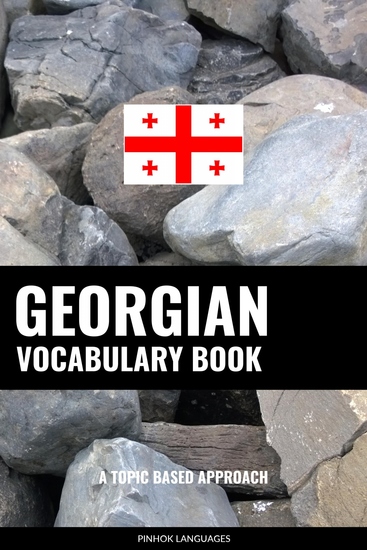
Georgian Vocabulary Book - A Topic Based Approach - cover

Georgian Vocabulary Book - A Topic Based Approach

Pinhok Languages

Publisher: Pinhok Languages

  • 0
  • 0
  • 0

Summary

Georgian vocabulary book + Georgian dictionaryThis Georgian vocabulary book contains more than 3000 words and phrases which are grouped by topic to make it easier for you to pick what to learn first. On top of that, the index in the second half of the book provides you with a basic Georgian-English as well as English-Georgian dictionary which makes this a great resource for learners of all levels.
 
What you can expect from this book:This Georgian learning resource is a combination of Georgian vocabulary book and a two-way basic Georgian dictionary:Part 1 - Topic based Georgian vocabulary book: This is the main part of the book and represents a list of chapters each containing Georgian vocabularies for a certain topic. The Georgian vocabularies in the chapters are unsorted on purpose to separate remembering them from a defined alphabetical order. You can start at any chapter and dive directly into the topics that interest you the most.Part 2 - Basic English-Georgian dictionary: The index in the second half of the book can be used as a basic Georgian dictionary to look up words you have learned but can't remember or learn new words you need.Part 3 - Basic Georgian-English dictionary: Easy to use and with just the right amount of words, this third part finishes off with a second index that allows you to look for Georgian words and directly find the English translation
 
How to use this Georgian vocabulary book:Not sure where to start? We suggest you first work your way through the verbs, adjectives and phrases chapters in part one of the book. This will give you a great base for further studying and already enough vocabulary for basic communication. The Georgian dictionaries in part two and three can be used whenever needed to look up words you hear on the street, English words you want to know the Georgian translation for or simply to learn some new words.
 
Some final thoughts:Vocabulary books have been around for centuries and as with so many things that have been around for some time, they are not very fashionable and a bit boring, but they usually work very well. Together with the basic Georgian dictionary parts, this vocabulary book is a great resource to support you throughout the process of learning Georgian and comes in particularly handy at times when there is no internet to look up words and phrases.
Available since: 11/17/2022.
Print length: 240 pages.

Other books that might interest you

  • On Writing (and Writers) - A Miscellany of Advice and Opinions - cover

    On Writing (and Writers) - A...

    C. S. Lewis

    • 0
    • 0
    • 0
    A definitive collection of wisdom on every style of writing and a celebration of the transformative power of the written word from one of the most influential writers and thinkers of the modern age, C. S. Lewis, the beloved author of the Chronicles of Narnia series, Mere Christianity, The Screwtape Letters, and other revered classics. 
    Featuring over one hundred excerpts—some short and some essay length—drawn from his wide body of letters, books, and essays, On Writing (and Writers) brings together C. S. Lewis’s reflections on the power, importance, and joy of a life dedicated to writing. 
    Writers and devoted readers will be enriched and inspired by Lewis’s commentary on a range of genres, including:On Good WritingOn Writing FictionOn Writing PoetryOn Writing for ChildrenOn Writing Science FictionOn Christian WritingOn Writing PersuasivelyOn Other Writers 
    Wise and practical, On Writing (and Writers) reveals Lewis’s thoughts on both mechanics and style, including choosing adjectives, the art of expression, how to connect with readers, and the core principles of clear, impactful writing. 
    A window into the mind of one of the greatest public intellectuals of the twentieth century—a gifted writer whose influence and insights remain relevant six decades after his death—this engaging collection reveals not only why Lewis loved the written word, but what it means to “gladly teach” the art of writing, so that wise readers can “gladly learn.” 
    Supplemental enhancement PDF accompanies the audiobook.
    Show book
  • Dutch Made Easy - Beginner - Volume 2 of 3 - cover

    Dutch Made Easy - Beginner -...

    Lingo Wave

    • 0
    • 0
    • 0
    We broke our new series on learning Dutch down into different learning stages. Start with the “Lower Beginner” books followed by the “Beginner” and “Upper Beginner” books. Next, progress to the “Intermediate” series, then test and reinforce your knowledge with the “Conversations” series. This audiobook is divided into units.While it provides different learning patterns and accommodates various needs, this audiobook focuses on helping you improve your ability to understand, speak, and memorise Dutch. The sample will give you a taste of what you can look forward to.  
    In Unit 1 you will hear Dutch decoded with each syllable spoken very slowly and clearly with repetition. Immediately before each sentence is spoken, you will hear the translation, so you will always understand what is being said. Unit 2 focuses solely on increasing your listening ability, which will improve your abilities to engage in dialogue with a native Dutch speaker. This chapter requires you to listen very carefully to nuances in the language.  
    By Unit 3 you will already notice progress in your abilities to speak and understand Dutch. The spoken translation is followed by two repetitions in Dutch at a completely natural speed. While you are learning to process naturally spoken Dutch, Units 3 and 4 will help you memorise new vocabulary and full sentences. In Unit 5 you can test yourself on how much you have learned. If you are having difficulties, we suggest you revisit the listening, speaking, or memorisation section of Units 1, 2 3 or 4, according to what you need more help with. 
    Topics covered in this book: 
    -Asking about family 
    -Asking about relationship status 
    -Expressing frequency 
    -Talking about spare time activities and hobbies 
    -Using quantifiers/determiners 
    -Talking about preference 
    -Talking about abilities 
    -Talking about location of places 
    -Describing appearance 
    -Talking about personality 
    -Talking about the weather 
    -Talking about being...
    Show book
  • Hungarian Made Easy - Lower beginner - Volume 1 of 3 - cover

    Hungarian Made Easy - Lower...

    Lingo Wave

    • 0
    • 0
    • 0
    We broke our new series on learning Hungarian down into different learning stages. Start with the “Lower Beginner” books followed by the “Beginner” and “Upper Beginner” books. Next, progress to the “Intermediate” series, then test and reinforce your knowledge with the “Conversations” series.  
    This audiobook is divided into units.While it provides different learning patterns and accommodates various needs, this audiobook focuses on helping you improve your ability to understand, speak, and memorise Hungarian. The sample will give you a taste of what you can look forward to.  
    In Unit 1 you will hear Hungarian decoded with each syllable spoken very slowly and clearly with repetition. Immediately before each sentence is spoken, you will hear the translation, so you will always understand what is being said. Unit 2 focuses solely on increasing your listening ability, which will improve your abilities to engage in dialogue with a native Hungarian speaker. This chapter requires you to listen very carefully to nuances in the language.  
    By Unit 3 you will already notice progress in your abilities to speak and understand Hungarian. The spoken translation is followed by two repetitions in Hungarian at a completely natural speed. While you are learning to process naturally spoken Hungarian, Units 3 and 4 will help you memorise new vocabulary and full sentences. In Unit 5 you can test yourself on how much you have learned. If you are having difficulties, we suggest you revisit the listening, speaking, or memorisation section of Units 1, 2 3 or 4, according to what you need more help with. 
    Topics covered in this book: 
    - Greeting 
    - Asking personal information 
    - Asking about people or things 
    - Talking about the current time and date 
    - Talking about the location of things 
    - Describing things  
    - Likes and dislikes 
    - Talking about abilities 
    - Talking about appearance 
    - Talking about personality 
    - Talking about the weather 
    - Talking about food 
    ...
    Show book
  • Introductory Turkish Language Course for Tourists An - cover

    Introductory Turkish Language...

    Mert Kaya

    • 0
    • 0
    • 0
    This 10 session course provides instruction in the key words and phrases for Tourists. Topics covered start with the basics of introductions, numbers and key questions and then cover a number of tourist scenarios including ordering in restaurants, travel, checking into a hotel and asking for and understanding. Repetition is used to reinforce learning, with a focus on words and phrases that can be easily put to use in lots of tourist situations when travelling to Turkey/Türkiye. This is the ideal way to learn to speak and understand key tourist vocabulary that you want to put to use on a visit to the enchanting destination of Turkey.
    Show book
  • Write Your Why (What Will Follow) - cover

    Write Your Why (What Will Follow)

    Julia Whelan

    • 0
    • 0
    • 0
    An approachable craft talk, written and read by Julia Whelan. Combining her perspectives as a writer, an educator, and a narrator, she breaks down what makes books connect with readers. Using Simon Sinek's seminal TedTalk for the business community, "Knowing Your Why", as a starting point, Julia applies this to the broader craft of storytelling: If you know why you are writing something, your audience will know why they're reading it. So... how does one do that? Originally presented as a keynote speech at Nashville's WriterFest. 
    Show book
  • 1000 Common Future Tense Verbs - Learn German Through Simple Sentences - cover

    1000 Common Future Tense Verbs -...

    Science-Based Language Learning Lab

    • 0
    • 0
    • 0
    Unlock German fluency with 1000 Common Future Tense Verbs: Learn German Through Simple Sentences. This guide is perfect for intermediate learners, introducing 1000 essential German verbs in future tense through clear, simple sentences. Each sentence includes an English translation, ideal for self-study or classroom use. Enhance your comprehension and communication skills by understanding these verbs in daily contexts. 
     
    Whether you're preparing for travel, boosting your career, or passionate about learning a new language, this book offers a solid foundation to advance your German skills. You'll expand your vocabulary and learn to use these verbs naturally in conversations, helping you speak confidently and understand native speakers. 
     
    Features: 
     
    - 1000 common German verbs in practical sentences 
     
    - Accurate English translations for each sentence 
     
    - Suitable for beginners and intermediate learners 
     
    - Improves vocabulary, comprehension, and conversation skills 
     
    - Great for self-study, travel, or classroom use 
     
    Start your German learning journey today. 1000 Common Future Tense Verbs: Learn German Through Simple Sentences is your essential guide to mastering one of the world's most widely spoken languages.
    Show book