Rejoignez-nous pour un voyage dans le monde des livres!
Ajouter ce livre à l'électronique
Grey
Ecrivez un nouveau commentaire Default profile 50px
Grey
Abonnez-vous pour lire le livre complet ou lisez les premières pages gratuitement!
All characters reduced
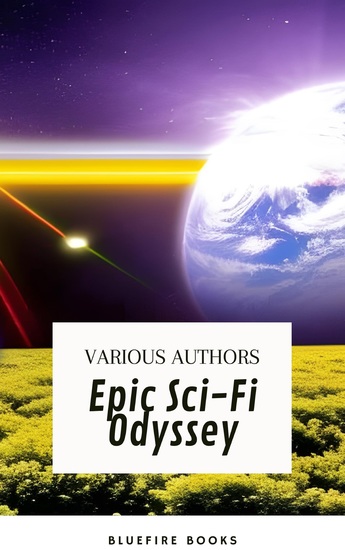
Epic Sci-Fi Odyssey - A Premium Collection of Classic Science Fiction Novellas and Short Stories - cover

Epic Sci-Fi Odyssey - A Premium Collection of Classic Science Fiction Novellas and Short Stories

Philip K. Dick, Harry Harrison, Murray Leinster, Lester Del Rey, Andre Norton, Marion Zimmer Bradley, Ben Bova, Fritz Leiber, Bluefire Books

Maison d'édition: Bluefire Books

  • 0
  • 0
  • 0

Synopsis

Dive into the realm of cosmic wonder and galactic intrigue with our collection, "Epic Sci-Fi Odyssey". This immersive e-book gathers together a remarkable anthology of classic science fiction works from the greatest authors of the genre. Journey through unknown worlds with legendary scribes like Murray Leinster, Ray Bradbury, Frederik Pohl, and Philip K. Dick, among others. From gripping space exploration stories like "The Sentimentalists" to dystopian narratives such as "Death Wish", the collection spans a rich tapestry of Science Fiction. This compendium encapsulates humanity's eternal fascination with the cosmos and our place within it. It is a must-have for any ardent reader, offering a chance to encounter the gems of the science fiction genre. Whether you are a long-time fan of science fiction or just discovering its magic, "Epic Sci-Fi Odyssey" is your gateway to the grand adventure that awaits beyond the stars.

This book now contains several HTML tables of contents that will make reading a real pleasure!

The Sentimentalists, by Murray Leinster
The Girls from Earth, by Frank Robinson
The Death Traps of FX-31, by Sewell Wright
Song in a minor key, by C.L. Moore
Sentry of the Sky, by Evelyn E. Smith
Meeting of the Minds, by Robert Sheckley
Junior, by Robert Abernathy
Death Wish, by Ned Lang
Dead World, by Jack Douglas
Cost of Living, by Robert Sheckley
Aloys, by R.A. Lafferty
With These Hands, by C.M. Kornbluth
What is POSAT?, by Phyllis Sterling-Smith
A Little Journey, by Ray Bradbury
Hunt the Hunter, by Kris Neville
Citizen Jell, by Michael Shaara
Operation Distress, by Lester Del Rey
Syndrome Johnny, by Charles Dye
Psychotennis, anyone?, by Lloyd Williams
Prime Difference, by Alan Nourse
Doorstep, by Keith Laumer
The Drug, by C.C. MacApp
An Elephant For the Prinkip, by L.J. Stecher
License to Steal, by Louis Newman
The Last Letter, by Fritz Lieber
The Stuff, by Henry Slesar
The Celestial Hammerlock, by Donald Colvin
Always A Qurono, by Jim Harmon
Jamieson, by Bill Doede
A Fall of Glass, by Stanley Lee
Shatter the Wall, by Sydney Van Scyoc
Transfer Point, by Anthony Boucher
Thy Name Is Woman, by Kenneth O'Hara
Twelve Times Zero, by Howard Browne
All Day Wednesday, by Richard Olin
Blind Spot, by Bascom Jones
Double Take, by Richard Wilson
Field Trip, by Gene Hunter
Larson's Luck, by Gerald Vance
Navy Day, by Harry Harrison
One Martian Afternoon, by Tom Leahy
Planet of Dreams, by James McKimmey
Prelude To Space, by Robert Haseltine
Pythias, by Frederik Pohl
Show Business, by Boyd Ellanby
Slaves of Mercury, by Nat Schachner
Sound of Terror, by Don Berry
The Big Tomorrow, by Paul Lohrman
The Four-Faced Visitors of…Ezekiel, by Arthur Orton
The Happy Man, by Gerald Page
The Last Supper, by T.D. Hamm
The One and the Many, by Milton Lesser
The Other Likeness, by James Schmitz
The Outbreak of Peace, by H.B. Fyfe
The Skull, by Philip K. Dick
The Smiler, by Albert Hernhunter
The Unthinking Destroyer, by Roger Phillips
Two Timer, by Frederic Brown
Vital Ingredient, by Charles De Vet
Weak on Square Roots, by Russell Burton
With a Vengeance, by J.B. Woodley
Zero Hour, by Alexander Blade
The Great Nebraska Sea, by Allan Danzig
The Valor of Cappen Varra, by Poul Anderson
A Bad Day for Vermin, by Keith Laumer
Hall of Mirrors, by Frederic Brown
Common Denominator, by John MacDonald
Doctor, by Murray Leinster
The Nothing Equation, by Tom Godwin
The Last Evolution, by John Campbell
A Hitch in Space, by Fritz Leiber
On the Fourth Planet, by J.F. Bone
Flight From Tomorrow, by H. Beam Piper
Card Trick, by Walter Bupp
The K-Factor, by Harry Harrison
The Lani People, by J. F. Bone
Advanced Chemistry, by Jack Huekels
Sodom and Gomorrah, Texas, by R. A. Lafferty
Keep Out, by Frederic Brown
All Cats are Gray, by Andre Norton
A Problem in Communication, by Miles J. Breuer
The Terrible Tentacles of L-472, by Sewell Peaslee Wright
Maroone
Disponible depuis: 12/06/2023.
Longueur d'impression: 3983 pages.

D'autres livres qui pourraient vous intéresser

  • The Big Bull -Rakesh Jhunjhunwala - cover

    The Big Bull -Rakesh Jhunjhunwala

    Aman Redhu

    • 0
    • 0
    • 0
    438 Rakesh Jhunjhunwala on the 2022 Billionaires - Investor with a Midas touch, Rakesh Jhunjhunwala, who passed away in August 2022, was often referred
    Voir livre
  • 50 Oscar Nights - Iconic Stars & Filmmakers on Their Career-Defining Wins - cover

    50 Oscar Nights - Iconic Stars &...

    Dave Karger

    • 0
    • 0
    • 0
    An exclusive look behind the scenes of the Academy Awards as top stars and filmmakers discuss their Oscar wins and tell never-before-told tales of Hollywood's biggest night, in a collection of original interviews with Turner Classic Movies host and entertainment media journalist Dave Karger. For almost a century, movie fans have been riveted by the Academy Awards and the stars who have won Oscars. 50 Oscar Nights takes readers behind the scenes of Hollywood’s most storied awards show through new and exclusive interviews with dozens of A-list actors, filmmakers, and craftspeople spanning sixty years of the Oscars. Here these artists reflect on their winning work and recount all the details of how they got ready, how they felt when they heard their name and got up on stage to accept their award, what they wore, how the entire experience impacted their life, and more. Some interviews bring to light fun stories like why Hilary Swank decided to celebrate her Academy Award at the Astro Burger in West Hollywood, or insight into the work as Elton John explains why he was convinced he won his Best Original Song award for the wrong tune. Other interviews illuminate why for some honorees, such as Julia Roberts, John Legend, and Octavia Spencer, the day remains a life highlight to be treasured, while for Marlee Matlin, Mira Sorvino, and Barry Jenkins, complex emotions cloud what most think would be a purely celebratory moment. Filled with more than 150 photos of red-carpet moments, emotional acceptances, and after-party play, 50 Oscar Nights is both a stunning record of cinema glamour and a must-read for any movie lover.  Full list of interviewees: Nicole Kidman, Elton John, Jennifer Hudson, Steven Spielberg, Jane Fonda, Barry Jenkins, Halle Berry, J. K. Simmons, Julia Roberts, John Legend, Rita Moreno, Martin Scorsese, Marlee Matlin, Dustin Hoffman, Hannah Beachler, Cameron Crowe, Mira Sorvino, Kevin O’Connell, Sally Field, Kristen Anderson-Lopez and Robert Lopez, Eddie Redmayne, Lee Grant, Louis Gossett Jr., Hilary Swank, Clint Eastwood, Jessica Yu, Michael Douglas, Catherine Martin, Francis Ford Coppola, Allison Janney, Mel Brooks, Emma Thompson, Peter Jackson, Marcia Gay Harden, Mark Bridges, Sofia Coppola, Joel Grey, Glen Hansard and Markéta Irglová, Olivia Colman, Rob Epstein, Whoopi Goldberg, Alan Menken, Melissa Etheridge, Sissy Spacek, Keith Carradine, Estelle Parsons, Geoffrey Fletcher, Octavia Spencer, Aaron Sorkin, Meryl Streep
    Voir livre
  • A Reading of the Inaugural Address of President Theodore Roosevelt - cover

    A Reading of the Inaugural...

    President Theodore Roosevelt

    • 0
    • 0
    • 0
    Theodore Roosevelt (October 27, 1858 - January 6, 1919) was the 26th president of the United States, serving from 1901 to 1909. Roosevelt was previously involved in New York politics, including serving as the state's 33rd governor for two years. He later served as the 25th vice president under President William McKinley for six months in 1901, assuming the presidency after McKinley's assassination. As president, Roosevelt emerged as a leader of the Republican Party and became a driving force for anti-trust and Progressive policies. The following is a reading of President Roosevelt's inaugural address delivered on March 04, 1905.
    Voir livre
  • Ice Age The: The History and Legacy of the Glacial Period during the Pleistocene Era - cover

    Ice Age The: The History and...

    Editors Charles River

    • 0
    • 0
    • 0
    The early history of Earth covers such vast stretches of time that years, centuries, and even millennia become virtually meaningless. Instead, paleontologists and scientists who study geochronology divide time into periods and eras.  
    	What humans commonly refer to as the “Ice Age” is actually a series of fluctuating climate events that have occurred throughout the planet’s history. These ongoing historical phenomena are difficult to conceptualize because of both the time frame involved and the natural process by which they cyclically unfold. The Earth’s climatic clock repeats the maneuver over millions of years per occurrence, a number that is intellectually graspable, but not viscerally well-perceivable by most members of the human race. The process by which ice ages form is not relevant to any societal function, and therefore remains a mystery. Those who attempt to define it are often met with either apathy or defiant superstition. 
    	As a basic definition, it may be said that an ice age is simply a period of time during which thick ice sheets cover vast areas of land. These sheets have advanced and retreated, at times taking over the entire planet, and conversely disappearing nearly altogether. Glacial ice formed by this regularly occurring process does not sit in a state of inertia, but moves dynamically, reshaping the geological features of the continents. Again, the time frame for glacial movement is far longer than any involving human activity, so close attention must be paid in order to correctly measure and interpret it for the modern day. 
    Voir livre
  • J Dilla's Donuts - cover

    J Dilla's Donuts

    Jordan Ferguson

    • 0
    • 0
    • 0
    From a Los Angeles hospital bed, equipped with little more than a laptop and a stack of records, James “J Dilla” Yancey crafted a set of tracks that would forever change the way beatmakers viewed their artform. The songs on Donuts are not hip hop music as “hip hop music” is typically defined; they careen and crash into each other, in one moment noisy and abrasive, gorgeous and heartbreaking the next. The samples and melodies tell the story of a man coming to terms with his declining health, a final love letter to the family and friends he was leaving behind. As a prolific producer with a voracious appetite for the history and mechanics of the music he loved, J Dilla knew the records that went into constructing Donuts inside and out. He could have taken them all and made a much different, more accessible album. If the widely accepted view is that his final work is a record about dying, the question becomes why did he make this record about dying?Drawing from philosophy, critical theory and musicology, as well as Dilla’s own musical catalogue, Jordan Ferguson shows that the contradictory, irascible and confrontational music found on Donuts is as much a result of an artist’s declining health as it is an example of what scholars call “late style,” placing the album in a musical tradition that stretches back centuries.
    Voir livre
  • It Can’t Rain All the Time - The Crow - cover

    It Can’t Rain All the Time - The...

    Alisha Mughal

    • 0
    • 0
    • 0
    A passionate analysis of the ill-fated 1994 film starring the late Brandon Lee and its long-lasting influence on action movies, cinematic grief, and emotional masculinity
    		 
    Released in 1994, The Crow first drew in audiences thanks to the well-publicized tragedy that loomed over the film: lead actor Brandon Lee had died on set due to a mishandled prop gun. But it soon became clear that The Crow was more than just an accumulation of its tragic parts. The celebrated critic Roger Ebert wrote that Lee’s performance was “more of a screen achievement than any of the films of his father, Bruce Lee.”
    		 
    In It Can’t Rain All the Time, Alisha Mughal argues that The Crow has transcended Brandon Lee’s death by exposing the most challenging human emotions in all their dark, dramatic, and visceral glory, so much so that it has spawned three sequels, a remake, and an intense fandom. Eric, our back-from-the-dead, grieving protagonist, shows us that there is no solution to depression or loss, there is only our own internal, messy work. By the end of the movie, we realize that Eric has presented us with a vast range of emotions and that masculinity doesn’t need to be hard and impenetrable.
    		 
    Through her memories of seeking solace in the film during her own grieving period, Alisha brilliantly shows that, for all its gothic sadness, The Crow is, surprisingly and touchingly, a movie about redemption and hope.
    		 
    About the Pop Classics Series
    		 
    Short books that pack a big punch, Pop Classics offer intelligent, fun, and accessible arguments about why a particular pop phenomenon matters.
    Voir livre