Rejoignez-nous pour un voyage dans le monde des livres!
Ajouter ce livre à l'électronique
Grey
Ecrivez un nouveau commentaire Default profile 50px
Grey
Abonnez-vous pour lire le livre complet ou lisez les premières pages gratuitement!
All characters reduced
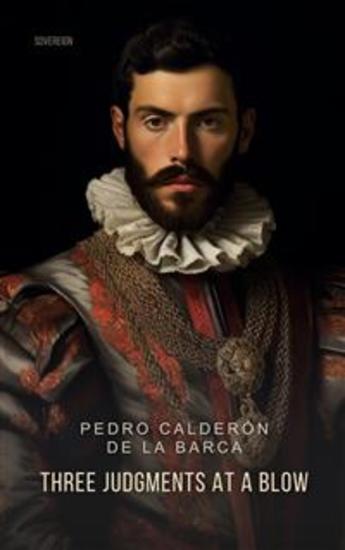
Three Judgments at a Blow - cover

Three Judgments at a Blow

Pedro Calderon de la Barca

Maison d'édition: Interactive Media

  • 0
  • 0
  • 0

Synopsis

"Three Judgments at a Blow" by Pedro Calderón de la Barca is a Spanish play. A king's decree sends a witty shoemaker on a journey of three tasks, testing his resourcefulness. With humor and clever wordplay, Calderón explores themes of justice, wit, and societal hierarchy. The shoemaker's triumphs reveal human ingenuity, highlighting the power of the common man. This comic tale, through entertaining plot twists and allegorical elements, imparts a message of wisdom and resilience.
Disponible depuis: 20/08/2023.
Longueur d'impression: 62 pages.

D'autres livres qui pourraient vous intéresser

  • Richard III - cover

    Richard III

    E.A. Copen, Pierre Arthur Laure,...

    • 0
    • 0
    • 0
    Brilliantly manipulative and entirely amoral, the hero-villain Richard is one of Shakespeare's greatest roles. 
    The Yorkists have emerged victorious from the civil wars and Edward IV wears the English crown. But Edward's misshapen brother Richard harbors kingly ambitions and will stop at nothing to achieve the throne. In a fatal battle on Bosworth Field, Richard meets the ghosts of all whom he has murdered and the Earl of Richmond, the future King Henry VII. 
    Richard III is played by David Troughton. Saskia Wickham plays Lady Anne, Margaret Robertson plays Queen Margaret, and Philip Voss is Buckingham.
    Voir livre
  • The Role of the Moon - Poems - cover

    The Role of the Moon - Poems

    D.S. Martin

    • 0
    • 0
    • 0
    A compelling, imagined dialogue with some of the most beloved Christian poets 
    
     
    GOLD MEDAL WINNER - Illumination Book Award
    
    
    Step into a captivating poetic conversation that spans centuries. The Role of the Moon explores the timeless themes of faith, loss, transcendence, human struggle, and renewal, echoing John Donne, George Herbert, and other 17th-century metaphysical poets. 
    
    In vivid dialogue with John Milton, William Shakespeare, Gerard Manley Hopkins, Emily Dickinson, Elizabeth Barrett Browning, and many others, D.S. Martin engages them in our modern world. A "new metaphysical" voice emerges, connecting the past to the present with wit, poignancy, and striking originality. 
    
    Perfect for readers who enjoy poetry and literature as a spiritual pursuit, this collection invites you to explore the beauty and power of classic Christian poetry in a fresh and modern way. 
    Voir livre
  • Henry IV Part One - cover

    Henry IV Part One

    Pierre Arthur Laure, Tom...

    • 0
    • 0
    • 0
    This play introduces Shakespeare’s greatest comedic character, the dissolute knight Sir John Falstaff. 
    While King Henry’s England is threatened by rebellion, the king’s scapegrace son Hal haunts the taverns of London, his companions a crew of rogues and thieves let by Falstaff. The earl of Northumberland and his fiery son Hotspur scheme to overthrow the crown. Can Hal be brought to a sense of duty as Prince of Wales? Or will the influence of Falstaff prove too strong? The issue is decided when Hal, Hotspur, and Falstaff come together at the climactic battle of Shrewsbury. 
    Hal is played by Jamie Glover and King Henry by Julian Glover. Richard Griffiths is Falstaff. 
    ACT IScene 1. King Henry’s plans to lead a crusade to the Holy Land are frustrated when he hears that an English army under Edmund Mortimer has been defeated by the Welsh chieftan Owen Glendower. Henry reveals that Harry Percy, known as Hotspur, has defeated the Scottish Earl of Douglas in battle. Thinking of his son, unruly Hal, the King envies the valiant Hotspur’s father, the Lord Northumberland. The King’s council is to convene on the following Wednesday when Hotspur will be made to account for his giving the king only one of his hostages.Scene 2. Ned Poins tries to persuade Prince Hal and his friend, the debauched knight Sir John Falstaff, to take part in a robbery at Gadshill. The Prince reuses but is finally persuaded by Poins, who has a secret scheme to expose Falstaff for the coward he is. Once alone, Hal muses on his unprincely behavior, comparing himself to the sun, who allows himself to be covered by the clouds, only to appear more brilliant when he emerges from the “ugly mists.”Scene 3. King Henry angrily dismisses Worcester when the Earl reminds him that it was his family that first put Henry on the throne. Hotspur claims that his irritation at the arrival of a foppish courtier on the battlefield has been misinterpreted as a refusal to give up prisoners to the king. However, he will only agree to surrender them if the King ransoms Mortimer, Hotspur’s brother-in-law. Henry is incensed: Mortimer, he says, is a traitor, having married his captor Owen Glendower’s daughter. Unmoved by Hotspur’s impassioned defense of Mortimer, he warns, “Send us your prisoners, or you will hear of it.” Northumberland restrains the enraged Hotspur. Worcester reminds them that the King’s hostility to Mortimer stems from the fact that he, not Henry, is Richard II’s rightful heir. When Hotspur finally calms down, his uncles suggests that they raise a rebellion against the King, relying on the support of Glendower, Douglas, Mortimer, and the Archbishop of York. 
    ACT IIScene 1. Gadshill hears that there are wealthy travelers on the road: an ideal prey for their planned robbery.Scene 2. Falstaff and his cronies rob the travelers, and are, in turn, assaulted by Hal and Poins, who are in disguise.Scene 3. Hotspur’s wife Kate begs him to tell her why he is so abstracted, but he warns her not to question him further.Scene 4. Prince Hal is relaxing in an Eastcheap tavern when Falstaff arrives and recounts how he fought off eleven men. When Hal reveals that the two assailants were, in fact, Poins and himself, Falstaff is unabashed, claiming that he recognized Hal all along, and would not have killed the heir apparent. A messenger arrives from the King, summoning the Prince to court in the morning: the rebels are rising. Hal is concerned at the prospect of being horribly “chid” by his father the king but Falstaff persuades him to practice an answer. A Sheriff arrives to arrest Falstaff for his part in the robbery, but Hal lies to protect his friend. The stolen money, he says, will be paid back with interest. 
    ACT IIIScene 1. The rebels gather at Glendower’s castle in Wales. Hotspur and Glendower quarrel over the division of the Kingdom, though Hotspur is finally pacified. The wives of Hotspur and Mortimer enter and the rebels seem at amity.Scene 2. The king
    Voir livre
  • Pandora's Box - cover

    Pandora's Box

    Frank Wedekind

    • 0
    • 0
    • 0
    Pandora's Box (1904) (Die Büchse der Pandora) is a play by the German dramatist Frank Wedekind. It forms the second part of his pairing of 'Lulu' plays (the first is Earth Spirit [1895]), both of which depict a society "riven by the demands of lust and greed". G. W. Pabst directed a silent film version (Pandora's Box), which was loosely based on the play, in 1929. Both plays together also formed the basis for the opera Lulu by Alban Berg in 1935 (premiered posthumously in 1937). In the original manuscript, dating from 1894, the 'Lulu' drama was in five acts and subtitled 'A Monster Tragedy'. Wedekind subsequently divided the work into two plays: Earth Spirit (German: Erdgeist, first printed in 1895) and Pandora's Box (German: Die Büchse der Pandora). It is now customary in theatre performances to run the two plays together, in abridged form, under the title Lulu. Wedekind is known to have taken his inspiration from at least two sources: the pantomime Lulu by Félicien Champsaur, which he saw in Paris in the early 1890s, and the sex murders of Jack the Ripper in London in 1888. The premiere of Pandora's Box, a restricted performance due to difficulties with the censor, took place in Nuremberg on 1 February 1904. The 1905 Viennese premiere, again restricted, was instigated by the satirist Karl Kraus. In Vienna Lulu was played by Tilly Newes, later to become Wedekind's wife, with the part of Jack the Ripper played by Wedekind himself. (Summary by Wikipedia)CastLulu: Amanda FridayAlva Schon: Chuck WilliamsonSchigolch: Alan MapstoneRodrigo Quast/Kungu Poti: WupperhippoAlfred Hugenberg: Charlotte DuckettCountess Geschwitz: Caprisha PageBianetta/Kadidia: Sally McLudmilla Steinherz/Narrator: Elizabeth KlettMagelone: Margaret EspaillatCount Casti Piani: Algy PugPuntschu: Alan WeymanHeilmann/Dr. Hilti: balaBob: rookieblueDetective: Grendel B. LightyearJack: Bob GonzalezAudio editing: Chuck Williamson
    Voir livre
  • Steps Forward - Based on a True Story - cover

    Steps Forward - Based on a True...

    Christina Fanelli

    • 0
    • 0
    • 0
    Rosa Santori has always been a rebel, refusing to conform to the limitations placed upon her. But when a car accident changes her life forever, she must fight for survival and find a new path forward. 
    As a psychology intern at Remington Hospital, Laura Falifax is eager to prove herself. But her husband's resentment and sabotage threaten to hold her back. 
    When Laura meets Rosa, their worlds collide, and they both find themselves in a place where struggle becomes motivation. But can they overcome their differences and work together, or will life's obstacles hinder their growth?
    Voir livre
  • A Piece of Work - cover

    A Piece of Work

    Felix Samual

    • 0
    • 0
    • 0
    This audiobook is narrated by an AI Voice.  
    a young woman's visit to a successful artist's gallery gets rather strange
    Voir livre