Join us on a literary world trip!
Add this book to bookshelf
Grey
Write a new comment Default profile 50px
Grey
Subscribe to read the full book or read the first pages for free!
All characters reduced
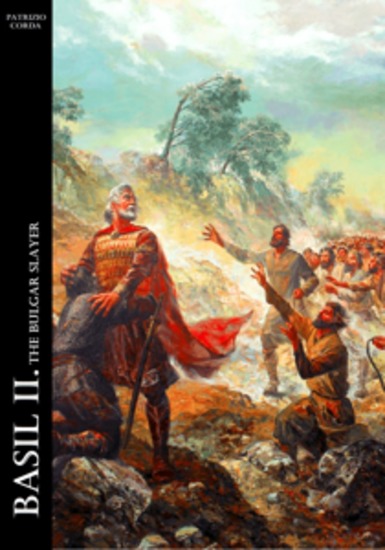
Basil II The Bulgar Slayer - cover

Basil II The Bulgar Slayer

Patrizio Corda

Publisher: Patrizio Corda

  • 0
  • 0
  • 0

Summary

969 AD. - Despite being the rightful heir to the throne, the prospects for Basil are not the best. Complicit in the maneuvers of his mother Teophano, wife, mother and creator of emperors, his childhood years are spent in the shadows.
The situation will not change even after his ascension, due to the intrusions of his great-uncle and grand chamberlain Basil Lecapenus.
Only after ridding himself of these encroaching influences will Basil succeed in fulfilling his destiny, becoming one of the best Byzantine emperors ever as well as the longest-ruling among all.
In his forty-nine-year reign he will will change the face of the Eastern Empire, thanks to far-sighted laws and countless wars won.
It will be only one of these, however, that will make his life a legend to be handed down to posterity.
The legend of the basileus Basil II, known as the Bulgar Slayer. The exterminator of Bulgarians.
Available since: 11/12/2024.

Other books that might interest you

  • Residual Governance - How South Africa Foretells Planetary Futures - cover

    Residual Governance - How South...

    Gabrielle Hecht

    • 0
    • 0
    • 0
    In Residual Governance, Gabrielle Hecht dives into the wastes of gold and uranium mining in South Africa to explore how communities, experts, and artists fight for infrastructural and environmental justice. Hecht outlines how mining in South Africa is a prime example of what she theorizes as residual governance—the governance of waste and discard, governance that is purposefully inefficient, and governance that treats people and places as waste and wastelands. She centers the voices of people who resist residual governance and the harms of toxic mining waste to highlight how mining's centrality to South African history reveals the links between race, capitalism, the state, and the environment. In this way, Hecht shows how the history of mining in South Africa and the resistance to residual governance and environmental degradation is a planetary story: the underlying logic of residual governance lies at the heart of contemporary global racial capitalism and is a major accelerant of the Anthropocene.
    Show book
  • Empire of the United States The: Forged by the Spirit of God in Man - cover

    Empire of the United States The:...

    Martin K. Ettington

    • 0
    • 0
    • 0
    In the United States of America today we live in a time of problems, confusion, and with lots of fighting between the main political parties. 
    Yet, people from all over the world still want to come here. 
    Why do so many persons still want to become Americans? I think it is because the United States has become the guiding star for the growth of humanity, now and in the future. People see their best futures to be here. 
    There is nowhere else that the rights our citizens possess allow many to go from being penniless to a multimillionaire in their lifetimes. And the provisions of freedom of religion and freedom of speech are important to our full expression as human beings. 
    But most American citizens despair about their lives, and the future of our country. Due to our poor educational system many don’t know the true history of this country and how it was formed to spread the Spirit of God in our country and around the world. 
    And what about new industries created here in the USA? In fact can anyone name a new industry which was not created here? 
    The purpose of this book is to show how the Spirit of God in man during the history of United States of America has made a huge positive difference in our world. 
    We should be extremely proud of the country we live in. 
    The United States was the light of the world in the past, is still in the present, and will continue to be so in the future.
    Show book
  • New Welsh Review 136 (winter 2024) - East Asia - cover

    New Welsh Review 136 (winter...

    Lafcadio Hearn, Jayne Joso,...

    • 0
    • 0
    • 0
    EDITORIAL by Gwen Davies
    
    
    EAST ASIAN LITERATURE
    
    
    'The River Claims Its Debt' – Story by Phước Tiến, translated from the Vietnamese by Nguyễn An Lý
    
    'Powder to the People! The philosophy of Hokkaido capitalist ski bum, Jack Philips' – Biography/oral history by Susan Karen Burton
    
    'Hi-Mawari', the lost Welsh story of Lafcadio Hearn (alias Koizumi Yakumo) –Translated from the Japanese
    
    Jayne Joso on how Japan shapes her work
    
    
    FURTHER FICTION
    
    
    'The Banana Banshee' – Story by Deidre Brennan, translated from the Irish by the author
    
    
    REVIEW-ESSAYS
    
    
    Steven Lovatt on restoring natural and cultural ecologies in the work of Ruth Bidgood, Rae Howells and Carwyn Graves
    
    JL George on trauma and the magical child in recent novels by Lloyd Markham, Carly Holmes and Vajra Chandrasekera
    Show book
  • Economic Landscape of Puerto Rico - Historical Perspectives - cover

    Economic Landscape of Puerto...

    Anya Solace

    • 0
    • 0
    • 0
    Puerto Rico’s economic landscape has been shaped by centuries of historical, political, and social transformations. From the indigenous societies that first inhabited the island to its complex relationship with Spain and the United States, the economy has evolved in response to shifting global and regional forces. Understanding Puerto Rico’s economic foundations requires an examination of its early economic structures, the colonial period’s trade policies, and the profound effects of U.S. annexation. These key moments set the stage for the challenges and opportunities that have defined the island’s development.  
    Before European colonization, the indigenous Taíno people sustained themselves through subsistence agriculture, fishing, and trade with neighboring Caribbean islands. Their economy, though not based on large-scale commerce, was well-adapted to the island’s resources. With the arrival of the Spanish in 1493, Puerto Rico was integrated into Spain’s mercantilist system, marking the beginning of an economic transformation that would prioritize colonial extraction over local prosperity. The Spanish introduced new crops such as sugarcane and coffee, which would later become vital to the island’s economy. However, strict trade regulations limited Puerto Rico’s ability to develop independently, as it was required to conduct commerce exclusively with Spain.  
    During the 18th and 19th centuries, Puerto Rico transitioned into a plantation-based economy, with sugar and coffee emerging as dominant industries. Enslaved Africans and later immigrant laborers contributed to the agricultural boom, making the island a key supplier to European and American markets. Despite periods of growth, the economy remained vulnerable to global price fluctuations, natural disasters, and restrictive colonial policies. By the time of the Spanish-American War in 1898, Puerto Rico’s economy was still largely agrarian, with limited industrial development.
    Show book
  • A Genocide Foretold - Reporting on Survival and Resistance in Occupied Palestine - cover

    A Genocide Foretold - Reporting...

    Chris Hedges

    • 0
    • 0
    • 0
    A Genocide Foretold confronts the stark realities of life under siege in Gaza and the heroic effort ordinary Palestinians are waging to resist and survive. Weaving together personal stories, historical context, and unflinching journalism, Chris Hedges provides an intimate portrait of systemic oppression, occupation, and violence. The book includes chapters on: 


    ● What life is like in Gaza City and Ramallah in the midst of approaching bombs and gunfire. 


    ● The history of the dispossession of Palestinians of their land in relation to the ideology of Zionism. 


    ● A portrait of Amr, a seventeen-year-old high school student who is forced to evacuate his village with his family. 


    ● Psychoanalysis of the state of permanent war that has led to the destruction of hospitals, telecommunications centers, governmental buildings, roads, homes universities, schools, and libraries and archaeological and heritage sites in Gaza. 


    ● The ways in which the collective retribution against innocents is a familiar tactic employed by colonial rulers. 


    ● A heartbreaking final chapter called "Letter to the Children of Gaza."
    Show book
  • The New Slave Masters - cover

    The New Slave Masters

    George Dallas McKinney

    • 0
    • 0
    • 0
    It's SLAVERY all over again! The New Slavemasters that are destroying hopes and dreams in families and relationships are even more threatening than their whip-wielding predecessors. These new Slavemasters’ evil-rooted forces – drugs, gangs, violence, racism, materialism, deception, teen pregnancy, and sexual promiscuity – still WALK AND LIVE AMONG US. 
    Nearly two centuries ago, Satan used mankind’s deeply rooted sin that resulted in humanity enslaving a race of God’s creation—African-Americans. In this new day when African-Americans enjoy complete freedom, there are new, insidious Slavemasters that work outside civilized law and labor to ensnare black families —and for that matter, families of all races. 
    This book provides a blueprint for restoration and strengthening of African American families. The term, The New Slavemasters, comes from my experiences of present-day enslavement of prevailing temptations and devastation of plagues that wrought the inner city suburbs in my community, resulting in self-imposed slavery and family destruction. When Christians [born-again] and non-Christians fail to recognize the bondage and break the chains that destroy our entire nation, they lose their freedom and volunteer to re-enter into forms of slavery. 
    This entire book helps give awareness of how to break free from and remain free of The New Slavemasters. Reader’s Study Guide, Chapter notes, questions and answers, true stories and illustrations are inserted to support and encourage Bible-study groups, scriptural understanding, and prayer devotions against the assault of the new Slavemasters. 
    The book begins with a mother trying desperately to save her son’s life that was impacted by drugs and “dirty” (drug) money. But, in the endless struggle to free her son from these new Slavemasters’ hold on him, tragedy occurs – he dies before her very eyes.
    Show book