Join us on a literary world trip!
Add this book to bookshelf
Grey
Write a new comment Default profile 50px
Grey
Subscribe to read the full book or read the first pages for free!
All characters reduced
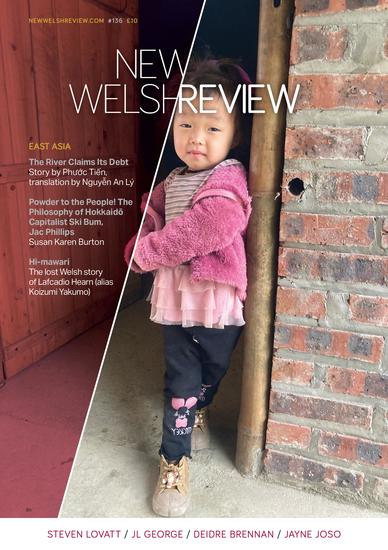
New Welsh Review 136 (winter 2024) - East Asia - cover

New Welsh Review 136 (winter 2024) - East Asia

Lafcadio Hearn, Jayne Joso, Phước Tiến, Susan Karen Burton

Publisher: Parthian Books

  • 0
  • 0
  • 0

Summary

EDITORIAL by Gwen Davies


EAST ASIAN LITERATURE


'The River Claims Its Debt' – Story by Phước Tiến, translated from the Vietnamese by Nguyễn An Lý

'Powder to the People! The philosophy of Hokkaido capitalist ski bum, Jack Philips' – Biography/oral history by Susan Karen Burton

'Hi-Mawari', the lost Welsh story of Lafcadio Hearn (alias Koizumi Yakumo) –Translated from the Japanese

Jayne Joso on how Japan shapes her work


FURTHER FICTION


'The Banana Banshee' – Story by Deidre Brennan, translated from the Irish by the author


REVIEW-ESSAYS


Steven Lovatt on restoring natural and cultural ecologies in the work of Ruth Bidgood, Rae Howells and Carwyn Graves

JL George on trauma and the magical child in recent novels by Lloyd Markham, Carly Holmes and Vajra Chandrasekera
Available since: 11/01/2024.
Print length: 80 pages.

Other books that might interest you

  • Narcissism - Identifying Traits and Navigating Toxic Relationships - cover

    Narcissism - Identifying Traits...

    Coral Nunez

    • 0
    • 0
    • 0
    Narcissism is a term often used to describe individuals who are excessively self-absorbed, lack empathy, and crave admiration. While everyone exhibits some level of self-interest, narcissism exists on a spectrum, ranging from healthy self-confidence to Narcissistic Personality Disorder (NPD), a diagnosable mental health condition. Understanding narcissism requires examining its characteristics, origins, and the myths that often surround it. 
    At its core, narcissism is marked by a grandiose sense of self-importance, a deep need for validation, and an inability to acknowledge the emotions of others. Narcissists often present themselves as charming, confident, and charismatic, but beneath the surface, they struggle with fragile self-esteem. Their self-worth depends on external validation, making them highly reactive to criticism or perceived rejection. 
    The origins of narcissistic traits can often be traced back to childhood experiences. Some narcissists are products of excessive praise and entitlement, while others develop these traits as a defense mechanism against neglect or abuse. A child raised in an environment where love is conditional—based on achievement or obedience—may grow up believing their worth is tied to external success rather than intrinsic value. In some cases, narcissistic tendencies are reinforced by societal pressures that prioritize status, power, and material success over genuine emotional connection.
    Show book
  • The Urban-Rural Divide - Understanding Interactions and Impacts - cover

    The Urban-Rural Divide -...

    Lyric Vale

    • 0
    • 0
    • 0
    The urban-rural divide is a concept that encompasses the differences between urban and rural areas in terms of population, economy, infrastructure, social services, and quality of life. As the world has rapidly urbanized in the past few centuries, the divide has grown wider, shaping the way people experience and interact with the world around them. Understanding the urban-rural divide requires looking not just at geographical distinctions but also at the historical, social, and economic forces that have led to the creation of these disparities. 
    At its core, the urban-rural divide refers to the uneven distribution of resources, opportunities, and access to services. Urban areas, often characterized by their dense population, advanced infrastructure, and proximity to economic opportunities, tend to attract people from rural areas in search of better livelihoods. On the other hand, rural areas are often defined by their smaller populations, agricultural economies, and more limited access to healthcare, education, and technological advancements. Over time, this gap has widened as cities have grown into centers of global commerce, culture, and innovation, leaving rural communities to face challenges such as depopulation, economic stagnation, and a lack of essential services. 
    This divide is not just a modern phenomenon. Historically, the urban-rural relationship has been shaped by factors like industrialization, the rise of agriculture, and migration patterns. During the Industrial Revolution, for example, many people from rural areas flocked to cities in search of work, marking a key moment in the expansion of the urban-rural divide. These migration patterns have continued in the present day, with rural populations in many countries continuing to shrink as more people move to urban centers for better prospects.
    Show book
  • The Best Is Possible - Book Sub Title: Modern Morocco Viewed Through the Lens of King Mohammed VI’s Speeches (1999–2019) - cover

    The Best Is Possible - Book Sub...

    Desmond Swan, Touria Jouilla McKee

    • 0
    • 0
    • 0
    “A compact, well-written and well-researched book. I am sure it will be welcomed as a valuable contribution to the history of contemporary Morocco and the remarkable process of transition it is undergoing as we speak.”
     
    Prof. Karim Bejjit, UniversityAbdelmalek Essadi, Tetouan, Morocco


    “Morocco has been experiencing major socio-economic transformation from an agricultural to an industrial economy… and His Majesty has been to the fore in these hugely significant developments. The authors paint a wonderful picture in this highly recommended book.”       
     
    Charles Flanagan, Minister for Foreign Affairs and Trade (2014–2017), Minister for Justice (2017–2020), Current Chair of Parliamentary Committee on Foreign Affairs and Defence (Irish Parliament)
    Show book
  • Paris Under Water - How the City of Light Survived the Great Flood of 1910 - cover

    Paris Under Water - How the City...

    Jeffrey H. Jackson

    • 0
    • 0
    • 0
    In the winter of 1910, the river that brought life to Paris quickly became a force of destruction.  Torrential rainfall saturated the soil, and faulty engineering created a perfect storm of conditions that soon drowned Parisian streets, homes, businesses, and museums. The city seemed to have lost its battle with the elements. Given the Parisians' history of deep-seated social, religious, and political strife, it was questionable whether they could collaborate to confront the crisis. Yet while the sewers, Métro, and electricity failed around them, Parisians of all backgrounds rallied to save the city and one another. Improvising techniques to keep Paris functioning and braving the dangers of collapsing infrastructure and looters, leaders and residents alike answered the call to action. This newfound ability to work together proved a crucial rehearsal for an even graver crisis four years later, when France was plunged into World War I. On the occasion of the hundredth anniversary of the flood, Jeffrey H. Jackson captures here for the first time the drama and ultimate victory of man over nature.
    Show book
  • Dispersals - On Plants Borders and Belonging - cover

    Dispersals - On Plants Borders...

    Jessica J. Lee

    • 0
    • 0
    • 0
    A prize-winning memoirist and nature writer turns to the lives of plants entangled in our human world to explore belonging, displacement, identity, and the truths of our shared future 


    A seed slips beyond a garden wall. A tree is planted on a precarious border. A shrub is stolen from its culture and its land. What happens when these plants leave their original homes and put down roots elsewhere? 


    In fourteen essays, Dispersals explores the entanglements of the plant and human worlds: from species considered invasive, like giant hogweed; to those vilified but intimate, like soy; and those like kelp, on which our futures depend. Each of the plants considered in this collection are somehow perceived as being "out of place"—weeds, samples collected through imperial science, crops introduced and transformed by our hand. Combining memoir, history, and scientific research in poetic prose, Jessica J. Lee meditates on the question of how both plants and people come to belong, why both cross borders, and how our futures are more entwined than we might imagine.
    Show book
  • The Cooking of Books - cover

    The Cooking of Books

    Ramachandra Guha

    • 0
    • 0
    • 0
    It is not often that an author and his editor strike up a relationship which survives forty years of epistolary exchanges and intellectual sparring.  
    The strangely enduring and occasionally fractious friendship which developed between the famously outspoken historian Ramachandra Guha and his reticent editor Rukun Advani is the subject of this quite eccentric and thoroughly compelling literary memoir. 
    It started in Delhi in the early 1980s, when Guha was an unpublished PhD scholar, and Advani a greenhorn editor with Oxford University Press. It blossomed through the 1990s, when Guha grew into a pioneering historian of the environment and of cricket, while also writing his pathbreaking biography of Verrier Elwin. Over these years Advani was Guha’s most constant confidant, his most reliable reader. He encouraged him to craft and refine the literary style for which Guha became internationally known – narrative histories which have made vast areas of scholarship popular and accessible. 
    Four decades later, though he no longer publishes his books, Advani remains Guha’s most trusted literary adviser. Yet they also disagree ferociously on politics, human nature, and the shape of their commitment to India. They usually make up – because it just wouldn’t do to allow such an odd relationship to die. 
    Built around letters and emails between an outgoing and occasionally combative scholar and a reclusive editor prone to private outbursts of savage sarcasm, this book is never short of the kind of wit, humour, and drollery that has been strangled by contemporary political correctness. 
    In THE COOKING OF BOOKS, Ramachandra Guha presents an autobiography that is a testament to the power of reading, criticism, and language in shaping personal and historical narratives. It's a best-seller in the non-fiction genre, offering a unique perspective on the disciplines of the publishing industry in Asia. 
    For fans of Ron Chernow (Titan), Amartya Sen (Home in the World), Jonathan Eig (Ali), Walter Isaacson (Invent and Wander), and Sanjeev Sanyal (Land of seven rivers). 
    HarperCollins 2024
    Show book