Join us on a literary world trip!
Add this book to bookshelf
Grey
Write a new comment Default profile 50px
Grey
Subscribe to read the full book or read the first pages for free!
All characters reduced
The Sequence Algorithms Handbook - cover

The Sequence Algorithms Handbook

Pasquale De Marco

Publisher: Publishdrive

  • 0
  • 0
  • 0

Summary

This book provides a comprehensive introduction to the average case analysis of algorithms on sequences, combining both analytical and probabilistic tools to provide a unified framework for the analysis of algorithms on words. Written in a clear and accessible style, it is suitable for both graduate students and researchers in the field.

The book begins by introducing the basic concepts of words and algorithms on words, covering topics such as string matching algorithms, pattern matching algorithms, compression algorithms, and data structures for words. It then introduces probabilistic models for words, including random words, Markov chains, hidden Markov models, context-free grammars, and Bayesian networks.

The book also introduces analytical models for words, including asymptotic analysis, generating functions, Mellin transforms, the inclusion-exclusion principle, and large deviations. It then introduces the subadditive ergodic theorem and its applications to data compression, pattern matching, computational molecular biology, and security.

The book also covers the inclusion-exclusion principle and its applications, first and second moment methods and their applications, complex asymptotic methods and their applications, analytic Poissonization and depoissonization and their applications, and elements of information theory and their applications.

Finally, the book discusses applications of average case analysis of algorithms on sequences to data compression, pattern matching, computational molecular biology, security, and other areas.

With its comprehensive coverage of the topic, clear and accessible writing style, and wealth of applications, this book is an essential resource for anyone working in the field of average case analysis of algorithms on sequences.


If you like this book, write a review!
Available since: 06/02/2025.
Print length: 157 pages.
Other books that might interest you

  • The Mind's Mirror - Risk and Reward in the Age of AI - cover

    The Mind's Mirror - Risk and...

    Daniela Rus, Gregory Mone

    • 0
    • 0
    • 0
    An exciting introduction to the true potential of AI from the director of MIT’s Computer Science and Artificial Intelligence Laboratory. 
     
    Imagine a technology capable of discovering new drugs in days instead of years, helping scientists map distant galaxies and decode the language of whales, and aiding the rest of us in mundane daily tasks, from drafting email responses to preparing dinner. Now consider that this same technology poses risks to our jobs and society as a whole. Artificial Intelligence is no longer science fiction; it is upending our world today.  
     
    As advances in AI spark fear and confusion, The Mind’s Mirror reminds us that in spite of the very real and pressing challenges, AI is a force with enormous potential to improve human life. Computer scientist and AI researcher Daniela Rus, along with science writer Gregory Mone, offers an expert perspective as a leader in the field who has witnessed many technological hype cycles. Rus and Mone illustrate the ways in which AI can help us become more productive, knowledgeable, creative, insightful, and even empathetic, as well as the many risks associated with misuse.  
     
    The Mind’s Mirror shows readers how AI works and explores what we, as individuals and as a society, must do to mitigate dangerous outcomes and ensure a positive impact for as many people as possible. The result is an accessible and lively exploration of the underlying technology and its limitations and possibilities—a book that illuminates our possible futures in the hopes of forging the best path forward.
    Show book
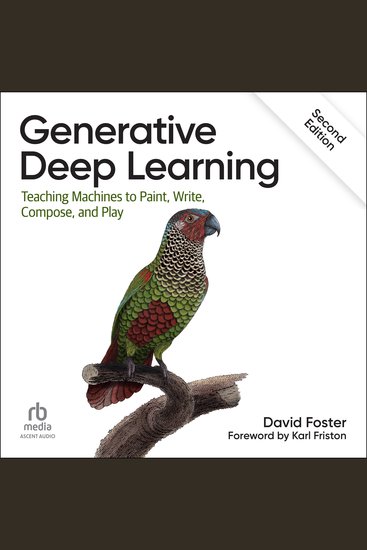
  • Generative Deep Learning - Teaching Machines To Paint Write Compose and Play (2nd Edition) - cover

    Generative Deep Learning -...

    David Foster

    • 0
    • 0
    • 0
    Generative AI is the hottest topic in tech. This practical book teaches machine learning engineers and data scientists how to use TensorFlow and Keras to create impressive generative deep learning models from scratch, including variational autoencoders (VAEs), generative adversarial networks (GANs), Transformers, normalizing flows, energy-based models, and denoising diffusion models. 


    The book starts with the basics of deep learning and progresses to cutting-edge architectures. Through tips and tricks, you'll understand how to make your models learn more efficiently and become more creative. You will discover how VAEs can change facial expressions in photos; train GANs to generate images based on your own dataset; build diffusion models to produce new varieties of flowers; train your own GPT for text generation; learn how large language models like ChatGPT are trained; explore state-of-the-art architectures such as StyleGAN2 and ViT-VQGAN; compose polyphonic music using Transformers and MuseGAN; understand how generative world models can solve reinforcement learning tasks; and dive into multimodal models such as DALL.E 2, Imagen, and Stable Diffusion. 


    This book also explores the future of generative AI and how individuals and companies can proactively begin to leverage this remarkable new technology to create competitive advantage.
    Show book
  • My Child the Algorithm - An Alternatively Intelligent Book of Love - cover

    My Child the Algorithm - An...

    Hannah Silva

    • 0
    • 0
    • 0
    A playful and provocative exploration of queer single parenting and love, in conversation with an AI algorithm and a toddler 


    My Child, the Algorithm describes encounters between a single parent, a curious, verbal toddler, and a language-producing algorithm. Like a male seahorse, Hannah Silva carried a baby made from her partner's egg. But when she gave birth, her partner left, and Hannah found herself navigating life alone with her child, surviving on United Kingdom universal credit, humor, and buckets of imagination. 


    As she navigates friendship, dating, and life as a queer parent in London, Hannah begins cowriting with an open-source language model, a precursor to ChatGPT, feeding the algorithm language and receiving language in return. Through her interactions with her toddler and the algorithm, expressions of humor, play, and insight begin to emerge. With the help and disruption of these unreliable narrators, Hannah deconstructs her story and constructs a new one, unraveling what she has been taught to want, finding alternative ways of thinking, loving, and parenting today.
    Show book
  • Artificial Intelligence Class 2 - cover

    Artificial Intelligence Class 2

    Team Orange

    • 0
    • 0
    • 0
    Touchpad Artificial Intelligence series has some salient features such as AI Reboot, AI Deep Thinking, 
    AI in Life, AI Lab and AI Ready which ensures that NEP 2020 guidelines are followed. 
    
    KEY FEATURES 
    - National Education Policy 2020 
    - AI Game: It contains an interesting game or activity for the students to try on their own or with their classmates to learn how the game mechanics work while having fun. 
    - Brainy Fact: It presents an interesting fact relevant to the topic or the chapters. 
    - AI in Life: It presents questions that promotes the moral growth and experiential learning. 
    - AI Deep Thinking: It presents a question/scenario in which the students are required to think deeply and apply their knowledge. 
    - Digital Solutions 
    
    DESCRIPTION 
    Artificial Intelligence is the most talked about subject and we all understand that the future lies in knowing it well. The Touchpad AI series is written for classes I to VII keeping in mind about the future and scope that lies in AI. Classes VIII to XII are strictly based on CBSE curriculum. They have competency-based questions to ensure that students are capable of applying their learning to solve some real-life challenges. The knowledge is spread in a phased manner so that at no age the kid finds it difficult to understand the theory. 
    
    Each lesson begins with a short conversation between human characters and one humanoid which tries to explain in simple words about the topics related to Artificial Intelligence. The story is built up in such a way that the curiosity of the reader compels to read the entire lesson. The idea behind introducing humanoid is to touch the hearts of our kids with the existence of friendly robots in the form of humanoids. 
    
    Touchpad Artificial Intelligence series has some salient features such as AI Reboot, AI Deep Thinking, AI in Life, AI Lab and AI Ready which ensures that NEP 2020 guidelines are followed. 
    
    There are plenty of Video Sessions for students and teachers to go beyond the syllabus and enrich their knowledge. There are some brainstorming questions in the form of AI Task in between the topics to ensure that students give pause to their learning and use their skills to reach to some creative ideas in solving given problems. 
    
    I would like to humbly acknowledge the support provided by my family, friends and Orange Education Pvt Ltd team to accomplish this noble task. I am sure that this book will prove to be a tool in making the students future ready for Artificial Intelligence. Wishing learners great success in future endeavours. Enjoy the journey of happy learning!! All your feedbacks and suggestions will always be wholeheartedly welcomed to improve and grow. 
    
    WHAT WILL YOU LEARN 
    You will learn about: 
    - Human-Machine Interaction 
    - Introduction to AI 
    - AI in Apps 
    - Types of Robots 
    - Myths and Facts of AI 
    
    WHO THIS BOOK IS FOR 
    Grade 2 
    
    TABLE OF CONTENTS (Numbered list) 
    
    1. Evolution of Computers 
    a) Early Counting Tools 
    b) Abacus—First Calculating Device 
    c) Charles Babbage’s Analytical Engine 
    d) Lady Ada Lovelace’s Programs 
    e) ENIAC—The First Electronic Computer 
    f) UNIVAC 
    g) IBM PC 
    h) Modern Computers 
    
    2. Artificial Intelligence 
    a) What is AI? 
    b) Real Life Examples of AI 
    c) Advantages and Disadvantages of AI 
    
    3. AI-Enabled Devices 
    a) Smartphone 
    b) Smartwatch 
    c) Chatbot 
    d) Smart TV 
    e) Smart Doorbe 
    f) Driverless Cars 
    g) Smart Speakers 
    
    4. Introducing Robots 
    a) What is a Robot? 
    b) Popular Robots 
    c) Advantages of Robots 
    d) Disadvantages of Robots 
    
    AI Ready 
    Projects
    Show book
  • Tap and Learn for Class 1 - cover

    Tap and Learn for Class 1

    Manish Soni

    • 0
    • 0
    • 0
    TAP AND LEARN For Class 1: In an age where digital literacy is as fundamental as traditional literacy, it is essential to introduce children to the world of computers early. This book has been meticulously designed to align with the NEP and NCERT guidelines, ensuring that young learners embark on their digital journey confidently and enthusiastically. The primary goal of this book is to make learning computer basics engaging, accessible, and effective for students. We believe that the foundation of digital literacy should be built with the same care and attention as any other subject. This book aims to ignite curiosity, foster a love for technology, and develop essential computer skills in young minds. The content of this book is structured to gradually introduce children to the world of computers, starting from the very basics and moving towards more interactive and practical applications. Each chapter is crafted to be engaging and informative, ensuring the learning process is enjoyable and impactful. The journey begins with a comprehensive introduction to computers, explaining what they are and why they are essential in our daily lives. This section sets the stage for more detailed learning by providing a solid foundation. Understanding the various parts of a computer is crucial. This chapter introduces the monitor, keyboard, mouse, and CPU and their functions. Colourful illustrations and simple explanations make it easy for children to grasp these concepts. Mastering the use of a mouse is a fundamental skill. Students practice clicking, dragging, and dropping through engaging exercises, enhancing their hand-eye coordination and control. Typing is an essential skill in the digital age. This section includes lessons on typing letters and numbers, designed to build typing speed and accuracy. Regular practice activities help reinforce these skills.
    Show book
  • Terrible Beauty - Reckoning with Climate Complicity and Rediscovering Our Soul - cover

    Terrible Beauty - Reckoning with...

    Auden Schendler

    • 0
    • 0
    • 0
    Something's gone badly awry with environmentalism. We faithfully separate our waste into different streams, but wonder whether it really makes a difference. Global companies announce their commitment to carbon negativity while simultaneously sponsoring oil conferences. American businesses, communities, and individuals assiduously measure their carbon footprints, then implement voluntary emissions-reduction programs, all while trumpeting their do-gooderism. 


    The problem is, none of this—whether individual efforts or corporate sustainability tactics—will make a dent in solving the civilizational threat of climate change. We only pretend it will, at our peril. 


    As Auden Schendler argues in this provocative, powerful book, we're living a big green lie. The hard truth is that much of the modern environmental road map could have been written by the fossil fuel industry specifically to avoid disrupting the status quo. But there is another truth: while ineffective or duplicitous environmentalism has become standard practice, we all have friends and family we love and care about, whose future depends on solving the problem of climate change. Conscience tells us we have an obligation to repair the world. How can our common dreams be so at odds with our daily practice? And how might we meld our spirit and our passion to create a better future?
    Show book