Join us on a literary world trip!
Add this book to bookshelf
Grey
Write a new comment Default profile 50px
Grey
Subscribe to read the full book or read the first pages for free!
All characters reduced
The City's Symphony - cover

The City's Symphony

Pasquale De Marco

Publisher: Publishdrive

  • 0
  • 0
  • 0

Summary

In a rapidly urbanizing world, cities are facing unprecedented challenges. From climate change to inequality to traffic congestion, the problems that cities face are complex and interconnected. Urban planning is a critical tool for addressing these challenges and creating more sustainable, equitable, and livable communities.

This comprehensive book provides a thorough overview of the principles and practices of urban planning. Drawing on the latest research and best practices, it explores the key challenges facing cities today and the strategies that can be used to address them.

Divided into ten chapters, the book covers a wide range of topics, including:

* The history of urban planning and the different theories and approaches that have influenced the field
* The practical aspects of urban planning, including the tools and techniques that planners use to create and implement plans
* The role of planning in addressing social and economic issues in cities, such as affordable housing, community development, and social services
* The role of planning in promoting sustainable development, including green infrastructure, energy efficiency, and climate resilience
* The role of planning in promoting economic development, including attracting and retaining businesses, creating jobs, and supporting entrepreneurship
* The role of planning in creating more livable and vibrant communities, including public space, walkability, and bikeability
* The role of planning in promoting good governance, including citizen participation, transparency, and accountability
* The challenges and opportunities that cities will face in the coming years, and the ways that planning can be used to create more sustainable, equitable, and livable communities

This book is an essential resource for anyone interested in urban planning, whether they are students, practitioners, or policymakers. It provides a comprehensive overview of the field and the challenges and opportunities that cities face today.


If you like this book, write a review!
Available since: 06/02/2025.
Print length: 167 pages.


Other books that might interest you

  • The American Operations in WW2: Tunisia - cover

    The American Operations in WW2:...

    U.S. Army Center of Military...

    • 0
    • 0
    • 0
    World War II was the largest and most violent armed conflict in the history of mankind. Highly relevant today, World War II has much to teach us, not only about the profession of arms, but also about military preparedness, global strategy, and combined operations in the coalition war against fascism. This book follows military operations of the US Army in Tunisia from 17 November 1942 to 13 May 1943. 
    Victory at Casablanca, Oran, and Algiers gave the United States Army and its British ally solid toeholds in the western Mediterranean Theater of Operations. But it offered no guarantee of easy access to Italy or southern Europe, or even to the eastern end of the Mediterranean, where the British desperately needed assistance to secure Egypt and strategic resources in the Near East. The sudden entrance of American forces during 8-11 November 1942 created an awkward deployment in which two pairs of opposing armies fought in North Africa, one in Tunisia, the other in Libya. Neither Axis nor Allies found any satisfaction in the situation; much fighting remained before either adversary could consider North Africa secure...
    Show book
  • Peig Sayers Vol 1 - Labharfad le Cách I Will Speak to You All - cover

    Peig Sayers Vol 1 - Labharfad le...

    Pádraig Ó Héalaí, Bo Almqvist

    • 0
    • 0
    • 0
    'Ach cérbh í Peig Sayers?'
    Níorbh í in aon chor an tseanbhean ologónach í ar chuir na glúnta de dhaltaí scoile aithne uirthi. Is léir ó chuntais uathu siúd arbh eol dóibh í gur bhean ghrámhar thuisceanach í a raibh acmhainn grinn inti; bean a fuair blas ar ghal tobac agus ar bhraoinín fuisce, agus a bhí oilte ar chraiceann a chur ar scéal.
    
    
    Saolaíodh Peig i nDún Chaoin i gCo. Chiarraí i 1873. Thug sí bua na scéalaíochta léi óna hathair agus tugadh a sárchuimhne agus an lé a bhí aici le comhluadar faoi deara go luath. Phós sí iascaire ón mBlascaod agus chaith sí saol cruógach i dteaghlach líonmhar ag déanamh cúraim don seisear leanbh léi a mhair.
    
    
    Tugann Labharfad le Cách le chéile den chéad uair na taifeadtaí a thóg an BBC agus RTÉ uaithi i 1946, 1947 agus 1953, mar aon le haistriúcháin Bhéarla orthu. Léiríonn siad fairsinge repertoire Pheig idir scéalta cráifeacha, paidreacha, scéalta rómánsacha, scéalta faoin osádúr agus cuntais ar an saol a caitheadh tráth ar an oileán ach go bhfuil a chuimhne ag dul i léig anois.
     
    'Who was that Peig Sayers?'
    She was anything but the maudlin and old-fashioned Peig remembered by generations of school children. From the descriptions of those who met her, the real Peig emerges as a warm, wise and humorous woman, with an addiction to tobacco, a fondness for a sup of whiskey and a mastery of the art of 'spin'.
    
    
    Born in Dún Chaoin in County Kerry in 1873, Peig learned the art of storytelling at her father's knee, and quickly became known for her sociable nature and excellent memory. Marrying a fisherman from the Great Blasket, she enjoyed a full life with a large extended family and the care of her six living children.
    
    I Will Speak to You All collects, for the first time, in both Irish and English, the recordings made by the BBC and RTÉ of Peig Sayers in 1946, 1947 and 1953. They illustrate Peig's repertoire, ranging from religious stories and prayers to humorous, romantic, even supernatural tales, as well as descriptions of an island life that is passing from living memory.
    Show book
  • Routes - cover

    Routes

    Rhiya Pau

    • 0
    • 0
    • 0
    At the core of this debut collection is a question – what is worth holding onto?
    Through poetic experiments that blend the academic and the artistic, Rhiya Pau queries complex characters and tender landscapes. Routes journeys from Ba's kitchen in Sonia Gardens to Independence hour in Delhi, across the pink shores of Nakuru, to meet a painter on Lee High Road.
    Celebrating fifty years since her community arrived in the UK, Pau chronicles the migratory histories of her ancestors and simultaneously lays bare the conflicts of identity that arise from being a member of the East African-Indian diaspora. In this multilingual discourse exhibiting vast formal range, Pau wrestles with language, narrative and memory, daring to navigate their collective fallibilities to architect her own identity.
    '[Routes]...holds up to the light the wisdom of the past, and asks what else is passed down along with it...a work of humane intelligence, formal experiment and linguistic verve' - Sarah Howe, Judge of Eric Gregory Awards 2022
    Show book
  • America’s Most Notorious Con Artists: The History and Schemes of Successful Cons in the United States - cover

    America’s Most Notorious Con...

    Editors Charles River

    • 0
    • 0
    • 0
    The art of the confidence trick is a controversial craft that is as old as time itself. In the early years of civilization, unscrupulous folks bottled and peddled assortments of fake cures and potions. Snake oil salesmen aside, charlatans posed as mystical beings with supernatural powers, promising to end droughts and other misfortunes of the gullible with what were in reality parlor tricks and illusions.  
    	Indeed, throughout history, unabashedly brazen characters managed to make careers out of deception. 17th century Britain, for instance, was terrorized by William Chaloner, the most infamous serial counterfeiter and con artist of his time before he was ultimately bested by Sir Isaac Newton himself. The British trickster posed as a quack doctor and a clairvoyant who dispensed false fortunes (most likely via an early form of cold reading) and bogus healing antidotes, but these were bush-league frauds in comparison to one of his most renowned claims to fame: he once bribed four Jacobite sympathizers to crank out pamphlets regarding King James II's denunciation of His Royal Highness William, and later double-crossed his co-conspirators by tipping off the cops and swiftly decamping with the 1,000 reward.  
    	Confidence women were equally active players in such dirty, fixed games. Doris Payne was a professional pilferer of jewels whose unconventional vocation spanned six decades. Throughout all her hits across the United States, Europe, and Asia, Payne adhered to a simple, yet effective method of operation: she donned stylish, pricey clothes, singled out impressionable male shopkeepers and distracted them with flirtatious small talk, and secretly palmed jewelry with sleight-of-hand tricks. One of the most recent was Frank Abagnale, a career impersonator, former forger of bank checks turned FBI employee, and the subject of the 2002 film Catch Me If You Can.  
    Show book
  • Capturing News Capturing Democracy - Trump and the Voice of America - cover

    Capturing News Capturing...

    Mel Bunce, Kate Wright, Martin...

    • 0
    • 0
    • 0
    The Voice of America (VOA) is the oldest and largest US government-funded international media organization. In 2020, Donald Trump nominated Michael Pack, a right-wing documentarian and close friend of Steve Bannon, to lead the US Agency for Global Media—the independent federal agency overseeing US-funded international media. During Pack's seven month tenure, more than thirty whistleblowers filed complaints against him, and a judge ruled that he had infringed journalists' constitutional right to freedom of speech. 


    How did such a major international public service media network become intensely politicized by government allies in such a short time, despite having its editorial independence protected by law? 


    Capturing News, Capturing Democracy puts these events in historical and international context—and develops a new analytical framework for understanding government capture and its connection to broader processes of democratic backsliding. Drawing from in-depth interviews with network managers and journalists, and analysis of private correspondence and internal documents, Kate Wright, Martin Scott, and Mel Bunce analyze how political appointees, White House officials, and right-wing media influenced VOA—changing its reporting of the Black Lives Matter movement, and the 2020 presidential election.
    Show book
  • Saddam Hussein - Warmonger Invader Dictator and Oil Trader - cover

    Saddam Hussein - Warmonger...

    Kelly Mass

    • 0
    • 0
    • 0
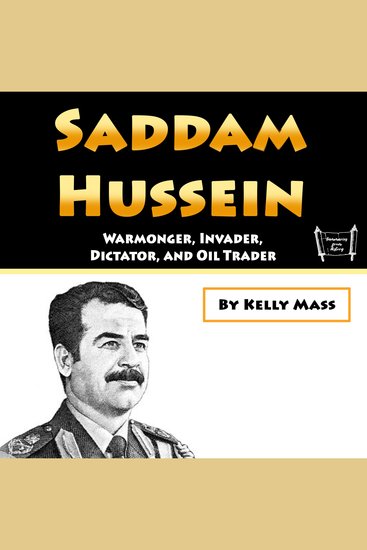
    Saddam Hussein, the sixth president of Iraq, held power from July 16, 1979, until his downfall on April 9, 2003. A central figure in Iraq's political history, Saddam was a founding member of the Arab Socialist Ba'ath Party, which advocated for a fusion of Arab nationalism and socialism, known as Ba'athism. The party's rise to power in Iraq was marked by the 1968 coup, often referred to as the 17 July Revolution, which saw the Ba'ath Party assume control. Saddam, a key figure in the party, was instrumental in establishing its dominance in Iraq. 
    Saddam's path to the presidency was shaped by his political astuteness and ruthless consolidation of power. He became vice president under General Ahmed Hassan al-Bakr, who was severely weakened by ill health. At a time when numerous factions within the country threatened to destabilize the government, Saddam focused on building and strengthening the security forces that would enable him to suppress dissent. He carefully navigated the complexities of power struggles between the administration and the military, ensuring his influence over both the party and the state apparatus. His careful maneuvering eventually led to his formal assumption of power in 1979, though he had already been Iraq's de facto leader for several years. 
    In the early 1970s, Saddam took aggressive steps to nationalize Iraq's most important industries, including the Iraq Petroleum Company and various independent banks. This move, though initially successful in securing Iraq's economic independence, led to long-term financial instability. The nationalization policies, combined with inflation and a series of bad loans, contributed to the eventual collapse of Iraq's financial sector. Nevertheless, Saddam's regime was buoyed by the economic boom fueled by Iraq's oil exports, which provided the government with significant wealth and the ability to fund state projects.
    Show book