Join us on a literary world trip!
Add this book to bookshelf
Grey
Write a new comment Default profile 50px
Grey
Subscribe to read the full book or read the first pages for free!
All characters reduced
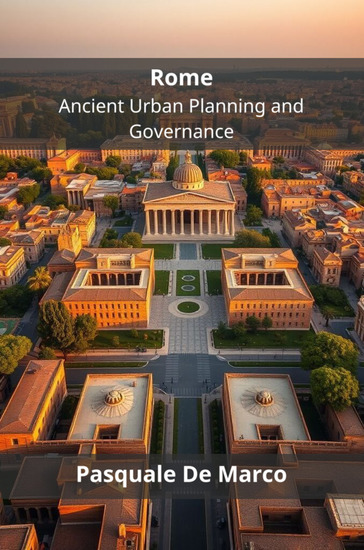
Rome - Ancient Urban Planning and Governance - cover

Rome - Ancient Urban Planning and Governance

Pasquale De Marco

Publisher: Publishdrive

  • 0
  • 0
  • 0

Summary

**Rome: Ancient Urban Planning and Governance** delves into the intricate workings of Rome's urban development, exploring how this ancient city managed to function and thrive for centuries. From its humble beginnings as a small settlement on the banks of the Tiber River to its growth into a sprawling metropolis, Rome's urban history is a story of ingenuity, resilience, and organizational prowess.

This book examines the legal framework that governed the city, the infrastructure that supported its large population, and the services and amenities that catered to its citizens' needs. We will explore the challenges faced by Rome's leaders, including maintaining order and security, providing food and water for a growing population, and managing waste and sanitation.

Despite these challenges, Rome flourished as a center of commerce, culture, and learning. Its influence can still be seen in cities around the world, from the design of our roads and bridges to the structure of our governments. By studying Rome's urban history, we can gain valuable insights into the development of cities and the challenges that they face.

**In this book, you will discover:**

* The founding and early development of Rome
* The role of the Roman Senate and Assembly in governance
* The construction and maintenance of infrastructure, such as aqueducts and roads
* The provision of public services, such as markets and baths
* The maintenance of order and security
* The impact of Rome's urban development on its citizens and the surrounding environment

**Rome: Ancient Urban Planning and Governance** is an essential read for anyone interested in urban history, Roman civilization, or the development of cities. Through this exploration of Rome's urban legacy, we can gain a deeper understanding of one of the greatest cities in history and the profound impact it has had on the world.


If you like this book, write a review!
Available since: 06/02/2025.
Print length: 162 pages.

Other books that might interest you

  • What Would You Do If You Ran the World? - Everyday Ideas From Women Who Want to Make the World a Better Place - cover

    What Would You Do If You Ran the...

    Shelly Rachanow

    • 0
    • 0
    • 0
    What would you do if you ran the world? If you knew you couldn't fail? Maybe it's time to stop wondering and start putting it into practice. Shelly Rachanow's daily words of encouragement will give you inspiration, hope, and words of courage to help you discover confidence in yourself. 


    Your acts, both big and small, matter. Learn about a teenage girl and CNN hero, kids in Zimbabwe saving their part of the planet, and a busy mom who is not too busy to work every day to help impoverished families live better lives. 


    Find the confidence and courage to change the world. Shelly Rachanow's book contains a diverse collection of brave, beautiful, brilliant, creative, and totally possible ideas that women have shared, complemented by inspirational quotes from famous women and action lists like "Ten Things You Can Start Doing Now." Rachanow's warm and encouraging voice motivates listeners to join other amazing women who are kicking serious butt for the good of all. Learn to listen to your own guiding voice, get involved in your own community, and live a satisfying life of "inspiration in action." If you enjoyed books that brought out your inner rockstar such as Untamed, Let That Sh*t Go, or You Are a Badass, then you'll love What Would You Do If You Ran the World?
    Show book
  • The Medieval Mind of C S Lewis - How Great Books Shaped a Great Mind - cover

    The Medieval Mind of C S Lewis -...

    Jason M. Baxter

    • 0
    • 0
    • 0
    C. S. Lewis had one of the great minds of the twentieth century.
    Many readers know Lewis as an author of fiction and fantasy literature, including the Chronicles of Narnia and the Space Trilogy. Others know him for his books in apologetics, including Mere Christianity and The Problem of Pain. But few know him for his scholarly work as a professor of medieval and Renaissance literature.
    What shaped the mind of this great thinker? Jason Baxter argues that Lewis was deeply formed not only by the words of Scripture and his love of ancient mythology, but also by medieval literature. For this undeniably modern Christian, authors like Dante and Boethius provided a worldview that was relevant to the challenges of the contemporary world.
    Here, readers will encounter an unknown figure to guide them in their own journey: C. S. Lewis the medievalist.
    Show book
  • Shadow Work and Healing the Inner Child: The Ultimate Guide to Integrating Your Dark Side and Restoring the Wounded Soul Within - cover

    Shadow Work and Healing the...

    Mari Silva

    • 0
    • 0
    • 0
    Two manuscripts in one audiobook:Shadow Work: A Guide to Integrating Your Dark Side for Spiritual AwakeningHealing the Inner Child: How You Can Begin to Heal the Wounded Soul Within Using Meditation, Awareness, Journaling, and More 
    In this audiobook, you will:Discover what the shadow meansLearn about the fact that you’ve got a shadow tailing youDiscover all the things that make up the shadowy version of yourselfUnderstand its place within the process of spiritual awakeningLearn what it means to discover your shadowFind out the importance of making friends with your shadowLearn how accepting the shadow key is to spiritual awakeningDiscover the importance of the reflection in the mirror through mirror workDiscover how to bring your shadow to the lightLearn about the important phases of spiritual awakeningUncover the connection between your soul’s wounds and your inner childDiscover which archetype your inner child belongs to and what their challenges areLearn more about the nature of your inner child and how to accept themRealize the impact of mediation when healing a wounded soulLearn how journaling can help you heal your inner childAnd much, much more! 
    Add this audiobook to your cart now to learn more about Shadow Work and Healing the Inner Child!
    Show book
  • Older Generations - An Overview of the Past (3 in 1) - cover

    Older Generations - An Overview...

    Valerie Vogue

    • 0
    • 0
    • 0
    This book combo contains the following three titles: 
    Boomers Uncovered - "Boomers Uncovered" seeks to explore the life and legacy of the Baby Boomer generation, examining their profound influence on society, culture, and history. Born in the years following World War II, Baby Boomers shaped the world in ways both seen and unseen, leaving an indelible mark on the world stage. This generation, defined by its optimism, resourcefulness, and rapid growth, experienced some of the most transformative decades in modern history. They not only witnessed but were active participants in the cultural, political, and technological revolutions that defined the second half of the 20th century. 
    Life as a Silent Gen - The Silent Generation, born between the mid-1920s and the early 1940s, is often characterized by its quiet strength and resilience. Unlike the more outspoken Baby Boomers or the politically vocal Millennials, members of this generation are sometimes referred to as the “silent” because they were raised in an era where conformity and restraint were the societal norms. Their lives unfolded during some of the most transformative and tumultuous events of the 20th century, including the Great Depression, World War II, and the early stages of the Cold War. 
    The X Factor - Generation X grew up in a rapidly changing world, marked by technological advancements, shifts in family dynamics, and significant political and economic changes. Many Gen Xers were raised during a time of uncertainty, from the economic recessions of the 1970s and early 1980s to the growing divorce rates and the rise of single-parent households. These formative experiences influenced their outlook on life, instilling in them a sense of independence, resilience, and adaptability. As a result, Generation X is often characterized as the "latchkey generation," having to navigate childhood with a degree of self-reliance that was uncommon in earlier times.
    Show book
  • California - An American History - cover

    California - An American History

    John Mack Faragher

    • 0
    • 0
    • 0
    A concise and lively history of California, the most multicultural state in the nation 
      
    “Faragher takes the reader on a captivating journey through myriad twists and turns of California’s multicultural history, enlivened by stories of people who rarely penetrate our traditional state chronicles.”—Carlos E. Cortés, University of California, Riverside 
      
    California is the most multicultural state in the nation. As John Mack Faragher argues in this concise and lively history, that is nothing new. California's natural variety has always supported diversity, including Native peoples speaking dozens of distinct languages, Spanish and Mexican colonists, gold seekers from all corners of the globe, and successive migrant waves from the eastern states, Europe, Latin America, Asia, and the Pacific Islands. 
      
    Beautifully crafted and elegantly written, Faragher tells the stories of a colorful cast of characters, some famous, others mostly unknown, including African American Archy Lee, who sued for his freedom; Sinkyone Indian woman Sally Bell, who survived genocide; and Jewish schoolgirl Marilyn Greene, who spoke up for her Japanese friends after Pearl Harbor. California's multicultural diversity often led to conflict, turmoil, and violence, but also to invention, improvisation, and a struggle for multicultural democracy.
    Show book
  • Dome of the Rock The: The History of the Oldest Islamic Shrine in Jerusalem - cover

    Dome of the Rock The: The...

    Charles River Editors

    • 0
    • 0
    • 0
    Among the world’s most recognizable man-made structures, the Dome of the Rock – known in Arabic as the Qubbat as-Sakara – is also one of its most mysterious. Although much of the Dome’s construction, reconstruction, and later additions are well-known from historical texts and archeological work, what it represents, why it was built where it was, and even its use remain the subject of scholarly controversy. Known for its immense size and beauty, and also for being located in the middle of Jerusalem, one of the world’s holiest cities, the Dome of the Rock has been the focus of political leaders who wished to legitimize their rule, religious warriors who believed that it empowered their weapons, and pilgrims who thought it was a site of salvation and enlightenment. As it drew these often diverse and sometimes disparate people to it, it has served the purposes of devout Jews, Muslims, and Christians, who -- although often not peacefully sharing the site -- seem to recognize its spiritual importance. 
    The Dome of the Rock has been many things to many people over the centuries, and historians, art historians, and archaeologists have studied the Dome of the Rock and its background extensively. Academics have created an accurate chronology of its life, as well as details about how the monument was built, including the construction and artistic techniques that were used. The dome was built on the site of what is believed to have been the Solomonic Temple that the Israelites built to worship their god, Yahweh, setting the stage for the entire area to be a holy site for the Abrahamic religions over the following centuries. Historians believe that the Umayyad Muslims saw this background as a prime location to build one of the greatest religious complexes in the Islamic world.
    Show book