Join us on a literary world trip!
Add this book to bookshelf
Grey
Write a new comment Default profile 50px
Grey
Subscribe to read the full book or read the first pages for free!
All characters reduced
Envisioning a Sustainable Future - Trends and Insights - cover

Envisioning a Sustainable Future - Trends and Insights

Pasquale De Marco

Publisher: Publishdrive

  • 0
  • 0
  • 0

Summary

In an era defined by global challenges and the urgent need for sustainable solutions, "Envisioning a Sustainable Future: Trends and Insights" emerges as a beacon of hope, guiding us toward a more sustainable and equitable world. This comprehensive book offers a panoramic view of the multifaceted dimensions of sustainability, providing readers with a deeper understanding of the interconnectedness of environmental, social, and economic issues.

Through its exploration of energy transition and climate action, the book underscores the critical role of renewable energy sources, energy efficiency, and international cooperation in mitigating the impacts of climate change. It delves into the preservation of natural resources and biodiversity, emphasizing the importance of protecting ecosystems, promoting sustainable land and water management practices, and striking a balance between economic development and environmental protection.

Furthermore, the book sheds light on the importance of advancing social equity and justice, addressing poverty and inequality, promoting gender equality, and ensuring access to education and healthcare for all. It advocates for the adoption of circular economy principles to reduce waste, foster resilience, and create sustainable supply chains.

Recognizing the significance of responsible consumption and production, the book encourages individuals and businesses to embrace sustainable behaviors, ethical and fair trade practices, and the reduction of the environmental footprint of products and services. It highlights the need for resilient communities and urban planning, promoting compact and transit-oriented development, enhancing urban resilience to climate change, and fostering community engagement and empowerment.

The book also emphasizes the imperative for collaboration and governance for sustainability. It calls for strengthening international cooperation, promoting multi-stakeholder partnerships, and enhancing environmental governance and policymaking. It underscores the crucial role of education and awareness in inspiring action and mobilizing change, recognizing that a sustainable future can only be achieved through the concerted efforts of all stakeholders.

With its thought-provoking insights and comprehensive analysis of trends, challenges, and opportunities, "Envisioning a Sustainable Future: Trends and Insights" serves as an invaluable resource for individuals, policymakers, businesses, and organizations committed to creating a more sustainable and equitable world. It offers a roadmap for transformative action, empowering readers to make informed choices and contribute to a thriving and resilient future for generations to come.


If you like this book, write a review!
Available since: 06/02/2025.
Print length: 164 pages.

Other books that might interest you

  • Data Science for Everyone - Concepts and Techniques - cover

    Data Science for Everyone -...

    Craig Dames

    • 0
    • 0
    • 0
    Data science is a multidisciplinary field that combines statistics, computer science, and domain expertise to extract meaningful insights from data. In today's digital era, data is generated at an unprecedented rate, making data science one of the most valuable skills in various industries. From healthcare to finance, businesses leverage data science to improve decision-making, optimize processes, and drive innovation. 
    At its core, data science follows a structured approach that includes data collection, cleaning, exploration, modeling, and interpretation. The first step in any data science project is acquiring relevant data. This data can come from multiple sources, such as databases, APIs, or even social media. Once collected, it often requires cleaning, as raw data may contain errors, inconsistencies, or missing values that can impact the accuracy of analyses. 
    After cleaning, exploratory data analysis (EDA) helps uncover patterns, trends, and relationships within the data. Visualization techniques, such as charts and graphs, make it easier to understand complex datasets. EDA also aids in feature selection, a crucial step in preparing data for machine learning models. Machine learning, a subset of artificial intelligence, allows computers to learn from data and make predictions. Common machine learning techniques include supervised learning, where models learn from labeled data, and unsupervised learning, which identifies hidden patterns without predefined labels.
    Show book
  • Emotional Power: Unleash Your Potential - "Unlock your best self! Experience captivating audio lessons tailored to unleash your emotional power and drive success!" - cover

    Emotional Power: Unleash Your...

    Cyrus Pendleton

    • 0
    • 0
    • 0
    Emotional Power: Unleash Your Potential 
    Are you ready to elevate your life and turn your struggles into a vibrant and joyful experience?  
    Searching for a thorough guide that encompasses everything you need to transform suffering into joyful living?  
    Your quest is over! 
    This guide acts as your essential ally in enhancing your understanding, applying your skills, and engaging in practical exercises. With this resource in hand, you're set for transformation. 
    Revised for the latest emotional empowerment methodologies. 
    Key features of this enriched guide include: 
    - In-depth insights into emotional intelligence and personal transformation 
    - Comprehensive explanations of emotional resilience 
    - Effective strategies for personal growth and overcoming obstacles 
    Our guide stands apart due to its extensive coverage, which is vital for your transformational journey. Topics are not merely glossed over; they are explored with precision and depth. 
    Please be aware that this guide operates independently and is not associated with any official emotional or psychological organization. It is meant solely for your personal growth. 
    Crafted with a clear structure and easy-to-understand language, our guide ensures smooth transitions between topics. Say farewell to complex jargon and embrace concise, clear, and technically accurate content. 
    So, why hesitate? Click the BUY NOW button, secure your guide, and embark on your journey towards emotional empowerment! 
    Emotional Power: Unleash Your Potential
    Show book
  • Artificial Intelligence Class 2 - cover

    Artificial Intelligence Class 2

    Team Orange

    • 0
    • 0
    • 0
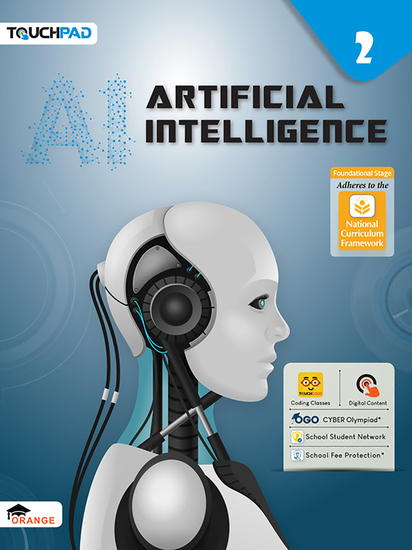
    Touchpad Artificial Intelligence series has some salient features such as AI Reboot, AI Deep Thinking, 
    AI in Life, AI Lab and AI Ready which ensures that NEP 2020 guidelines are followed. 
    
    KEY FEATURES 
    - National Education Policy 2020 
    - AI Game: It contains an interesting game or activity for the students to try on their own or with their classmates to learn how the game mechanics work while having fun. 
    - Brainy Fact: It presents an interesting fact relevant to the topic or the chapters. 
    - AI in Life: It presents questions that promotes the moral growth and experiential learning. 
    - AI Deep Thinking: It presents a question/scenario in which the students are required to think deeply and apply their knowledge. 
    - Digital Solutions 
    
    DESCRIPTION 
    Artificial Intelligence is the most talked about subject and we all understand that the future lies in knowing it well. The Touchpad AI series is written for classes I to VII keeping in mind about the future and scope that lies in AI. Classes VIII to XII are strictly based on CBSE curriculum. They have competency-based questions to ensure that students are capable of applying their learning to solve some real-life challenges. The knowledge is spread in a phased manner so that at no age the kid finds it difficult to understand the theory. 
    
    Each lesson begins with a short conversation between human characters and one humanoid which tries to explain in simple words about the topics related to Artificial Intelligence. The story is built up in such a way that the curiosity of the reader compels to read the entire lesson. The idea behind introducing humanoid is to touch the hearts of our kids with the existence of friendly robots in the form of humanoids. 
    
    Touchpad Artificial Intelligence series has some salient features such as AI Reboot, AI Deep Thinking, AI in Life, AI Lab and AI Ready which ensures that NEP 2020 guidelines are followed. 
    
    There are plenty of Video Sessions for students and teachers to go beyond the syllabus and enrich their knowledge. There are some brainstorming questions in the form of AI Task in between the topics to ensure that students give pause to their learning and use their skills to reach to some creative ideas in solving given problems. 
    
    I would like to humbly acknowledge the support provided by my family, friends and Orange Education Pvt Ltd team to accomplish this noble task. I am sure that this book will prove to be a tool in making the students future ready for Artificial Intelligence. Wishing learners great success in future endeavours. Enjoy the journey of happy learning!! All your feedbacks and suggestions will always be wholeheartedly welcomed to improve and grow. 
    
    WHAT WILL YOU LEARN 
    You will learn about: 
    - Human-Machine Interaction 
    - Introduction to AI 
    - AI in Apps 
    - Types of Robots 
    - Myths and Facts of AI 
    
    WHO THIS BOOK IS FOR 
    Grade 2 
    
    TABLE OF CONTENTS (Numbered list) 
    
    1. Evolution of Computers 
    a) Early Counting Tools 
    b) Abacus—First Calculating Device 
    c) Charles Babbage’s Analytical Engine 
    d) Lady Ada Lovelace’s Programs 
    e) ENIAC—The First Electronic Computer 
    f) UNIVAC 
    g) IBM PC 
    h) Modern Computers 
    
    2. Artificial Intelligence 
    a) What is AI? 
    b) Real Life Examples of AI 
    c) Advantages and Disadvantages of AI 
    
    3. AI-Enabled Devices 
    a) Smartphone 
    b) Smartwatch 
    c) Chatbot 
    d) Smart TV 
    e) Smart Doorbe 
    f) Driverless Cars 
    g) Smart Speakers 
    
    4. Introducing Robots 
    a) What is a Robot? 
    b) Popular Robots 
    c) Advantages of Robots 
    d) Disadvantages of Robots 
    
    AI Ready 
    Projects
    Show book
  • No Walk in the Park - Seeking Thrills Eco-Wisdom and Legacies in the Grand Canyon - cover

    No Walk in the Park - Seeking...

    Michael Engelhard

    • 0
    • 0
    • 0
    In the footsteps of Desert Solitaire, these essays by an award-winning writer and student of culture sift decades of experience backpacking and boating for a stance that questions the mainstream. More than mere tales of bravado, they offer glimpses into the heart of the places explored, with the Grand Canyon as their center of gravity. Vivid, finely crafted, shot through with humor, self-effacing while deeply opinionated, No Walk in the Park shows what it means to meet nature on nature's terms. Listen at home in an armchair, or at a river camp, or before you go wandering. 


    Join this author on a night hike to the great chasm's bottom; trek forty days in his company below one rim, or snowshoe the other; visit a Hopi mesa for a ceremony; marvel at hidden rock art; sip epic solitude; tag threatened fish; and float next to Glen Canyon's slickrock or below Niagara-size fleeting falls.
    Show book
  • Internet of Things (IoT) - Part 3 Future of IoT Ethics and Governance - cover

    Internet of Things (IoT) - Part...

    Daniel Garfield

    • 0
    • 0
    • 0
    As the Internet of Things (IoT) continues its exponential growth, propelling us into an era of unprecedented connectivity, "Internet of Things (IoT)" serves as a thought-provoking guide that explores the future of IoT, focusing on the critical dimensions of ethics and governance. 
    In this insightful book, readers are invited to embark on a compelling journey that uncovers the ethical considerations and governance challenges arising from the widespread deployment of IoT technologies. It examines the profound implications of IoT on society, individuals, and the environment, urging readers to reflect on the ethical implications associated with the vast amounts of data collected, analyzed, and utilized by interconnected devices. 
    "Internet of Things (IoT)" delves into the complex web of privacy, consent, and transparency in the IoT landscape. It examines the delicate balance between data utilization and protecting individual rights, encouraging readers to envision responsible and inclusive governance models that foster trust, accountability, and user empowerment. The book showcases real-world examples, inspiring readers to participate actively in shaping the ethical and regulatory frameworks that guide the future of IoT. 
    As we stand at the precipice of an interconnected future, "Internet of Things (IoT)" offers a roadmap for individuals and organizations to navigate the uncharted waters of the IoT landscape. Join the conversation, contemplate the ethical dilemmas, and contribute to the establishment of responsible governance frameworks that shape a future where IoT flourishes ethically and benefits society as a whole. 
     
    Show book
  • The History of Computing - From the Abacus to Artificial Intelligence - cover

    The History of Computing - From...

    Craig Dames

    • 0
    • 0
    • 0
    The story of computing begins not with electricity or screens, but with simple tools and the human need to solve problems. Long before the modern computer, ancient civilizations were already creating devices to aid in counting, measuring, and performing basic arithmetic. These early innovations laid the groundwork for centuries of progress in computing. 
    One of the most enduring tools from this era is the abacus. Believed to have originated in Mesopotamia over 4,000 years ago, the abacus evolved in various cultures, including Chinese, Roman, and Japanese societies. It was a portable, efficient device that allowed users to perform addition, subtraction, multiplication, and division by sliding beads along rods or grooves. Although simple in design, the abacus was powerful for its time and is still used in some regions for teaching arithmetic and mental calculation skills. 
    In addition to the abacus, ancient number systems were critical to the development of computation. The Babylonians used a base-60 numeral system, which influenced the way we measure time and angles today. The Egyptians employed a system based on units of ten, using hieroglyphs to represent values. Meanwhile, the Romans had a cumbersome numeral system that made complex calculations challenging. It wasn't until the adoption of the Hindu-Arabic numeral system, with its concept of zero and place value, that true advances in mathematical computation became possible.
    Show book