Join us on a literary world trip!
Add this book to bookshelf
Grey
Write a new comment Default profile 50px
Grey
Subscribe to read the full book or read the first pages for free!
All characters reduced
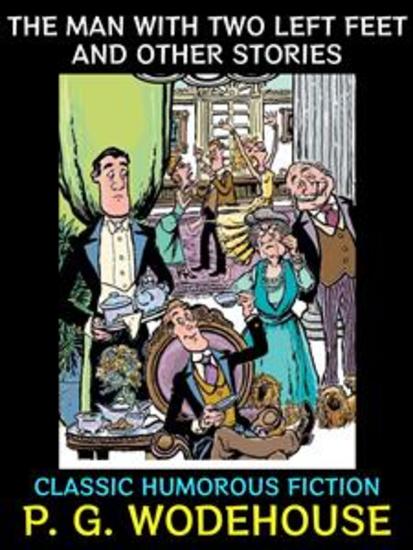
The Man With Two Left Feet And Other Stories - Classic Humorous Fiction - cover

The Man With Two Left Feet And Other Stories - Classic Humorous Fiction

P. G. Wodehouse

Publisher: Diamond Book Publishing

  • 0
  • 0
  • 0

Summary

The Man With Two Left Feet, and Other Stories is a collection of short stories by P. G. Wodehouse, first published in the United Kingdom on March 8, 1917. All the stories had previously appeared in periodicals, usually the Strand in the UK and the Red Book magazine or the Saturday Evening Post in the US. It is a fairly miscellaneous collection — most of the stories concern relationships, sports and household pets, and do not feature any of Wodehouse's regular characters; one, however, "Extricating Young Gussie", is notable for the first appearance in print of two of Wodehouse's best-known characters, Jeeves and his master Bertie Wooster (although Bertie's surname isn't given and Jeeves's role is very small), and Bertie's fearsome Aunt Agatha.
Available since: 05/06/2022.

Other books that might interest you

  • To the Lighthouse - cover

    To the Lighthouse

    Virginia Woolf

    • 0
    • 0
    • 0
    This landmark work of modernist literature explores the inner lives of a typical English family while vividly exploring the nature of loss and memory. Following her celebrated masterpiece Mrs. Dalloway, Virginia Woolf continues to develop her groundbreaking stream-of-consciousness technique in To the Lighthouse. Every summer, the Ramsey family returns to the Isle of Skye for a tranquil holiday, where the imposing lighthouse seems to promise everlasting constancy. But as their idyllic holiday confronts the realities of World War I, the Ramseys must also face the inescapable nature of change.  A profound evocation of marriage, parenthood, aging, and grief, To the Lighthouse is regarded as one of the greatest novels of the twentieth century.
    Show book
  • A Country Cottage - cover

    A Country Cottage

    Anton Chekhov

    • 0
    • 0
    • 0
    Anton Chekhov's story "A Country Cottage" is about a young couple, Sasha the husband and Vanya his wife, enjoying their night alone together. The couple walks together, taking in the sights around them, which they find picturesque and charming. First publication of the work: June 15, 1885.
    Show book
  • A Cullenden of Virginia - From their pens to your ears genius in every story - cover

    A Cullenden of Virginia - From...

    Thomas Wolf

    • 0
    • 0
    • 0
    Thomas Clayton Wolfe was born at the family home, 92 Woodfin Street, in Asheville, North Carolina on October 3rd, 1900.  
    Aged 15, Wolfe began his studies at the University of North Carolina at Chapel Hill (UNC) where he enrolled in a playwriting course. Wolfe graduated in 1920 and enrolled at the Graduate School for Arts and Sciences at Harvard. Here he studied playwriting under the tutelage of George Pierce Baker. In 1922 he received his master's degree from Harvard.  
    Wolfe now began the transition from studying to commercial playwright. He went to New York in November, 1923 trying to sell his plays to Broadway.  The Theatre Guild came close to producing Welcome to Our City but in the end declined.  Wolfe now believed his style of writing was more suited to fiction.  Grasping the opportunity this afforded him he sailed to England in October 1924 to write and from there on to France, Italy and Switzerland. 
    In 1926 Wolfe began writing a novel, O Lost. This would eventually become Look Homeward, Angel. It was based on his years in Asheville. The original manuscript of O Lost was over 1100 pages. Maxwell Perkins, one of the great book editors of the age, worked at his publishers, Scribner’s and he began to focus the book, cutting and re-shaping it to center it on the character of Eugene.   
    The novel was published in 1929. It was a success.   
    Wolfe now committed the next 4 years to writing a multi-volume epic entitled The October Fair.  At Scribner’s Perkins once more decided to edit it down to a single volume; Of Time and the River.  It was even more successful than his first. It was hailed as the literary event of 1935 and cemented his reputation as one of America’s foremost novelists.  
    In 1938, after submitting his new opus, which ran to an incredible one million words, to his new editor, Edward Aswell, Wolfe left to tour the West, a part of the country he had never before visited. Whilst travelling Wolfe became ill with pneumonia and spent three weeks in a Seattle hospital. Complications arose. The prognosis was serious.  He was diagnosed with miliary tuberculosis of the brain. 
    On September 6th, he was sent to Baltimore's Johns Hopkins Hospital for treatment. The ensuing operation revealed that the disease had overrun the entire right side of his brain.  
    Thomas Clayton Wolfe never regained consciousness and died shortly before his 38th birthday on September 15th, 1938.
    Show book
  • Wake Not the Dead - One of the earliest ever vampire stories this tale full of suspense and intrigue has been hugely influential - cover

    Wake Not the Dead - One of the...

    Ernst Raupach

    • 0
    • 0
    • 0
    Ernst Benjamin Salomo Raupach was born on 21st May 1784 at Straupitz in Silesia, a son of the village pastor.  
     
    After attending the gymnasium at Liegnitz, he studied theology at the university of Halle.  This led to a tutorship in St Petersburg in 1804 and occasionally some preaching in the German Lutheran church.  He was also hard at work writing his first dramatic tragedies and in 1817 he gained a professorship in German literature and history. 
     
    In 1822, after anti-German outbreaks in Russia, he left for Italy and thence to Berlin, where he would remain for the rest of his life.  In his career he wrote some 80 plays and other works which greatly influenced life and Culture in the Prussian capital across tragedies, comedies and historical dramas.  
     
    His seminal early prose vampire story ‘Wake Not the Dead’ was originally published in 1823 in Minerva Magazine.  When translated into English it was for many decades wrongly attributed to Johann Ludwig Tieck. 
     
    Ernst Raupach died in Berlin on 18th March 1852.   He was 67.
    Show book
  • Heart of Darkness - cover

    Heart of Darkness

    Joseph Conrad

    • 0
    • 0
    • 0
    Embark on a haunting journey into the depths of the human psyche with "Heart of Darkness" by Joseph Conrad, now available as a captivating audiobook. In this timeless classic, listeners will be transported to the heart of Africa as they accompany the enigmatic narrator, Marlow, on a voyage up the Congo River in search of the elusive ivory trader, Kurtz. 
    As the narrative unfolds, listeners will be immersed in Conrad's evocative prose and mesmerizing descriptions of the African landscape, encountering themes of colonialism, imperialism, and the darkness that resides within every human soul. Through Marlow's harrowing journey into the wilderness, Conrad invites listeners to confront the moral ambiguity of civilization and the brutality of the human condition. 
    Perfect for listeners seeking a thought-provoking exploration of human nature and the consequences of unchecked power, this audiobook delivers a compelling performance that will leave you spellbound. Whether you're a fan of classic literature or new to Conrad's work, "Heart of Darkness" promises to captivate and challenge your perceptions. 
    So, if you're ready to embark on a voyage into the heart of darkness and confront the darkness within us all, start listening to "Heart of Darkness" today and immerse yourself in a literary masterpiece that continues to resonate with readers around the world. Start Listening to "Heart of Darkness" today!
    Show book
  • Waltz Through Eternity - cover

    Waltz Through Eternity

    Margaret Teegarden

    • 0
    • 0
    • 0
    Sit back and relax. Let your mind slip right into the characters of the pages that follow. When you completely drift into the lives of the characters you'll experience frustration, anger, hurt and despair and soon you'll feel pain and agony that lasts for all eternity. This type of suffering can only be relieved by truth and everlasting love.
    Show book