Join us on a literary world trip!
Add this book to bookshelf
Grey
Write a new comment Default profile 50px
Grey
Subscribe to read the full book or read the first pages for free!
All characters reduced
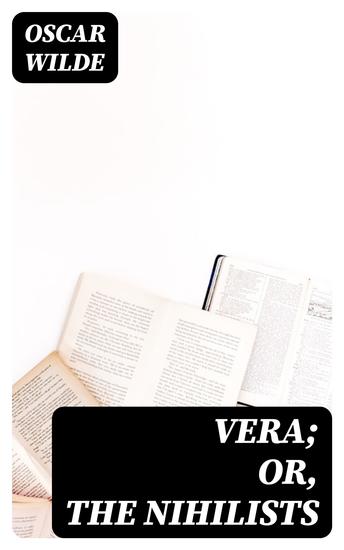
Vera; Or The Nihilists - cover

Vera; Or The Nihilists

Oscar Wilde

Publisher: DigiCat

  • 0
  • 0
  • 0

Summary

In "Vera; Or, The Nihilists," Oscar Wilde intricately weaves a tale of love and political idealism against the backdrop of 19th-century Russia's revolutionary fervor. Employing his characteristic wit and rich symbolism, Wilde explores themes of identity, morality, and the struggle between individual desires and societal expectations. The play is marked by its eloquent dialogue and vivid characterizations, offering a compelling portrayal of nihilism not only as a philosophical doctrine but also as a moral quandary that permeates human relationships in a time of upheaval. Oscar Wilde, a prominent figure of the Aesthetic Movement, was known for his flamboyant style and controversial views. His encounters with various intellectual currents of his time, as well as his own experiences with societal rejection, likely influenced his exploration of nihilism in this work. Wilde's fascination with the darker sides of human nature and his critiques of Victorian morality are vividly manifested in "Vera," a reflection of both personal and cultural tensions. This play is highly recommended for readers who appreciate rich literary texts that challenge conventional norms. Wilde's masterful blending of tragedy and philosophical inquiry invites readers to reflect on the nature of sacrifice and moral conflict, making "Vera; Or, The Nihilists" not only a significant work of its time but also a timeless exploration of the human condition.
Available since: 09/16/2022.
Print length: 47 pages.
Other books that might interest you

  • 101 Great American Poems - cover

    101 Great American Poems

    The American Poetry & Literacy...

    • 0
    • 0
    • 0
    "101 Great American Poems" is a thoughtfully curated anthology that brings together a diverse collection of classic American poetry. Spanning over two centuries, the book features works from some of the nation's most celebrated poets, including Edgar Allan Poe, Emily Dickinson, Walt Whitman, Robert Frost, and Langston Hughes. Each poem has been carefully selected to represent the richness and variety of American poetic expression, capturing themes of nature, love, identity, and the human experience. This accessible volume serves as both an introduction to American poetry for newcomers and a treasured collection for enthusiasts, making it an essential addition to any literary library.
    Show book
  • Primordial - Poems - cover

    Primordial - Poems

    Mai Der Vang

    • 0
    • 0
    • 0
    Mai Der Vang's poetry—lyrically insistent and visually compelling—constitutes a groundbreaking investigation into the collective trauma and resilience experienced by Hmong people and communities, the ongoing cultural and environmental repercussions of the war in Vietnam, the lives of refugees afterward, and the postmemory carried by their descendants. Primordial is a crucial turn to the ecological and generational impact of violence, a powerful and rousing meditation on climate, origin, and fate. 


    With profound and attentive care, Vang addresses the plight of the saola, an extremely rare and critically endangered animal native to the Annamite Mountains in Laos and Vietnam. Remarkably, the saola has only been known to the outside world since 1992, and sightings are so rare that it has now been more than a decade since the last known image of one was captured in a camera trap photo in 2013. 


    Primordial examines the saola's relationship to Hmong refugee identity and cosmology and a shared sense of exile, precarity, privacy, and survival. Can a war-torn landscape and memory provide sanctuary, and what are the consequences for our climate, our origins, our ability to belong to a homeland? Written during a difficult pregnancy and postpartum period, Vang's poems are urgent stays against extinction.
    Show book
  • Asphyxia - The Story of a Life Scripted in Parentheses - cover

    Asphyxia - The Story of a Life...

    Thomas Tomazo Pagonis

    • 0
    • 0
    • 0
    This audiobook is narrated by an AI Voice.   
    Asphyxia is a hauntingly lyrical novel that unfolds like a cinematic screenplay in parenthetical time and conditional mood. Told through the voice of Nefeli—a young woman observing her life on a mental screen—this work blurs the boundaries between memory, myth, narration, and madness. Set in a literary universe where authors are tyrants, muses are merciless, and reality is often just a rumour, the story follows Nefeli’s metaphysical descent into guilt, obsession, and poetic hallucination. 
    Through the echo of voices—narrators, poets, and ghosts—the book explores the invisible lives of the mentally fragile, those who vanish quietly between diagnoses and metaphors. With a cast of characters both archetypal and painfully human, Asphyxia is not a love story, nor a murder mystery, though it flirts with both. It is a philosophical narrative about stories themselves: who writes them, who performs them, and who suffers them. 
    Written by Tomazo Pagonis and originally crafted in Greek, this audiobook has been translated into rich British English by Marilu Pagoni. It is recommended for lovers of experimental fiction, metafictional narrative, and those who sense their own lives unfolding in parentheses.
    Show book
  • Poems for Honeymooners - Love poems for married people - cover

    Poems for Honeymooners - Love...

    W B Yeats

    • 0
    • 0
    • 0
    Honeymoons are a relatively modern concept in the western world, dating from the 19th Century and have since become a multi-billion dollar industry turning the beginning of wedded bliss into a smorgsboard of ‘must have this’ and ‘must do that’.   
     
    However, celebrating a marriage is something we perhaps all feel should be a more intimate occasion.  After all this part of the journey is possibly unique as well as universal and timeless.  Sex, possibly for the first time, is now an expression of the wedded state, cementing and reframing the relationship as a new couple.   
     
    Within the lines of this volume are perfect poems for those on such a journey, whether it a romantic holiday setting or relaxed at home as our classic poets revel in the sensual, the sexy and above all the love for that very special chosen person in our lives.   Our verse includes those from Shakespeare, Elizabeth Barrett Browning, Rossetti, W B Yeats, Khalil Gibran, Ella Wheeler Wilcox and many more. 
     
    01 - Poetry for Honeymooners - An Introduction 
    02 - He Wishes For the Cloths of Heaven by W B Yeats 
    03 - A Red, Red Rose by Robert Burns 
    04 - Now Sleeps the Crimson Petal from The Princess by Alfred Lord Tennyson 
    05 - I Love You by Ella Wheeler Wilcox 
    06 - Wild Nights, Wild Nights by Emily Dickinson 
    07 - Love and Sleep by Algernon Charles Swinburne 
    08 - Nuptial Sleep by Dante Gabriel Rossetti 
    09 - The Sunne Rising by John Donne 
    10 - Song of the Flower by Khalil Gibran 
    11 - My Delight and Your Delight by Robert Seymour Bridges 
    12 - The Passionate Shepherd to His Love by Christopher Marlowe 
    13 - The Willing Mistress by Aphra Behn 
    14 - A Nuptial Verse to Mistress Elizabeth Lee, Now Lady Tracy by Robert Herrick 
    15 - The Bride by Laurence Hope aka Violet Nicholson 
    02 - Love's Philosophy by Percy Bysshe Shelley 
    17 - Her Breast is Fit For Pearls by Emily Dickinson 
    18 -  Invitation to Love by Paul Laurence Dunbar 
    19 - The Flea by John Donne 
    20 - To Celia by Ben Jonson 
    21 - She Lay Naked All in Bed - Anonymous 
    22 - Delight in Disorder by Robert Herrick 
    23 - Amores - Book I Elegy V - Corinna in an Afternoon by Ovid 
    24 - For the Courtesan Ch'ing Lin Wu Zao 
    25 - The Kiss by Charlotte Dacre 
    26 - That Kiss By Daniel Sheehan 
    27 - The First Kiss Of Love by Lord Byron 
    28 - First Love by John Clare 
    29 - Longing by Matthew Arnold 
    30 - Give All To Love by Ralph Waldo Emerson 
    31 - Sonnet IV - Lovesight by Dante Gabriel Rossetti 
    32 - Love is Enough by William Morris 
    33 - Lips and Eyes by Thomas Carew 
    34 - She Walks in Beauty by Lord Byron 
    35 - When I Too Long Have Looked Upon Your Face by Edna St Vincent Millay 
    36 - Go Lovely Rose by Edmund Waller 
    37 - Sonnet 18 - Shall I Compare Thee to a Summers Day by William Shakespeare 
    38 - Beauty That is Never Old by James Weldon Johnson 
    39 - Bright Star by John Keats 
    40 - Falling Stars by Rainer Maria Rilke 
    41 - A Bridal Song by John Ford 
    42 - Wedded by Isaac Rosenberg 
    43 - To a Husband by Anne Kingsmill Finch 
    44  - On Marriage by Khalil Gibran 
    45 - I Am Not Yours by Sara Teasdale 
    46 - Unending Love by Tagore 
    47 - Fidelity by D H Lawrence 
    48 - June, a Tale by William Cowper 
    49 - The Owl and the Pussycat by Edward Lear 
    50 - An Extract of the Wife's Will by Charlotte Bronte 
    51 - How Do I Love Thee by Elizabeth Barrett Browning 
    52 - Terminus by Edith Wharton 
    53 - The Good Morrow by John Donne 
    54 - If Thou Must Love Me Let It Be For Nought by Elizabeth Barrett Browning
    Show book
  • Poets on Poetry - The most artistic and creative form of writing we have a selection of poems from those artistic and creative minds about poetry itself - cover

    Poets on Poetry - The most...

    Matthew Arnold, Sarojini Naidu,...

    • 0
    • 0
    • 0
    Who has not tried to write a poem?  The poetic form of words seems to be rather easy.  In its basic form, which we learn as children, the rhyming couplet is, in a child’s written and spoken words, pure joy - success!  In the hands of a Shakespeare it is magnificent with a reach and understanding that the rest of us enjoy but are far from even attempting.    
     
    As we listen to various poetic forms, schools and movements we can only react with wonder at how these innocent words are assembled to create symphonies of ideas, wonder and revelation.  The emotions they seek to invoke can be anything from happiness to sadness, from love to revulsion. 
     
    Arnold, Stevens, Keats, Akhmatova, Browning, Herrick, Hood, Killigrew are but a few of the roll-call of wordsmiths who with mere words create ravenous beauty that reveals tender lines and sensitive verse on how and why they are who they are. 
     
    01 - Poets on Poetry - An Introduction 
    02 - When I Write Poems by Anna Akhmatova 
    03 - Of My Poems by Thomas MacDonagh 
    04 - An Apology For Her Poetry by Duchess of Newcastle, Margaret Cavendish 
    05 - Sonnet 76 - Why is My Verse So Barren of New Pride by William Shakespeare 
    06 - The Austerity of Poetry by Matthew Arnold 
    07 - Of Modern Poetry by Wallace Stevens 
    08 - Poetry by Claude McKay 
    09 - The Poetry of Keats by George Meredith 
    10 - Future Poetry by Alice Meynell 
    11 - Sonnet 17 - Who Will Believe My Verse in Time to Come by William Shakespeare 
    12 - Poetic Eggs by Ezra Pound 
    13 - Poem by William Carlos Williams 
    14 - On the Grasshopper and Cricket by John Keats 
    15 - Ode on the Poetical Character by William Collins 
    16 - Introduction and Conclusion of a Long Poem by Alan Seeger 
    17 - A True Account of the Birth and Conception of a Late Famous Poem by Charles Sackville, Earl Of Dorset 
    18 - The Poem That Took the Place of a Mountain by Wallace Stevens 
    19 - The Poet and the Poem by Elizabeth Stuart Phelps 
    20 - Of English Verse by Edmund Waller 
    21 - Love, The Soul of Poetry by Anne Killigrew 
    22 - Why, If All Poets Crown Their Love with Verse by Emily Hickey 
    23 - Verse Making Was the Least of My Virtues by Robert Browning 
    24 - The Poet's Love-Song by Sarojini Naidu 
    25 - A Letter to a Brother of the Pen in Tribulation by Aphra Behn 
    26 - Not Every Day Fit for Verse by Robert Herrick 
    27 - On the Poetic Muse by George Moses Horton 
    28 - Sonnet - Written in Keats by Thomas Hood 
    29 - Sonnet 86 -Was It the Proud Full Sail of His Great Verse by William Shakespeare 
    30 - Song in Imitation of Shakespeare by James Beattie 
    31 - The High-toned Old Christian Woman by Wallace Stevens 
    32 - Poetry is a Destructive Force by Wallace Stevens 
    33 - To My Most Dearly Loved Friend Henry Reynolds Esquire of Poets and Poesie by Michael Drayton 
    34 - His Poetry His Pillar by Robert Herrick 
    35 - To Live Merrily and to Trust to Good Verses by Robert Herrick 
    36 - Poem for the End by Ivor Gurney
    Show book
  • White Terror Black Trauma - Resistance Poems About Black History - cover

    White Terror Black Trauma -...

    Philip C. Kolin

    • 0
    • 0
    • 0
    The 61 poems in White Terror Black Trauma concentrate on some of the most traumatic events in Black history from colonial to contemporary times, from the arrival of enslaved Africans in 1619 to Black revolts, Civil War atrocities, incalculable lynchings, the Tulsa massacre, the brave sacrifices of Rosa Parks, the Freedom Riders, the heroes of school desegregation, the murders of Emmet Till, Dr. King, Fred Hampton, Malcolm X, Trayvon Martin, Michael Brown, George Floyd, Breanna Taylor, Eric Garner, and Tyre Nichols. And so many other Black tragedies.  
     
     
    Each poem here carries a brief head note identifying the person, place, time, or event that addresses the historical context of the poem. Some poems are written in a his/her recollection of the historical event. Above all, each poem highlights the topography of Black trauma, be that a Civil War fort, a lynching tree, a prison, a school, an island, a ghetto, a river, a national monument, a church, or city street. These resistance poems are chronicles, laments, petitions, heroic recollections about racial attacks on Black people in America.
    Show book