Join us on a literary world trip!
Add this book to bookshelf
Grey
Write a new comment Default profile 50px
Grey
Subscribe to read the full book or read the first pages for free!
All characters reduced
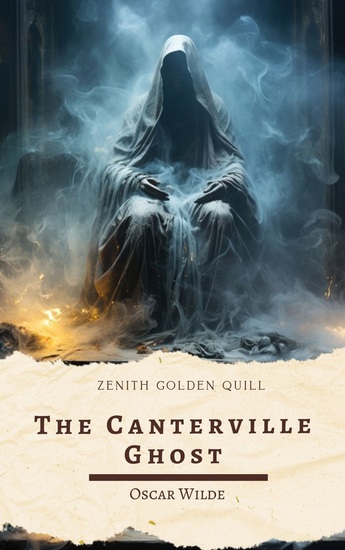
The Canterville Ghost - A Gothic Comedy Where an American Family Meets an English Phantom—With Wildean Wit and Heart - cover

The Canterville Ghost - A Gothic Comedy Where an American Family Meets an English Phantom—With Wildean Wit and Heart

Oscar Wilde, Zenith Golden Quill

Publisher: Zenith Golden Quill

  • 0
  • 0
  • 0

Summary

A ghost. A family. A curse—and a twist only Oscar Wilde could deliver.

The Canterville Ghost is a delightful fusion of gothic horror and satire, penned by Oscar Wilde with his trademark humor and social insight. When a brash American family moves into a haunted English manor, they're unimpressed by the ghostly antics of Sir Simon de Canterville—who, in turn, is equally baffled by their irreverence.

Beneath the laughs and spectral encounters lies a touching story of forgiveness, love, and the unexpected humanity of a restless spirit.

This annotated and illustrated edition includes historical context, Wildean analysis, and period artwork—ideal for students, families, and lovers of classic supernatural fiction.

"A rare blend of wit and melancholy—Oscar Wilde at his most playful and profound." — The Times Literary Supplement
"Wilde turns the ghost story upside down and makes it his own." — The Guardian

Click Buy Now to experience this enchanting tale where horror meets hilarity—and redemption haunts us all.
Available since: 05/16/2025.
Print length: 54 pages.

Other books that might interest you

  • Metamorphoses - cover

    Metamorphoses

    Publius Ovidius Naso

    • 0
    • 0
    • 0
    Ovid's Metamorphoses is an epic poem written in Latin, composed of fifteen books, which explores the theme of transformation and change. The narrative follows a chronological order, beginning with the world's creation and ending with the reign of Julius Caesar. Ovid retells traditional Greek and Roman myths, focusing on the transformations of gods, heroes, and mortals as they undergo physical, emotional, and psychological changes that reflect the complexities of the human experience. Some of the most famous stories in the Metamorphoses include the tales of Apollo and Daphne, Pyramus and Thisbe, Narcissus and Echo, and the fall of Icarus.
    While modern scholars consider this epic poem to be Ovid's magnum opus, the work was not well received by its contemporaries; the Roman emperor Augustus went so far as to exile Ovid and ban his books from Rome's libraries. Today, this work is considered one of the most influential works in Western culture and has inspired countless authors like Shakespeare, Chaucer, and Dante.
    Show book
  • A Thousand Deaths - From their pens to your ears genius in every story - cover

    A Thousand Deaths - From their...

    Jack London

    • 0
    • 0
    • 0
    John Griffith Chaney was born on January 12th, 1876 in San Francisco.   
    His father, William Chaney, was living with Flora Wellman when she became pregnant.  Chaney insisted she have an abortion.  Flora's response was to turn a gun on herself.  Although her wounds were not severe the trauma made her temporarily deranged. 
    In late 1876 his mother married John London and the young child was brought to live with them as they moved around the Bay area, eventually settling in Oakland where now, calling himself Jack, he completed grade school. 
    Jack worked hard at several jobs, sometimes 12-18 hours a day, but his dream was university.  He studied hard and borrowed the money to enrol in the summer of 1896 at the University of California in Berkeley. 
    In 1897, at 21, Jack searched out newspaper accounts of his mother's suicide attempt and for the name of his biological father. He wrote to Chaney, then living in Chicago, who claimed he could not be Jack’s father because he was impotent and casually asserted that London's mother had relations with other men.  Jack, devastated by the response, quit Berkeley and went to the Klondike. Other accounts suggest that his dire finances presented Jack with the excuse he needed to leave. 
    In the Klondike Jack began to gather material for his writing but also accumulated many health problems, including scurvy, which together with hip and leg problems he would carry for the rest of his life. 
    During the late 1890's Jack was regularly publishing short stories and by the turn of the century full blown novels. 
    By 1904 Jack had married, fathered two children and was now in the process of divorcing.  A stint as a reporter on the Russo-Japanese war of 1904 was equal amounts trouble and experience. But that experience was always put to good use in a continuing and remarkable output of work. 
    In 1905 he married Charmian Kittredge who at last was a soul and companion who brought him some semblance of peace despite his advancing alcoholism and his incurable wanderlust. 
    Twelve years later Jack had amassed both wealth and a literary reputation through such classics as ‘The Call of the Wild’, ‘White Fang’ and many others. He had a reputation as a social activist and was a tireless friend of the workers.   
    Jack London died suffering from dysentery, late-stage alcoholism and uremia, aged only 40, on November 22nd 1916 at his property in Glen Elen in California.
    Show book
  • Strange Case of Dr Jekyll and Mr Hyde The - Audiobook - cover

    Strange Case of Dr Jekyll and Mr...

    Robert Louis Stevenson, Classic...

    • 0
    • 0
    • 0
    The Strange Case of Dr. Jekyll and Mr. Hyde is a dark and gripping novella by Robert Louis Stevenson that explores the duality of human nature. Set in Victorian London, it tells the story of the respectable Dr. Jekyll, who creates a potion to separate the good and evil within himself. The result is the terrifying Mr. Hyde, a man who embodies his darkest impulses. As Hyde begins to take control, Jekyll finds himself in a desperate struggle for his soul.This haunting tale is both a psychological thriller and a moral allegory, raising timeless questions about identity, repression, and the battle between good and evil. Stevenson's masterful storytelling and atmospheric writing make it one of the most enduring classics of Gothic literature.
    Show book
  • The Book of Dragons - cover

    The Book of Dragons

    Edith Nesbit

    • 0
    • 0
    • 0
    "The Book of Dragons" by Edith Nesbit is a delightful collection of whimsical tales where magic and mischief collide. From mischievous dragonets causing chaos to a magic carpet with a mind of its own, Nesbit weaves enchanting stories that captivate the imagination. Each tale explores the unexpected consequences of magical encounters, offering a blend of humor, fantasy, and moral lessons in this timeless collection.
    Show book
  • The Red Badge of Courage - cover

    The Red Badge of Courage

    Stephen Crane

    • 0
    • 0
    • 0
    On a cold day, the 304th New York Infantry Regiment awaits battle beside a river. Eighteen-year-old Private Henry Fleming, remembering his reasons for enlisting as well as his mother's resulting protests, wonders whether he will remain brave in the face of fear or turn and run. The story follows Fleming on the fateful days to come, through flight and redemption, injury and the horrors of war. The Red Badge of Courage received generally positive reviews from critics on its initial publication; in particular, it was said to be a remarkably modern and original work., the original 1895 publication went through ten editions in the first year alone, making Crane an overnight success at the age of twenty-four. 
    This bestselling book in both the US and the States, praised for its sense of realism is reproduced here, narrated by Michael Ward.
    Show book
  • Iliad The (Unabridged) - cover

    Iliad The (Unabridged)

    Homer

    • 0
    • 0
    • 0
    Dating to the ninth century B.C., Homer's timeless poem still vividly conveys the horror and heroism of men and gods wrestling with towering emotions and battling amidst devastation and destruction, as it moves inexorably to the wrenching, tragic conclusion of the Trojan War. Renowned classicist Bernard Knox observes in his superb introduction that although the violence of the Iliad is grim and relentless, it coexists with both images of civilized life and a poignant yearning for peace.
    Show book