Join us on a literary world trip!
Add this book to bookshelf
Grey
Write a new comment Default profile 50px
Grey
Subscribe to read the full book or read the first pages for free!
All characters reduced
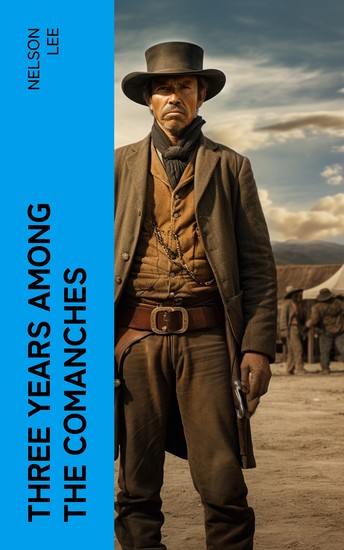
Three Years Among the Comanches - The Narrative of the Texas Ranger - cover

Three Years Among the Comanches - The Narrative of the Texas Ranger

Nelson Lee

Publisher: e-artnow

  • 0
  • 0
  • 0

Summary

This narrative has been recorded, as received from Nelson Lee's lips, from day to day, not precisely in his own words, inasmuch as he is not an educated, though an intelligent man, but his history is told substantially as he relates it. Of the entire truth of his statements, however marvelous many of them may appear, or however much the incredulous may be inclined to dispute, there can be no reasonable doubt. Evidences corroborating them are abundant. He bears upon his person the visible scars of all the wounds he is represented as having received in the border wars of Texas, and while a prisoner among the Indians. He is familiar, to the minutest detail, with the history of those stirring times when Jack Hays, and Ben McCullough, and Ewen Cameron, at the head of the hardy Rangers were wont to sally forth from the grand square of San Antonio, to uphold the banner of the "lone star'' against Mexican domination.
Available since: 12/15/2023.
Print length: 143 pages.

Other books that might interest you

  • Stop Overthinking Today - Master Your Mind Release Stress and Live Fully in the Present - cover

    Stop Overthinking Today - Master...

    Mason Keller

    • 0
    • 0
    • 0
    Are you tired of endless mental loops, constant worry, and sleepless nights spent overthinking every little detail? Stop Overthinking Today is your practical guide to reclaiming control of your mind, reducing stress, and living fully in the present. 
    Packed with 23 powerful, actionable techniques, this book shows you how to silence mental chatter, release anxiety, and break free from the spirals that steal your peace. From mindfulness exercises and journaling to mental anchors, gratitude practices, and purposeful action, each strategy is designed to be simple, effective, and easy to integrate into your daily life. 
    Whether you struggle with decision-making, self-doubt, or chronic worry, Stop Overthinking Today offers tools to:Calm your racing thoughts and declutter your mindFocus on what you can control and let go of what you cannotTransform stress and anxiety into clarity and confidenceBuild lasting habits that prevent overthinking from creeping back 
    Written in clear, relatable language and filled with practical guidance, this book empowers you to stop letting your thoughts control your life. By applying these techniques consistently, you’ll cultivate a calm, resilient mindset that allows you to act with confidence, enjoy the present moment, and finally experience mental peace. 
    Take the first step toward freedom from overthinking. Master your mind, release stress, and start living fully today.
    Show book
  • Underground Railroad - in Pennsylvania - cover

    Underground Railroad - in...

    William J Switala

    • 0
    • 0
    • 0
    A revised and expanded history of Pennsylvania’s role in the Underground Railroad, featuring escape route maps and eyewitness accounts. Organized in antebellum America to help enslaved people escape to freedom, the Underground Railroad was cloaked in secrecy and operated at great peril to everyone involved. The system was extremely active in Pennsylvania, with routes running through cities and towns in all parts of the state.  This revised second edition of Underground Railroad in Pennsylvania retraces the routes with detailed maps, discusses the large city networks, identifies the houses and sites where escapees found refuge, and records the names of the people who risked their lives to support the operation.
    Show book
  • Ramses II - The Great Pharaoh of Egypt - cover

    Ramses II - The Great Pharaoh of...

    Omar Khalil

    • 0
    • 0
    • 0
    Ramses II, also known as Ramses the Great, ascended to the throne of Egypt at the age of around twenty-five, marking the beginning of one of the most illustrious reigns in ancient Egyptian history. Born to Seti I and Queen Tuya, Ramses was the second son in a royal family with a rich history of military conquest and religious devotion. His early life was marked by a deep connection to his father, who was a powerful Pharaoh and who taught him the ways of leadership, military strategy, and governance. 
    Ramses II’s rise to power was in part due to the untimely death of his older brother, Amunherkhepeshef. His subsequent coronation followed the traditional Egyptian custom, but Ramses’s reign would quickly set him apart from his predecessors. Under Seti I’s rule, Egypt had already gained considerable strength, and Ramses inherited an empire that was well-positioned for further military expansion. Yet, it was his own brilliance, both as a military leader and as a strategist, that allowed him to solidify his place as one of the greatest Pharaohs of Egypt. 
    One of the first significant moments of his reign was his involvement in the Battle of Kadesh. Although young at the time, Ramses’s leadership during this critical battle would define his reputation as a warrior king. Despite facing a large Hittite force, Ramses II's audacity and resilience ensured Egypt's power remained strong. Though the battle ended in a stalemate, Ramses managed to secure his status through subsequent peace negotiations, leaving a lasting legacy on Egypt’s military and political landscape.
    Show book
  • Essay on the Principle of Population An - cover

    Essay on the Principle of...

    Thomas Malthus

    • 0
    • 0
    • 0
    Thomas Malthus, an English economist and cleric, published his influential work "An Essay on the Principle of Population" in 1798. The book introduced the idea that population growth would outstrip resources in the long run, leading to catastrophic consequences such as famine, disease, and war. 
    Malthus argued that population growth was exponential, while resources grew at a much slower arithmetic rate. This meant that over time, the population would inevitably outstrip the ability of the land to produce food, leading to a "positive check" on population growth in the form of famine, disease, or war. 
    Malthus also identified a "preventative check" on population growth, which he saw as the moral restraint of individuals to delay marriage and childbirth until they could support a family. However, he believed that this restraint would only be effective for the wealthy and educated classes, while the poor would continue to have large families out of necessity. 
    Malthus's ideas were controversial at the time, as they challenged the prevailing belief in progress and the idea that human ingenuity and technological advances could overcome any resource constraints. However, his ideas gained traction in the 19th century as Europe experienced a series of famines and population pressures, and his work influenced later economists such as David Ricardo and John Stuart Mill. 
    Critics of Malthus have argued that his predictions did not come to pass, as the world has experienced significant improvements in food production and living standards over the last two centuries. However, Malthus's ideas continue to influence debates on population growth, resource constraints, and environmental sustainability.
    Show book
  • A City Within One Building - Exploring the Unique Architecture of Urban Life - cover

    A City Within One Building -...

    John Harpoon

    • 0
    • 0
    • 0
    In the heart of urban landscapes, the idea of a "city within one building" has evolved from a futuristic concept to a tangible reality. These monumental structures encapsulate the essence of urban life, redefining the way we live, work, and interact within confined yet dynamic environments. At their core, they embody the idea of vertical urbanism—a vision that seeks to concentrate the diversity and vibrancy of a city into a single architectural entity. 
    The origins of this vision can be traced to the pressures of urbanization and the relentless march of technological innovation. As cities expanded horizontally, they encountered spatial limitations, environmental challenges, and infrastructural strain. The solution lay not outward, but upward. Vertical urbanism emerged as a response to these challenges, combining architectural ingenuity with a commitment to sustainability. The result is a new typology of buildings that integrate residential, commercial, recreational, and even cultural spaces into a cohesive, self-contained ecosystem. 
    One of the most compelling aspects of these megastructures is their ability to transform our perception of space and connectivity. Traditional cities rely on sprawling layouts that separate different functions—housing, offices, schools, and leisure activities are often miles apart. By contrast, a city within a building integrates these elements into a seamless whole. Residents can live, work, and play without stepping outside, reducing reliance on transportation and fostering a sense of community within the structure’s walls.
    Show book
  • Life Map - A Short Guide For Future Generations - (and a couple of personal anecdotes) - cover

    Life Map - A Short Guide For...

    Ioniţă "Shumu” Mihai

    • 0
    • 0
    • 0
    My aim with this book is to help bring some clarity and a sense of direction to adults and younger people alike. 
    As an adult, if you find yourself kind of stuck, say you’ve had a fair amount of experiences up to this point, you are financially independent and overall pretty content but feel you kind of lost contact with some of your dreams and aspirations from around…10 years ago…keep on reading. 
    Or, if you’re a student who feels overwhelmed in today’s world where we’re all constantly flooded by the online medium which fights for each second of our attention and distorts reality by feeding us fake reference points…keep on reading. 
    It’s completely understandable how someone can feel lost and not know what to do with one’s life. 
    While I do not claim to hold an absolute truth, I firmly believe that this book can and will be seen as a clear and solid starting point in helping you find at least some answers to questions you have or may have, whether you’re an adult looking to improve your life, or a student feeling your life is just starting out. 
    In short, my idea was to take Abraham Maslow’s Expanded Hierarchy of Needs and pump it full of steroids. 
    I wanted to take this pyramid and turn it into a tesseract. 
    Ok…so maybe that fifth cup of coffee at 3 a.m. wasn’t such a good idea after all.
    Show book