Join us on a literary world trip!
Add this book to bookshelf
Grey
Write a new comment Default profile 50px
Grey
Subscribe to read the full book or read the first pages for free!
All characters reduced
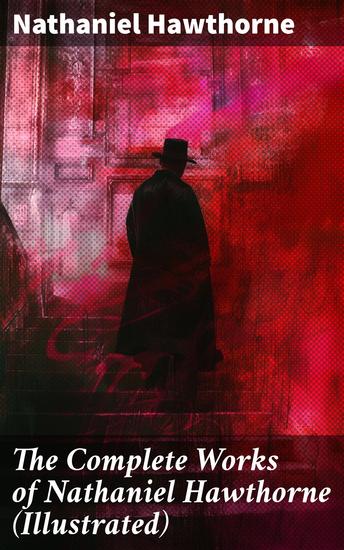
The Complete Works of Nathaniel Hawthorne (Illustrated) - Exploring Dark Romanticism and Moral Allegory in American Literature - cover

The Complete Works of Nathaniel Hawthorne (Illustrated) - Exploring Dark Romanticism and Moral Allegory in American Literature

Nathaniel Hawthorne

Publisher: Good Press

  • 0
  • 0
  • 0

Summary

In 'The Complete Works of Nathaniel Hawthorne (Illustrated)', the reader encounters a masterful compilation of Hawthorne'Äôs oeuvre, which captures the complexities of human nature, moral dilemmas, and the intricate relationship between the individual and society. Characterized by his distinctive dark romanticism, Hawthorne's prose navigates transcendental themes, exploring guilt, sin, and redemption through a tapestry of rich detail and profound symbolism. The illustrations accompanying the text serve to enhance the emotional depth of his narratives, allowing readers to engage with the mesmerizing landscapes and characters that populate his imaginative worlds, from the Puritanical setting of 'The Scarlet Letter' to the allegorical depths of 'The House of the Seven Gables.' Nathaniel Hawthorne (1804-1864) stands as one of America's preeminent literary figures, his work deeply informed by his ancestry, particularly the legacy of the witch trials that colored his Massachusetts roots. A contemporary of Emerson and Thoreau, his writing reflects a keen awareness of both Romantic and Gothic traditions, as well as a deep exploration of psychological themes influenced by his own introspective nature. Hawthorne'Äôs pursuit of truth in human experience led him to delve into darker moral territories, presenting readers with intricate narratives that resonate on multiple levels. This pivotal collection is recommended for both new readers and seasoned scholars, as it provides a comprehensive exploration of Hawthorne'Äôs philosophical inquiries and artistic imagination. Offering a unique opportunity to appreciate the breadth of his genius, this illustrated volume is an essential addition to the library of anyone interested in American literature, morality, and the human condition.
Available since: 01/06/2024.
Print length: 4700 pages.

Other books that might interest you

  • Constant Reader - The New Yorker Columns 1927-28 - cover

    Constant Reader - The New Yorker...

    Dorothy Parker, Sloane Crosley

    • 0
    • 0
    • 0
    Dorothy Parker's complete weekly New Yorker column about books and people and the rigors of reviewing. 


    When, in 1927, Dorothy Parker became a book critic for the New Yorker, she was already a legendary wit, a much-quoted member of the Algonquin Round Table, and an arbiter of literary taste. In the year that she spent as a weekly reviewer, under the rupic "Constant Reader," she created what is still the most entertaining book column ever written. Parker's hot takes have lost none of their heat, whether she's taking aim at the evangelist Aimee Semple MacPherson ("She can go on like that for hours. Can, hell—does"), praising Hemingway's latest collection ("He discards detail with magnificent lavishness"), or dissenting from the Tao of Pooh ("And it is that word 'hummy,' my darlings, that marks the first place in The House at Pooh Corner at which Tonstant Weader Fwowed up"). 


    Introduced with characteristic wit and sympathy by Sloane Crosley, Constant Reader gathers the complete weekly New Yorker reviews that Parker published from October 1927 through November 1928, with gimlet-eyed appreciations of the high and low, from Isadora Duncan to Al Smith, Charles Lindbergh to Little Orphan Annie, Mussolini to Emily Post.
    Show book
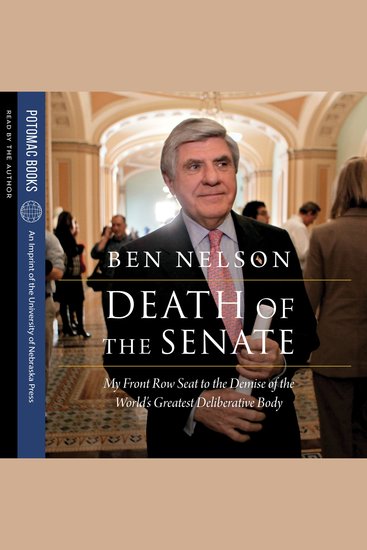
  • Death of the Senate - My Front Row Seat to the Demise of the World's Greatest Deliberative Body - cover

    Death of the Senate - My Front...

    Ben Nelson

    • 0
    • 0
    • 0
    Something is rotten in the U.S. Senate, and the disease has been spreading for some time. But Ben Nelson, former U.S. senator from Nebraska, is not going to let the institution destroy itself without a fight. Death of the Senate is a clear-eyed look inside the Senate chamber and a brutally honest account of the current political reality. 
    In his two terms as a Democratic senator from the red state of Nebraska, Nelson positioned himself as a moderate broker between his more liberal and conservative colleagues and became a frontline player in the most consequential fights of the Bush and Obama years. His trusted centrist position gave him a unique perch from which to participate in some of the last great rounds of bipartisan cooperation, such as the “Gang of 14” that considered nominees for the federal bench—and passed over a young lawyer named Brett Kavanaugh for being too partisan. 
    Nelson learned early on that the key to any negotiation at any level is genuine trust. With humor, insight, and firsthand details, Nelson makes the case that the “heart of the deal” is critical and describes how he focused on this during his time in the Senate. As seen through the eyes of a centrist senator from the Great Plains, Nelson shows how and why the spirit of bipartisanship declined and offers solutions that can restore the Senate to one of the world’s most important legislative bodies.
    Show book
  • Anselm - A Very Short Introduction - cover

    Anselm - A Very Short Introduction

    Thomas Williams

    • 0
    • 0
    • 0
    Anselm of Canterbury (1033–1109) was the outstanding philosopher-theologian of the Latin West between Augustine and the thirteenth century. As a public figure, especially as Archbishop of Canterbury, he corresponded with kings and nobles, popes and bishops, in letters that reveal a fascinating personality and flesh out the practical dimensions of his theoretical philosophy. He wrote at a time when a renewed interest in logic encouraged careful and rigorous argumentation, but before the recovery of Aristotle filled the philosophical discourse with difficult technical jargon, making for writing that is unrivalled for its lucidity and accessibility. He offers the first clear account of what we now call a libertarian view of free will, according to which free choices cannot be determined by the agent's internal states or by external influences. His famous "ontological argument" for the existence of God continues to generate discussion, debate, and puzzlement. His understanding of God is rightly regarded as one of the definitive expressions of classical theism or perfect-being theology, which remains influential in philosophy of religion and analytic theology. His account of the Atonement is one that every theologian to this day still grapples with.
    Show book
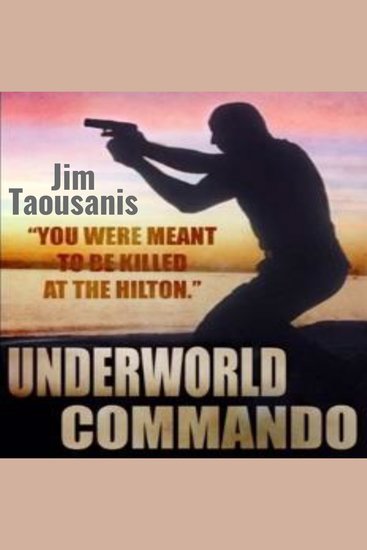
  • Underworld Commando - cover

    Underworld Commando

    Jim Taousanis

    • 0
    • 0
    • 0
    Jim is a former Australian Commando Intelligence Operative that had once lost his way. He now works in Brisbane as an authour, speaker and fitness consultant. 
    His autobiography "Underworld Commando" leaps out of a 1980s Kings Cross world of crime, corrupt police, commandos and some of the most notorious, infamous mob identities in Australian crime history. 
    Jim gives the true-crime account of his double life as a Special Forces soldier and moonlight enforcer for the mob's Lennie 'Mr Big' McPherson and 'Salami' Kon Kontorinakis. At the Sydney Hilton in 1991 the "good times" come to a sudden stop with a fierce gunfight against 3 corrupt police sergeants of the Infamous NSW Armed holdup Squad. The Hilton gunfight brought NSW Police corruption to a halt and launched the Wood Royal Commission into Police Corruption and cascading Pandora's Box of evils. 
    Jim draws on his skills to traverse the decades beyond the gunfight, escape, courts and robberies, prison, informers, fights, a fake murder trial, the Wood Royal Commission, reform, shot after his release, repatriation, resilience and determination to start over again and again. 
    Having survived all, he now fights against a global 'Order of Evil' intent on depopulating the Earth and genetically downgrading the human race into forced slavery. 
    This time, he's on the right side.
    Show book
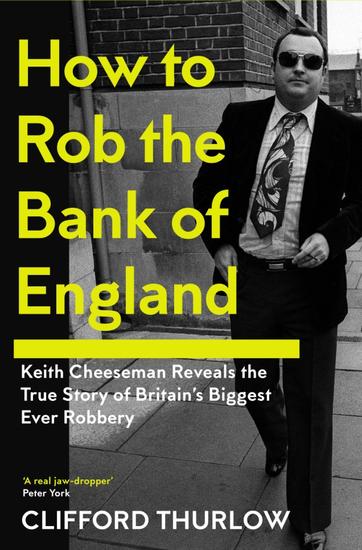
  • How to Rob the Bank of England - Keith Cheeseman Reveals the True Story of Britain's Biggest Ever Robbery - cover

    How to Rob the Bank of England -...

    Clifford Thurlow, Keith Cheeseman

    • 0
    • 0
    • 0
    On a sunny May morning in 1990, a bank courier strode out of the Bank of England and, minutes later, was robbed at knifepoint of 301 bearer bonds valued at £292 million. It was the biggest theft in British history.
    
    The thing is... when Keith Cheeseman received a call from a disbarred lawyer connected to London's underworld and attended a meeting on the night of the robbery, he counted £427 million in bonds - £135 million more than the Bank of England had reported.
    
    As Keith set out to launder the bonds, Scotland Yard and the FBI were always one step ahead in tracking them down. Over the next eighteen months, two gangland figures were shot dead and more than eighty people were arrested. Keith was the only man ever jailed for the crime.
    
    Keith Cheeseman is the last of the old-time gangsters, a con man who detests violence, wears Savile Row suits and gold watches, and loves classic cars and good dining. He bought non-league Dunstable football club and signed Manchester United star George Best to play for the team. He knew the legendary Kray twins and killer Frankie Fraser once threatened to snuff him out him over a game of chess.
    
    So what happened to the missing £135 million?
    
    In this breathtaking adventure, featuring colourful characters from showbusiness alongside royalty, the IRA and even Pablo Escobar, Clifford Thurlow reveals Keith Cheeseman's incredible true story for the first time.
    Show book
  • Life In The Pits - My Time as a Trader on the Rough-and-Tumble Exchange Floors - cover

    Life In The Pits - My Time as a...

    Brad Schaeffer

    • 0
    • 0
    • 0
    In 1989, Brad Schaeffer was working as an artist when his trader brother invited him to visit the floor of the Chicago Mercantile Exchange. Schaeffer promptly quit his job and became a clerk in that most iconic arena of raw capitalism. During the next six years, Schaeffer rose from clerk to trader, making markets on Eurodollar options in Chicago and heating oil options in New York. In that time, jammed literally shoulder-to-shoulder, he screamed, flailed his arms, hurled expletives, and pushed and shoved his way through his day. 


    In Life in the Pits, Schaeffer recalls the uneasy camaraderie of working right next to fierce competitors, the sheer intensity of dealing in stacks of money changing hands with a simple scream or hand signal, and the hijinks, excesses, and collection of characters as colorful as the jackets they wore, giving the listener an intimate look into what life was like down in the financial mosh pits. 


    A worthy successor to Liar's Poker and Reminiscences of a Stock Operator, Life in the Pits offers nuggets of wisdom on what makes a successful trader and the rules all must follow to survive in such an unforgiving environment. Schaeffer's often hilarious, yet sometimes profound, reflections take us on his personal journey from penniless artist to moving millions of dollars' worth of commodities in the blink of an eye.
    Show book