Join us on a literary world trip!
Add this book to bookshelf
Grey
Write a new comment Default profile 50px
Grey
Subscribe to read the full book or read the first pages for free!
All characters reduced
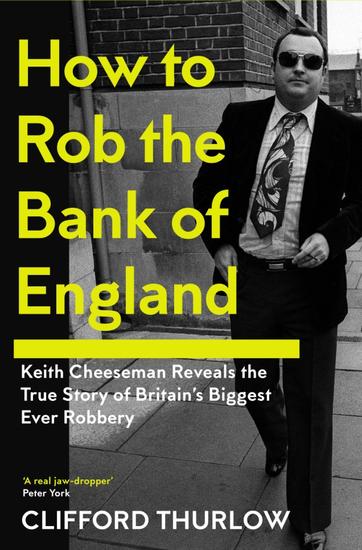
How to Rob the Bank of England - Keith Cheeseman Reveals the True Story of Britain's Biggest Ever Robbery - cover

How to Rob the Bank of England - Keith Cheeseman Reveals the True Story of Britain's Biggest Ever Robbery

Clifford Thurlow, Keith Cheeseman

Publisher: Icon Books

  • 0
  • 0
  • 0

Summary

On a sunny May morning in 1990, a bank courier strode out of the Bank of England and, minutes later, was robbed at knifepoint of 301 bearer bonds valued at £292 million. It was the biggest theft in British history.

The thing is... when Keith Cheeseman received a call from a disbarred lawyer connected to London's underworld and attended a meeting on the night of the robbery, he counted £427 million in bonds - £135 million more than the Bank of England had reported.

As Keith set out to launder the bonds, Scotland Yard and the FBI were always one step ahead in tracking them down. Over the next eighteen months, two gangland figures were shot dead and more than eighty people were arrested. Keith was the only man ever jailed for the crime.

Keith Cheeseman is the last of the old-time gangsters, a con man who detests violence, wears Savile Row suits and gold watches, and loves classic cars and good dining. He bought non-league Dunstable football club and signed Manchester United star George Best to play for the team. He knew the legendary Kray twins and killer Frankie Fraser once threatened to snuff him out him over a game of chess.

So what happened to the missing £135 million?

In this breathtaking adventure, featuring colourful characters from showbusiness alongside royalty, the IRA and even Pablo Escobar, Clifford Thurlow reveals Keith Cheeseman's incredible true story for the first time.
Available since: 09/26/2024.
Print length: 288 pages.

Other books that might interest you

  • Hannibal Barca - The Carthaginian General’s Life and Mission - cover

    Hannibal Barca - The...

    Kelly Mass

    • 0
    • 0
    • 0
    Hannibal Barca, one of Carthage’s most influential generals, lived a couple hundred years before Christ, and has led many Roman troops to victory to conquer the surrounding nations. Famous were his battles with elephants he employed during tactical moves of cavalry and infantry armies alike. His resistance against the Roman powers in the Punic Wars have been praised and lamented worldwide. 
    What was his life like? 
    Where did he come from? 
    What were his motives? 
    Which fights were mostly significant when we speak of his name? 
    How did he die? 
    These are just some of the questions that will be answered in this comprehensive guide. You will get a better understanding of the culture, the times, and the pressures that Hannibal Barca was confronted with.
    Show book
  • A Society - From their pens to your ears genius in every story - cover

    A Society - From their pens to...

    Virginia Woolf

    • 0
    • 0
    • 0
    Adeline Virginia Woolf was born on the 25th January 1882 in South Kensington in London. 
    Although lauded as a founder of modernist writing with such classics as ‘Orlando’, ‘Mrs Dalloway’ and ‘To the Lighthouse’ and, of course, many classic short stories, her background is filled with elements of tragedy that she somehow overcame to become such a revered writer.   Her mother died when she was 13, her half-sister Stella two years later and with it her first of several nervous breakdowns.  Appallingly it was later found that three of her half-brothers had sexually abused her so darkness must have seemed ever present.   
    She began writing professionally at age 20 but her father’s death two years later brought a complete mental collapse and she was briefly institutionalised.  Somehow she found within herself a literary career and with it great innovations in writing; she was a pioneer of “stream of consciousness”.    
    Her tight circle of friends were the founders of the Bloomsbury Group, a movement whose legacy still influences across the arts and society in many way to this day.   
    Whilst the dark periods continued to interrupt her emotional state her rate of work never ceased.  Until, on 28th March 1941, Woolf put on her overcoat, filled up its pockets with stones, and walked into the River Ouse, in Lewes, East Sussex and drowned herself.  Her body was not recovered until the 18th April.  She was 59. 
    She left behind a note which read in part “Dearest, I feel certain that I am going mad again.  I feel we can't go through another of those terrible times.  And I shan't recover this time.  I begin to hear voices, and I can't concentrate.  So I am doing what seems the best thing to do”.
    Show book
  • The Rise And Fall Of The Confederate Goverment - cover

    The Rise And Fall Of The...

    Jefferson Davis

    • 0
    • 0
    • 0
    Jefferson Davis was an American politician who served as the president of the Confederate States from 1861 to 1865. He represented Mississippi in the United States Senate and the House of Representatives as a member of the Democratic Party before the American Civil War. He had previously served as the United States Secretary of War from 1853 to 1857 under President Franklin Pierce. 
    Davis, the youngest of ten children, was born in Fairview, Kentucky to a moderately prosperous farmer couple. He grew up in Wilkinson County, Mississippi, and also lived in Louisiana. His eldest brother Joseph Emory Davis secured the younger Davis's appointment to the United States Military Academy. After graduating, Jefferson Davis served six years as a lieutenant in the United States Army. He fought in the Mexican–American War (1846–1848) as the colonel of a volunteer regiment. Before the American Civil War, he operated in Mississippi a large cotton plantation that his brother Joseph had given him, and owned as many as 113 slaves. Although Davis argued against secession in 1858, he believed the states had an unquestionable right to leave the Union. 
     
    During the American Civil War, Davis guided Confederate policy and served as its commander-in-chief. When the Confederacy was defeated in 1865, Davis was captured, accused of treason, and imprisoned at Fort Monroe in Hampton, Virginia. He was never tried and was released after two years. Davis's legacy is intertwined with his role as President of the Confederacy. Immediately after the war, he was often blamed for the Confederacy's loss. After he was released, he was seen as a man who suffered unjustly for his commitment to the South, becoming a hero of the Lost Cause of the Confederacy during Reconstruction. This is his story.
    Show book
  • KNOW ABOUT "Voltaire" - A French Writer Historian and Philosopher - cover

    KNOW ABOUT "Voltaire" - A French...

    Saurabh Singh Chauhan

    • 0
    • 0
    • 0
    This is small introduction of the book: In the annals of intellectual history, the name "Voltaire" stands as a beacon of enlightenment, a multifaceted figure whose life and ideas continue to shape our understanding of the world. François-Marie Arouet, better known by his pen name Voltaire, emerged as a pivotal force in 18th-century France, leaving an indelible mark as a writer, historian, and philosopher. 
    Born on November 21, 1694, in the heart of Paris, Voltaire's journey traversed the corridors of power, the confines of prison walls, and the intellectual salons of Europe. His story unfolds against the backdrop of a time marked by profound social and philosophical transformations—the Enlightenment. 
    As we embark on this exploration of Voltaire's life, we delve into the tumultuous yet captivating events that shaped his character and fueled his intellectual pursuits. From his early years at the Jesuit College Louis-le-Grand to the transformative sojourn in England, where he imbibed the spirit of liberty and reason, each chapter in Voltaire's life reads like a riveting narrative. 
    In Chapter 2, "Birth and Early Life - 1694," we delve into the origins of this influential thinker, exploring the circumstances of his birth and the early influences that set the stage for his intellectual curiosity. Chapter 3, "His Education," uncovers the formative years of Voltaire's learning, providing insights into the foundations that would support his later literary and philosophical endeavors.
    Show book
  • 25+ The World's Greatest Short Stories Vol 2 - Roger Malvin's Burial Notes From The Underground The Mark On The Wall Heart Of Darkness and other - cover

    25+ The World's Greatest Short...

    Washington Irving, Edgar Allan...

    • 0
    • 0
    • 0
    Contents:
     • Washington Irving: Rip Van Winkle
    • Edgar Allan Poe: The Murders In The Rue Morgue
    • Fyodor Dostoevsky: Notes From The Underground
    • Franz Kafka: The Metamorphosis
    • Charles Dickens: The Chimes
    • Ivan Turgenev: Mumu
    • Francis Scott Fitzgerald: The Curious Case Of Benjamin Button
    • Joseph Conrad: Heart Of Darkness
    • Ambrose Bierce: Chickamauga
    • Arthur Conan Doyle: A Study In Scarlet
    • H. P. Lovecraft: At the Mountains of Madness
    • Nathaniel Hawthorne: Roger Malvin's Burial
    • Guy de Maupassant: Necklace
    • Leo Tolstoy: God Sees The Truth, But Waits
    • Anton Chekhov: The Lottery Ticket
    • Virginia Woolf: The Mark On The Wall
    • Katherine Mansfield: The Garden Party
    • H.G. Wells: The Star
    • Stendhal: Vanina Vanini
    • Honoré De Balzac: The Unknown Masterpiece
    • Mark Twain: The Celebrated Jumping Frog of Calaveras County
    • Aldous Huxley: Crome Yellow
    • Ernest Hemingway: Up In Michigan
    • Nikolay Gogol: A May Night
    • O. Henry: The Ransom Of Red Chief
    • Jack London: To Build a Fire
    Show book
  • The Valley of the Kings - Tombs and Treasures of the Pharaohs - cover

    The Valley of the Kings - Tombs...

    Omar Khalil

    • 0
    • 0
    • 0
    The Valley of the Kings, one of the most iconic archaeological sites in the world, first captured the attention of explorers and scholars in the 18th century. Though long known to local inhabitants, it was not until European adventurers began systematically exploring Egypt that the valley's true significance came to light. These early explorers, driven by a mix of scholarly curiosity and treasure hunting, began mapping and cataloging the tombs they encountered in the barren hills west of the Nile. Among them were figures like Giovanni Belzoni and Howard Carter, whose efforts would lay the foundation for modern Egyptology. 
    The role of local communities, particularly the people of Qurna and other nearby villages, cannot be overlooked. Many locals worked closely with foreign archaeologists, guiding them through the rugged terrain and even assisting in excavations. Their intimate knowledge of the landscape proved invaluable. Some families, generation after generation, were involved in archaeological digs, and many tombs might have remained hidden much longer without their contributions. However, this collaboration also brought complex dynamics, especially regarding the protection of cultural heritage and the handling of newly uncovered treasures. 
    Transforming what seemed like a lifeless desert into a thriving center of discovery, the Valley soon became a symbol of ancient grandeur and mystery. The dry climate and remote location helped preserve many of the tombs, allowing researchers to uncover not only the resting places of kings but also the beliefs, rituals, and artistry of ancient Egypt. With each new find, the Valley revealed more about the powerful individuals buried there and the civilization they ruled.
    Show book