Join us on a literary world trip!
Add this book to bookshelf
Grey
Write a new comment Default profile 50px
Grey
Subscribe to read the full book or read the first pages for free!
All characters reduced
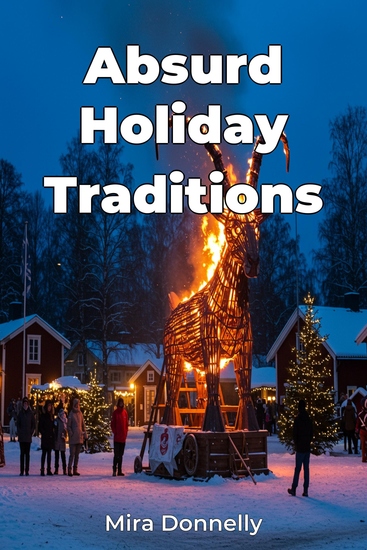
Absurd Holiday Traditions - cover

Absurd Holiday Traditions

Mira Donnelly

Translator A AI

Publisher: Publifye

  • 0
  • 0
  • 0

Summary

Absurd Holiday Traditions explores the fascinating world of unusual festive practices across different cultures. Delving into World History and Social Science, the book examines why certain holidays involve bizarre activities like throwing tomatoes or burning effigies, revealing how these customs persist and shape cultural identity. It highlights the surprising resilience of these traditions, demonstrating how they reinforce social cohesion and provide outlets for emotional expression.

 
The book approaches its subject matter with a blend of historical context and contemporary social science, tracing the origins of these practices and examining their modern-day significance. For example, costume-based celebrations, sometimes seemingly terrifying, often serve as a way for societies to confront and manage collective fears.

 
Unfolding in a structured manner, the book begins by defining "absurd traditions," then progresses through case studies categorized by type, such as food-related festivities and effigy-burning rituals, before synthesizing broader implications for understanding cultural behavior.
Available since: 03/31/2025.
Print length: 55 pages.
Other books that might interest you

  • The Soviet Army's High Commands in War and Peace 1941–1992 - cover

    The Soviet Army's High Commands...

    Richard W. Harrison

    • 0
    • 0
    • 0
    The first full history of the Soviet Army’s High Commands during World War II and the Cold War—“Provides valuable and original research that reveals a great deal about the Soviet Union’s military command structure during World War II, with a few important insights into the almost fifty years that followed” (Journal of Military History).The war on the Eastern Front during 1941–45 was an immense struggle, running from the Barents Sea to the Caucasus Mountains. The vast distances involved forced the Soviet political-military leadership to resort to new organizational expedients in order to control operations along the extended front. These were the high commands of the directions, which were responsible for two or more fronts (army groups) and, along maritime axes, one or more fleets.In all, five high commands were created along the northwestern, western, southwestern, and North Caucasus strategic directions during 1941–42. However, the highly unfavorable strategic situation during the first year of the war, as well as interference in day-to-day operations by Stalin, severely limited the high commands' effectiveness. As a consequence, the high commands were abolished in mid-1942 and replaced by the more flexible system of supreme command representatives at the front. A High Command of Soviet Forces in the Far East was established in 1945 and oversaw the Red Army's highly effective campaign against Japanese forces in Manchuria.The Far Eastern High Command was briefly resurrected in 1947 as a response to the tense situation along the Korean peninsula and the ongoing civil war in China, but was abolished in 1953, soon after Stalin's death. Growing tensions with China brought about the recreation of the Far Eastern High Command in 1979, followed a few years later by the appearance of new high commands in Europe and South Asia. However, these new high commands did not long survive the collapse of the Soviet Union in 1991 and were abolished a year later.The book relies almost exclusively on Soviet and post-communist archival and other sources and is the first unclassified treatment of this subject in any country, East or West.
    Show book
  • Allow Me to Interrupt - A Psychologist Reveals the Emotional Truth Behind Women's ADHD - cover

    Allow Me to Interrupt - A...

    PhD Gilly Kahn

    • 0
    • 0
    • 0
    For many women, the lack of knowledge surrounding ADHD's unique presentation in their lives has led to feeling misunderstood, criticized, frustrated, and alone. Female biology is complicated, and the mainstream understanding of ADHD often simplifies a condition that isn't simple.One thing we are quickly learning about ADHD in women is that the role of emotions and emotion dysregulation have been underemphasized in the ADHD criteria. Think about it: If it's hard to control our behavior, it will, by default, be hard to control our emotional responses. And this relationship is amplified for girls, who are more susceptible to anxiety and depression than boys.Allow Me to Interrupt takes a deep dive into the most unjustifiably underrecognized ADHD symptom: emotion dysregulation. In an effort to educate, inspire, and support other women with ADHD, clinical psychologist and writer, Dr. Gilly Kahn, shares other women's and girls' ADHD stories along with her own.As women with ADHD, we are misunderstood, underappreciated, and unidentified. But it isn't too late to interrupt the status quo, correct misperceptions, and describe the very real emotional lives of girls and women with ADHD.
    Show book
  • When Bad Things Happen to Privileged People - Race Gender and What Makes a Crisis in America - cover

    When Bad Things Happen to...

    Dara Z. Strolovitch

    • 0
    • 0
    • 0
    A deep and thought-provoking examination of crisis politics and their implications for power and marginalization in the United States. 
      
    From the climate crisis to the opioid crisis to the Coronavirus crisis, the language of crisis is everywhere around us and ubiquitous in contemporary American politics and policymaking. But for every problem that political actors describe as a crisis, there are myriad other equally serious ones that are not described in this way. Why has the term crisis been associated with some problems but not others? What has crisis come to mean, and what work does it do? 
      
    In When Bad Things Happen to Privileged People, Dara Z. Strolovitch brings a critical eye to the taken-for-granted political vernacular of crisis. Using systematic analyses to trace the evolution of the use of the term crisis by both political elites and outsiders, Strolovitch unpacks the idea of “crisis” in contemporary politics and demonstrates that crisis is itself an operation of politics. She shows that racial justice activists innovated the language of crisis in an effort to transform racism from something understood as natural and intractable and to cast it instead as a policy problem that could be remedied. Dominant political actors later seized on the language of crisis to compel the use of state power, but often in ways that compounded rather than alleviated inequality and injustice. In this eye-opening and important book, Strolovitch demonstrates that understanding crisis politics is key to understanding the politics of racial, gender, and class inequalities in the early twenty-first century.
    Show book
  • Western Europe - The Fascinating History of Germany and the Netherlands - cover

    Western Europe - The Fascinating...

    Kelly Mass

    • 0
    • 0
    • 0
    This bundle of books is a perfect combination of historical records of the western parts of Europe, the Germanic nations of the Netherlands, Germany, and also some about Belgium. 
    In this book, you will learn about the Batavian Republic, William of Orange, the Eighty Years' War, the Unification of Germany, the Weimar Republic, Otto von Bismarck, the Dutch East-Indian Trading Company, and their empires throughout the last few centuries. There is a lot to cover, so let's hope you're excited to get started.
    Show book
  • Blind Obedience and Denial - The Nuremberg Defendants - cover

    Blind Obedience and Denial - The...

    Andrew Sangster

    • 0
    • 0
    • 0
    "...offers a unique and valuable insight into the psychology of human beings who violate the laws of war. Anyone interested in war crimes generally and the IMT in particular should read this interesting book." — Journal of Military HistoryA revealing yet accessible examination of the Nuremberg trial, and most crucially all 23 men who stood accused, not just the most infamous—Speer, Hess, and Göring. This account sets the scene by explaining the procedures, the legal context, and the moments of hypocrisy in the Allies’ prosecution—ignoring the fact that the Katyn massacre was a Soviet crime and overlooking carpet bombing.  Author Andrew Sangster discusses how the word “Holocaust” was not used until long after the trial, probably due to Russian objection as they had lost many more people, and because the Allies generally were not innocent of anti-Semitism themselves, especially Russia and Vichy France. However, the defendants to a person immediately recognized that this was the singular issue which placed them on the steps of the gallows, and their various defenses on this charge are therefore crucial to understanding the trial. Sangster also explores how the prisoners related to one another in their approach to defending themselves on the charge of genocide and extermination camps, especially in facing the bully-boy Göring.  This new study utilizes not only the trial manuscripts, but the pre-trial interrogations, the views of the psychiatrists and psychologists, and the often-overheard conversations between prisoners—who did not know their guards spoke German—to give the fullest exploration of the defendants, their state of mind, and their attitudes towards the Third Reich, Hitler and each other as they faced judgement by the victors of the war.
    Show book
  • The New Slave Masters - cover

    The New Slave Masters

    George Dallas McKinney

    • 0
    • 0
    • 0
    It's SLAVERY all over again! The New Slavemasters that are destroying hopes and dreams in families and relationships are even more threatening than their whip-wielding predecessors. These new Slavemasters’ evil-rooted forces – drugs, gangs, violence, racism, materialism, deception, teen pregnancy, and sexual promiscuity – still WALK AND LIVE AMONG US. 
    Nearly two centuries ago, Satan used mankind’s deeply rooted sin that resulted in humanity enslaving a race of God’s creation—African-Americans. In this new day when African-Americans enjoy complete freedom, there are new, insidious Slavemasters that work outside civilized law and labor to ensnare black families —and for that matter, families of all races. 
    This book provides a blueprint for restoration and strengthening of African American families. The term, The New Slavemasters, comes from my experiences of present-day enslavement of prevailing temptations and devastation of plagues that wrought the inner city suburbs in my community, resulting in self-imposed slavery and family destruction. When Christians [born-again] and non-Christians fail to recognize the bondage and break the chains that destroy our entire nation, they lose their freedom and volunteer to re-enter into forms of slavery. 
    This entire book helps give awareness of how to break free from and remain free of The New Slavemasters. Reader’s Study Guide, Chapter notes, questions and answers, true stories and illustrations are inserted to support and encourage Bible-study groups, scriptural understanding, and prayer devotions against the assault of the new Slavemasters. 
    The book begins with a mother trying desperately to save her son’s life that was impacted by drugs and “dirty” (drug) money. But, in the endless struggle to free her son from these new Slavemasters’ hold on him, tragedy occurs – he dies before her very eyes.
    Show book