Join us on a literary world trip!
Add this book to bookshelf
Grey
Write a new comment Default profile 50px
Grey
Subscribe to read the full book or read the first pages for free!
All characters reduced
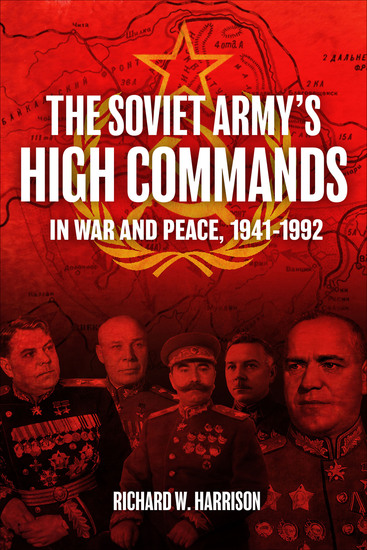
The Soviet Army's High Commands in War and Peace 1941–1992 - cover

The Soviet Army's High Commands in War and Peace 1941–1992

Richard W. Harrison

Publisher: Casemate Academic

  • 0
  • 0
  • 0

Summary

The first full history of the Soviet Army’s High Commands during World War II and the Cold War—“Provides valuable and original research that reveals a great deal about the Soviet Union’s military command structure during World War II, with a few important insights into the almost fifty years that followed” (Journal of Military History).The war on the Eastern Front during 1941–45 was an immense struggle, running from the Barents Sea to the Caucasus Mountains. The vast distances involved forced the Soviet political-military leadership to resort to new organizational expedients in order to control operations along the extended front. These were the high commands of the directions, which were responsible for two or more fronts (army groups) and, along maritime axes, one or more fleets.In all, five high commands were created along the northwestern, western, southwestern, and North Caucasus strategic directions during 1941–42. However, the highly unfavorable strategic situation during the first year of the war, as well as interference in day-to-day operations by Stalin, severely limited the high commands' effectiveness. As a consequence, the high commands were abolished in mid-1942 and replaced by the more flexible system of supreme command representatives at the front. A High Command of Soviet Forces in the Far East was established in 1945 and oversaw the Red Army's highly effective campaign against Japanese forces in Manchuria.The Far Eastern High Command was briefly resurrected in 1947 as a response to the tense situation along the Korean peninsula and the ongoing civil war in China, but was abolished in 1953, soon after Stalin's death. Growing tensions with China brought about the recreation of the Far Eastern High Command in 1979, followed a few years later by the appearance of new high commands in Europe and South Asia. However, these new high commands did not long survive the collapse of the Soviet Union in 1991 and were abolished a year later.The book relies almost exclusively on Soviet and post-communist archival and other sources and is the first unclassified treatment of this subject in any country, East or West.
Available since: 07/28/2022.
Print length: 480 pages.

Other books that might interest you

  • Transforming Race Conversations - A Healing Guide for Us All - cover

    Transforming Race Conversations...

    Eugene Ellis

    • 0
    • 0
    • 0
    A guide to supporting our emergence from the tight grip of race discomfort. 


    If we are to address the injustice of racism, we need to have the "race conversation." All too often, however, attempts at this conversation are met with silence, denial, anger, or hate. This is largely because the construct of race resides not only in our minds, but principally in the body. In order to have productive conversations about race and racism, a paradigm shift is needed—one which will empower us to remain present and embodied, rather than constricted with fear, regardless of our racial identities. 


    Here, psychotherapist Eugene Ellis explores what is needed for this bodily shift to occur as he unpacks the visceral experience of the race conversation. He offers a trauma-informed, neurophysiological approach that emphasizes resourcing, body awareness, mindfulness, and healing. Transforming Race Conversations is essential for therapy practitioners as well as anyone looking to engage more effectively in the ongoing dialogue around race.
    Show book
  • End of the World and the Unknown - What Lies Beyond Our Understanding (5 in 1) - cover

    End of the World and the Unknown...

    John Harpoon

    • 0
    • 0
    • 0
    This book contains the following titles: 
    10 Ways the World Could End 
     Examine the most plausible scenarios that could bring about humanity's extinction or civilization's collapse. From natural disasters like supervolcano eruptions and asteroid impacts to human-driven threats including climate change and nuclear warfare, this section provides a sobering yet scientifically grounded exploration of existential risks. 
    Why We Haven't Found Aliens Yet 
     Delve into the Fermi Paradox—the contradiction between the high probability of extraterrestrial life and our lack of contact. This section explores competing theories including the Great Filter, the Zoo Hypothesis, and technological limitations that might explain the cosmic silence. 
    7 Areas Without Laws 
     Journey to the world's most lawless regions where traditional governance breaks down. From international waters and Antarctic territories to failed states and digital realms, explore these unique jurisdictional vacuums and their surprising social orders. This section reveals how humans organize themselves in the absence of conventional authority and the implications these zones hold for concepts of sovereignty. 
    7 Strange Religions That Exist 
     Explore lesser-known belief systems that challenge conventional religious paradigms. From technological faiths centered on artificial intelligence to psychedelic spiritual movements and reconstructed ancient practices, this section examines alternative approaches to life's ultimate questions. 
    The Dark Side of Introverts 
     Investigate the lesser-discussed aspects of introverted personalities. While often celebrated for depth and creativity, introverts may also struggle with isolation, rumination, and avoidance.
    Show book
  • Skull and Bones: The History and Mystery of Yale University’s Notorious Secret Society - cover

    Skull and Bones: The History and...

    Editors Charles River

    • 0
    • 0
    • 0
    Conspiracy theories, and particularly the belief that elements of the world are secretly controlled by individuals or groups, have been around for as long as people have lived in groups. Perhaps that’s inevitable - after all, those who are excluded from power are very likely to be inclined to see their position not as an outcome of their own choices or situation but because of the secret machinations of shadowy groups. 
    When members of a secret society are some of the wealthiest and most powerful people in the world, it’s easy to see why rumors persist about the group, and among such secret societies, few have engendered interest quit like Skull and Bones, an undergraduate senior society at Yale University. Its members have included American presidents and the CEOs of some of the largest companies in the world, but the group’s secrecy has maintained itself to the extent that some of the membership is virtually all anyone knows for certain, leaving most of what is found in books and websites speculation and unproven legend. Is there any truth to the suggestion that this society is linked to the 18th century Illuminati? Is it a mafia-like organization that intends to see the creation of a New World Order? Why, during its almost 200-year history, has no member of this group ever talked publicly about what it involves? Have those who attempted to reveal more really been subject to intimidation, threats of violence, and even murder? Is the skull of the legendary Geronimo really kept within the group’s secret lair? 
    Writing about any secret society is difficult, and writing about a group that has maintained absolute privacy for a long time is even more difficult.
    Show book
  • Cognitive Behavior Therapy Basics - cover

    Cognitive Behavior Therapy Basics

    Celine Zerth

    • 0
    • 0
    • 0
    Cognitive Behavior Therapy Basics: An Introduction to Changing Negative Thoughts and Behaviors and Overcoming Common Mental Health ChallengesIf you're looking into CBT, you may be struggling with depression, anxiety, or other emotional difficulties, or you may just be interested in learning more about CBT as a mental health professional. Regardless of your motivation, this audiobook will provide you with a solid foundation in the principles and techniques of CBT, as well as practical tips for applying these concepts to your own life or to your work with clients.In this audiobook, you will learn all about CBT, what it is about and how it can help overcome negative thoughts and behaviors. This audiobook will cover the following topics:- What does cognitive behavioral therapy do?- Mindful Cognitive Behavioral Therapy- The Most Popular Techniques Used In CBT- What is cognitive therapy best used for?- Three main cognitive disorders- Signs Of Cognitive Issues- 7 Cognitive Abilities- How do you fix cognitive disorders?- Practices to Improve Thoughts- And many more!If you want to have a basic understanding of the principles and practices of CBT, this audiobook is for you so scroll up and click “add to cart” now to download this audiobook today!
    Show book
  • The Avoidant Attachment Workbook - Get Over the Fear of Intimacy Uncover Deactivation Triggers and Move to Secure Attachment - cover

    The Avoidant Attachment Workbook...

    Melanie Barnett

    • 0
    • 0
    • 0
    Do you feel like relationships are more of a burden than a joy? 
    Ever catch yourself pushing people away, despite yearning for closeness? 
    You're not alone. I've been there, feeling trapped by my own fears and uncertainties. 
    Does any of these situations sound familiar? 
    You can't seem to meet the right person. 
    You're not feeling what you should feel. 
    No one compares to your ex. 
    Something's missing for you. 
    Your relationship's making you feel trapped. 
    Your partners are too needy. 
    They're being emotional, it's too much drama for you. 
    You keep thinking about other options. 
    Here's a little sneak preview of what you’ll get: 
    - How to Overcome Guilt, Shame, and the Fear of Commitment. 
    - 10 Key Techniques to Foster Connection in Relationships 
    - How to Rebuild Trust After it's Broken 
    - Real and Proven Ways to Build a Healthy Relationship That Lasts. 
    - How To Stop Ruminating On Past Relationships (And Finally Move On). 
    - The Four Key Abilities for Nurturing Intimacy 
    - Why Compatibility Is More Important Than Chemistry. 
    - Vulnerability: How Being Real Makes You Irresistible 
    - The 3 Stages Of Relationships Everyone Should Know. 
    - The Early Dating Mistakes You Must Avoid. 
    - Common Avoidant Attachment Misconceptions. 
    - Turn Self Sabotage Into Self Improvement 
    - 16 Relationship Red Flags You Should Never Ignore 
    - The Hidden Truths to Break the Cycle of Unhealthy Relationships. 
    - 9 Practical Steps to Transform Guilt into Growth 
    - 8 Key Strategies to Build Self-Esteem 
    - Addressing the "I'm-No-Victim" Identity in Therapy 
    - 6 Powerful Ways to Release Trapped Emotions 
    - How To Communicate Your Needs Without Being An Assh*le 
    - How to Shift From Avoidant to Secure Attachment
    Show book
  • Gardening at the Margins - Convivial Labor Community and Resistance - cover

    Gardening at the Margins -...

    Gabriel R. Valle

    • 0
    • 0
    • 0
    Gardening at the Margins tells the remarkable story of a diverse group of neighbors working together to grow food and community in the Santa Clara Valley in California. Based on four years of deeply engaged ethnographic field research via a Participatory Action Research project with the people and ecosystems of La Mesa Verde home garden program, Gabriel R. Valle develops a theory of convivial labor to describe how the acts of care among the diverse gardeners—through growing, preparing, and eating food in one of the most income unequal places in the country—are powerful, complex acts of resistance. 


    The individuals featured in the book are imagining and building alternative worlds and futures amid the very real challenges they embody and endure. Climate change, for example, is forcing thousands of migrants to urban areas, which means recent immigrants' traditional environmental, nutritional, and healing knowledge will continue to be threatened by the pervasiveness of modernity and the homogenization of global capitalism. Moreover, once rural people migrate to urban areas, their ability to retain traditional foodways will remain difficult without spaces of autonomy. The stories in this book reveal how people create the physical space to grow food and the political space to enact autonomy to revive and restore agroecological knowledge needed for an uncertain future.
    Show book