Join us on a literary world trip!
Add this book to bookshelf
Grey
Write a new comment Default profile 50px
Grey
Subscribe to read the full book or read the first pages for free!
All characters reduced
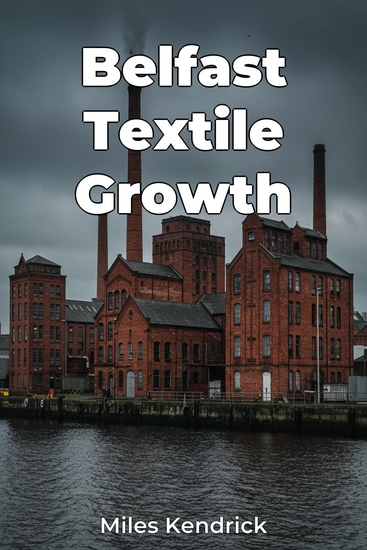
Belfast Textile Growth - cover

Belfast Textile Growth

Miles Kendrick

Translator A Ai

Publisher: Publifye

  • 0
  • 0
  • 0

Summary

Belfast Textile Growth explores how Belfast transformed into a global linen production hub during the Industrial Revolution, examining the economic boom and its profound social consequences. The book argues that while the textile industry spurred economic growth, it also created social inequalities. For example, the introduction of power looms revolutionized production but significantly altered the demand for skilled labor. The book traces the linen industry's evolution from cottage production to factory-based systems, highlighting technological innovations and Belfast's rise as a textile epicenter.It then analyzes the changing nature of work, particularly the experiences of women and child laborers, and the rise of labor movements. Finally, it examines Belfast's role in global trade networks, analyzing its relationships with raw material suppliers and export markets within the British Empire. This approach, supported by factory records and personal accounts, provides a nuanced understanding of the industry's intertwined economic, labor, and social history.
Available since: 05/05/2025.
Print length: 57 pages.
Other books that might interest you

  • Uncle Tom's Cabin: The Icon Black Lives Matter Series - cover

    Uncle Tom's Cabin: The Icon...

    Harriet Beecher Stowe

    • 0
    • 0
    • 0
    Uncle Tom's Cabin is an antislavery novel by American author Harriet Beecher Stowe. Published in two volumes in 1852, the novel had a profound effect on attitudes toward African Americans and slavery in the U.S., and is said to have "helped lay the groundwork for the [American] Civil War". 
      
    Stowe, a Connecticutborn woman of English descent, was part of the religious Beecher family and an active abolitionist. She wrote the sentimental novel to depict the reality of slavery while also asserting that Christian love could overcome slavery. The novel focuses on the character of Uncle Tom, a longsuffering black slave around whom the stories of the other characters revolve. 
      
    Uncle Tom's Cabin was the bestselling novel and the second bestselling book of the 19th century, following the Bible, and is credited with helping fuel the abolitionist cause in the 1850s. The impact attributed to the book was so great that a likely apocryphal story arose of Abraham Lincoln meeting Stowe at the start of the Civil War and declaring, "So this is the little lady who started this great war." 
      
    The book and the plays it inspired helped popularize a number of negative stereotypes about black people including that of the namesake character "Uncle Tom", with the term now used to describe an excessively subservient person. These associations with Uncle Tom's Cabin have, to an extent, overshadowed the historical impact of the book as a "vital antislavery tool". However, the novel stands as a "landmark" in protest literature with later books such as The Jungle by Upton Sinclair and Silent Spring by Rachel Carson owing a large debt to it A oneofakind audio encounter for lovers of history, literature, spiritual texts, and inspirational writing. 
      
     
    Show book
  • If You Were My Daughter - A Memoir of Healing an Unmothered Heart - cover

    If You Were My Daughter - A...

    Marianne Richmond

    • 0
    • 0
    • 0
    At nine years old, Marianne Richmond's life is upended when she collapses with full-body convulsions. "Pinched nerve," says the ER doctor. But when one episode becomes many, it's clear something is wrong. Afraid to be at school, in her body, and in her life, Marianne desperately hopes for help and healing. But her emotionally unavailable mother refuses medication on Marianne's behalf, preferring prayer and homeopathy. 


    At age 18, a full-body seizure in Marianne’s dorm room leads her to a diagnosis, medication, and neurological intervention. Physically, Marianne feels "fixed," but emotional healing proves more elusive. In the years to come, Marianne becomes a parent and writes a new story for her life. She authors children's books that touch millions of lives, each of them celebrating a mother's unconditional love. When her mother becomes ill, Marianne has a choice to make: will she be present for the mother who rarely felt present to her? 


    If You Were My Daughter is a story of learning to hear your own voice, of one daughter's return to wholeness, and a story of accepting that a mother's best can still fall far too short. Richmond illuminates how the stories we're born into shape the ones we tell about ourselves—and reminds us that we have the powerful permission to develop a new relationship with what is difficult in our lives.
    Show book
  • The Shocking Truth about Political Corruption - cover

    The Shocking Truth about...

    Zoey Fraisers

    • 0
    • 0
    • 0
    Political corruption is a pervasive issue that has existed for centuries, shaping the course of governments and societies worldwide. It manifests in various forms, from bribery and fraud to nepotism and abuse of power. Regardless of the system of governance, corruption erodes trust, distorts policies, and undermines democratic principles. While many assume corruption is limited to authoritarian regimes, it is also deeply embedded in democratic institutions, where influence and money often dictate political decisions.  
      
    The roots of corruption can be traced back to the earliest civilizations, where leaders sought personal gain at the expense of their people. Throughout history, political scandals have exposed the extent of corruption within governments, from financial embezzlement to electoral fraud. These cases serve as stark reminders of how unchecked power can lead to widespread deception and exploitation. Corruption is not only a moral failure but a structural issue that allows those in power to manipulate systems designed to serve the public.  
      
    Beyond historical examples, the impact of corruption is far-reaching. It weakens economies by diverting public funds into private hands, leaving essential services such as healthcare, education, and infrastructure underfunded. It fuels inequality, as the wealthy and well-connected benefit from corrupt dealings while the average citizen suffers. When corruption becomes the norm, public trust in institutions erodes, leading to political apathy, civil unrest, and, in extreme cases, the collapse of governments. 
    Show book
  • Wonder and Worry - Contemporary History in an Age of Uncertainty - cover

    Wonder and Worry - Contemporary...

    Francis J. Gavin

    • 0
    • 0
    • 0
    The current global order appears to be collapsing. Long forgotten challenges, such as the return of great power competition and the specter of nuclear war, demand fresh attention, while novel, complex, and menacing planetary crises ranging from climate and disease to emerging technology loom. Meanwhile, the United States—the most consequential nation in the international system, behaves erratically and seems willing to abandon its decades-long strategy of building strong alliances, countering authoritarianism and supporting openness. How should we understand these unsettling trends? 
    Wonder and Worry offers Francis J. Gavin’s best insights on the pressing, fundamental questions we face. Gavin’s answers are nuanced, counterintuitive, and often surprisingly optimistic in this incisive and accessible contemporary history for our uncertain age. 
    Francis J. Gavin is Giovanni Agnelli Distinguished Professor and Director of the Henry A. Kissinger Center for Global Affairs at Johns Hopkins University School of Advanced International Studies in Washington, D C.
    Show book
  • Dr Nurse - Science Politics and the Transformation of American Nursing - cover

    Dr Nurse - Science Politics and...

    Dominique A. Tobbell

    • 0
    • 0
    • 0
    An analysis of the efforts of American nurses to establish nursing as an academic discipline and nurses as valued researchers in the decades after World War II. 
     
    Nurses represent the largest segment of the U.S. health care workforce and spend significantly more time with patients than any other member of the health care team. Dr. Nurse probes their history to examine major changes that have taken place in American health care in the second half of the twentieth century. The book reveals how federal and state health and higher education policies shaped education within health professions after World War II. 
     
    Starting in the 1950s, academic nurses sought to construct a science of nursing—distinct from that of the related biomedical or behavioral sciences—that would provide the basis for nursing practice. Their efforts transformed nursing’s labor into a valuable site of knowledge production and proved how the application of their knowledge was integral to improving patient outcomes. Exploring the knowledge claims, strategies, and politics involved as academic nurses negotiated their roles and nursing’s future, Dr. Nurse highlights how state-supported health centers have profoundly shaped nursing education and health care delivery. 
    Show book
  • The Bible Told Them So - How Southern Evangelicals Fought to Preserve White Supremacy - cover

    The Bible Told Them So - How...

    J. Russell Hawkins

    • 0
    • 0
    • 0
    Why did southern white evangelical Christians resist the civil rights movement in the 1950s and 1960s? Simply put, they believed the Bible told them so. These white Christians entered the battle certain that God was on their side. Ultimately, the civil rights movement triumphed in the 1960s and fundamentally transformed American society. But this victory did little to change southern white evangelicals' theological commitment to segregation. Rather than abandoning their segregationist theology, white evangelicals turned their focus on institutions they still controlled and fought on. 


    Focusing on the case of South Carolina, The Bible Told Them So shows how, despite suffering defeat in the public sphere, white evangelicals continued to battle for their own institutions, preaching and practicing a segregationist Christianity they continued to believe reflected God's will. Increasingly caught in the tension between their sincere belief that God desired segregation and their reluctance to give voice to such ideas for fear of being perceived as bigoted or intolerant, by the late 1960s southern white evangelicals embraced the rhetoric of colorblindness and protection of the family as measures to maintain both segregation and respectable social standing. This strategy set southern white evangelicals on an alternative path for race relations in the decades ahead.
    Show book