Join us on a literary world trip!
Add this book to bookshelf
Grey
Write a new comment Default profile 50px
Grey
Subscribe to read the full book or read the first pages for free!
All characters reduced
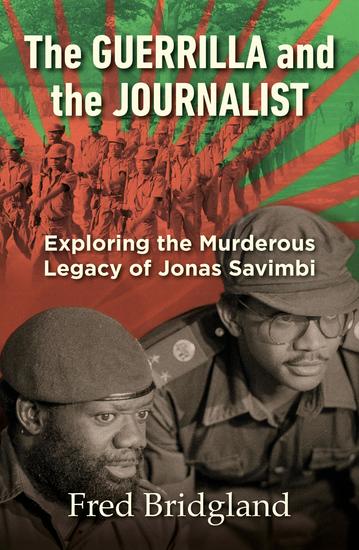
The Guerrilla and the Journalist - Exploring the Murderous Legacy of Jonas Savimbi - cover

The Guerrilla and the Journalist - Exploring the Murderous Legacy of Jonas Savimbi

Fred Bridgland

Publisher: Jonathan Ball

  • 0
  • 0
  • 0

Summary

For many years, UNITA leader Jonas Savimbi was known for his charisma, charm and brio: he convinced millions of his fellow countrymen and also international statesmen that he was Angola's and the West's best hope for democratic rule.
More than 30 years after writing a sympathetic biography of Savimbi, Fred Bridgland sets the record straight. Based on new evidence that has come to light, he reveals the rebel leader's murderous legacy. In the 1970s and 1980s, when Angola was a hotbed of the Cold War, few people would have believed that Savimbi was a manipulative and paranoid tyrant prepared to kill anyone he viewed as a threat to his power.
Tito Chingunji, the brilliant young foreign secretary of Savimbi's UNITA movement, who approached Bridgland to write the original biography in the early 1980s, risked his life to help Bridgland tell the true story of what was going on behind the scenes. This is an account of the intense friendship that developed between the two men, the adventures they shared and the terrifying challenges they faced as they revealed Savimbi's true face.
Available since: 09/21/2022.
Print length: 320 pages.

Other books that might interest you

  • A Rare Recording of President Franklin D Roosevelt's Fourth Inaugural Address - cover

    A Rare Recording of President...

    President Franklin D. Roosevelt

    • 0
    • 0
    • 0
    Franklin Delano Roosevelt (January 30, 1882 - April 12, 1945), also known as FDR, was the 32nd president of the United States, serving from 1933 until his death in 1945. The longest-serving U.S. president, he is the only president to have served more than two terms. His initial two terms were centered on combating the Great Depression, while his third and fourth saw him shift his focus to America's involvement in World War II. The following recording is from his fourth inaugural address delivered on January 20, 1945.
    Show book
  • Fall of Rome The: The History and Legacy of the Western Roman Empire’s Collapse in the 5th Century - cover

    Fall of Rome The: The History...

    Editors Charles River

    • 0
    • 0
    • 0
    For the people of the ancient Mediterranean and beyond, the city of Rome had been a symbol of power for centuries, and entering the early 5th century CE, the Eternal City hadn’t been taken by an enemy force since the Gauls had done it about 800 years, an unheard of period of tranquility in a world wracked with almost constant warfare. 
    	Thus, when the Visigoths, whom the Romans considered uncultured and inferior, took the city of Rome and sacked it in 410, the world was stunned. It made theologians of the newly Christianized empire question God’s plan on Earth, and it encouraged many leading Romans to look east to Constantinople for their future. Indeed, the Western Roman Empire would completely collapse in the late 5th century, less than 70 years after the Visigoths sacked Rome, and just how it went from being a superpower to a poorly led, weak, and vulnerable shadow of its former self has preoccupied historians for centuries.  
    	To this day, it remains difficult to trace just when the decline began, but it’s fair to say that the sack of Rome was the result of a number of factors that had been coalescing for many years. Only Roman arrogance kept the empire from seeing the grave peril its capital was in, which helped bring about the events leading up to the fall of Rome itself. The Latin phrase imperium sine fine (“empire without end”) neatly summed up not just the geographic reach of the mighty empire, but the feeling that it would never end. Nonetheless, little more than 300 years after the end of the Pax Romana, the Western Roman Empire had all but ceased to exist. During the same period, the population of the city of Rome itself declined from over a million people to less than 30,000. Within the walls of Rome, vast areas returned to pastureland and shepherds grazed their flocks in a surreal landscape among the ruins of structures representing the might of the empire.
    Show book
  • Summary: Read People Like a Book - How to Analyze Understand and Predict People’s Emotions Thoughts Intentions and Behaviors: How to Be More Likable and Charismatic Book 9 By Patrick King: Key Takeaways Summary and Analysis - cover

    Summary: Read People Like a Book...

    Brooks Bryant

    • 0
    • 0
    • 0
    DISCLAIMER: THIS IS NOT THE OFFICIAL BOOK. 
    This is a summary, and it does not accompany the official 
    'Read People Like a Book' by Patrick King offers insights into analyzing and understanding human behavior without relying on verbal communication. It goes beyond traditional body language and facial expression analysis, delving into human psychology and nature as influenced by past experiences. The book presents methods to detect lies, understand motivations, and increase emotional intelligence, drawing from scientific research, academic knowledge, and real-life experiences. It provides practical guidance on interpreting physical cues, such as limb movements and eye contact, and emphasizes the importance of context in lie detection. Additionally, the book explores the art of quickly forming deep connections with others and using an understanding of human nature as a tool for influencing and persuading. Patrick King's approach combines his expertise as a social skills coach with various informational sources to offer a comprehensive guide to reading and influencing people effectively.
    Show book
  • The US Congress - A Very Short Introduction - cover

    The US Congress - A Very Short...

    Donald A. Ritchie

    • 0
    • 0
    • 0
    Donald A. Ritchie, a congressional historian for forty years, takes listeners on a fascinating, behind-the-scenes tour of Capitol Hill, pointing out the key players, explaining their behavior, and translating parliamentary language into plain English. He also explores the essential necessity of compromise to accomplish anything significant in the legislative arena. However, recent events show that political polarization has hardened and produced gridlock. The 2020 election also produced a more diverse membership in terms of gender, ethnicity, religion, and ideology, with primary elections resulting in the defeat of moderate candidates, making bipartisan compromise harder to achieve. 


    Among the most significant events, the Senate ignored President Obama's last nomination to the Supreme Court and then adopted a "nuclear option" to streamline future Supreme Court confirmations. The House also twice impeached President Trump, processes that starkly expose the differences between the majority-rule requirements of the House and the super-majority requirements of the Senate. This new edition explains how the parties have changed in light of the unprecedented politics of the past four years, culminating in the mob attack on the U.S. Capitol on January 6, 2021, and how this development has affected both the House and the Senate.
    Show book
  • Zhuangzi | Chuang Tzu - cover

    Zhuangzi | Chuang Tzu

    Zhuang Zhuangzi, Chuang Tsu

    • 0
    • 0
    • 0
    The Chuang Tsu is one of the most important books in Chinese literature and philosophy. It is one of the two foundational texts of Daoism. Also titled Zhuangzi, it is a commentary and extension of the Dao de Jing/Tao Te Ching, in the same way that Mencius' Analects are an exploration of Confucius' thought. Written in around 300BCE during the Warring States period, it is a collection of anecdotes, fables, and stories that are as silly and funny as they are profound and thought provoking.Where the Dao De Jing is a distilled and poetic exploration of the Way, Zhuangi takes a much more human and real-world path through the mysteries of the Dao. Using often humorous anecdotes, allegories, parables and fables mixed with conversations about particular aspects of the Way.James Legge’s translation is perhaps the most sophisticated and exacting one in existence. It carries as much as possible of the subtlety and detail in the original masterwork. It is regarded as one of the greatest literary works in all of Chinese history, and has been called "the most important pre-Qin text for the study of Chinese literature." Its main themes are of spontaneity in action and of freedom from the human world and its conventions. The fables and anecdotes in the text illustrate the illusion of distinctions between good and bad, large and small, life and death, and human and nature. While other ancient Chinese philosophers focused on moral and personal duty, Zhuangzi promoted carefree wandering and becoming one with "the Way" (Dào 道) by following nature.It has influenced great Chinese and Western writers for more than 2000 years, including Oscar Wilde, Yeats, Nietzsche, Sima Xiangru, Li Bai, Su Shi and Lu You.
    Show book
  • American History - A Very Short Introduction - cover

    American History - A Very Short...

    Paul S. Boyer

    • 0
    • 0
    • 0
    Ranging from the earliest Native American settlers to the presidency of Barack Obama, this Very Short Introduction offers an illuminating account of politics, diplomacy, and war as well as the full spectrum of social, cultural, and scientific developments that shaped our country. 


    Here is a masterful picture of America's achievements and failures, large-scale socio-historical forces, and pivotal events. Boyer sheds light on the colonial era, the Revolution, and the birth of the new nation; right up to the tragedy of 9/11, the wars in Iraq and Afghanistan, and the epoch-making election of Barack Obama. Certain broad trends shape much of the narrative—immigration, urbanization, slavery, continental expansion, the global projection of U.S. power, the centrality of religion, the progression from an agrarian to an industrial to a post-industrial economic order. Boyer also highlights the diversity of the American experience and the crucial role of race, ethnicity, gender, and social class in shaping the contours of specific groups within the nation's larger tapestry. And along the way, he touches upon the cultural milestones of American history, from Tom Paine's The Crisis to Allen Ginsberg's Howl. 


    American History: A Very Short Introduction is a panoramic history of the United States, one that covers virtually every topic of importance.
    Show book