Join us on a literary world trip!
Add this book to bookshelf
Grey
Write a new comment Default profile 50px
Grey
Subscribe to read the full book or read the first pages for free!
All characters reduced
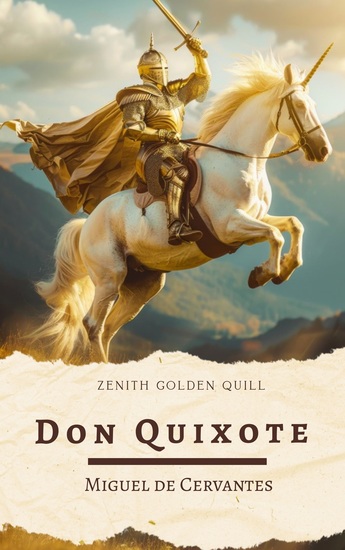
Don Quixote - The First Modern Novel—A Heroic Misadventure That Redefined Literature - cover

Don Quixote - The First Modern Novel—A Heroic Misadventure That Redefined Literature

Miguel de Cervantes, Zenith Golden Quill

Publisher: Zenith Golden Quill

  • 0
  • 0
  • 0

Summary

He dreamed of knighthood in a world that no longer believed in it.

Don Quixote is a literary masterpiece that follows the misadventures of a deluded Spanish nobleman who, inspired by tales of knights and honor, sets out to revive chivalry—accompanied by his faithful squire, Sancho Panza. With windmills as giants and inns as castles, the line between reality and imagination blurs into a deeply human and hilariously tragic quest.

Written by Miguel de Cervantes in the 17th century, this novel revolutionized storytelling with its groundbreaking blend of satire, pathos, humor, and metafiction. As relevant today as it was 400 years ago, Don Quixote explores themes of idealism, delusion, friendship, and the search for purpose.

This edition includes annotations, historical insights, and classic illustrations that bring the story and its significance to life for modern readers.

"The best novel ever written." — Harold Bloom
"A profound work of art that mocks and honors its genre all at once." — The New York Times Book Review

Click Buy Now to embark on literature's most iconic journey of madness, courage, and imagination.
Available since: 05/16/2025.
Print length: 981 pages.

Other books that might interest you

  • Far from the Madding Crowd - cover

    Far from the Madding Crowd

    Thomas Hardy

    • 0
    • 0
    • 0
    "Far from the Madding Crowd," published in 1874, is one of Thomas Hardy's most celebrated novels and the first to introduce readers to the fictional county of Wessex. The story follows the independent and headstrong Bathsheba Everdene, who inherits her uncle's farm and decides to manage it herself, which was unusual for a woman of her time. Throughout the narrative, Bathsheba attracts three very different suitors: the loyal shepherd Gabriel Oak, the mature and prosperous farmer Mr. Boldwood, and the dashing but reckless Sergeant Troy. As the story unfolds, it delves deep into themes of love, honor, and betrayal against the backdrop of the pastoral English countryside.
    Show book
  • Mathias Sandorf - cover

    Mathias Sandorf

    Jules Verne

    • 0
    • 0
    • 0
    Mathias Sandorf is one of Jules Verne's most dramatic and politically charged adventure novels, often regarded as his tribute to The Count of Monte Cristo. Set against the turbulent backdrop of 19th-century Europe, the story weaves together revolution, betrayal, endurance, and justice in a sweeping journey across continents.
    
    The novel follows Count Mathias Sandorf, a Hungarian patriot falsely accused of treason after a conspiracy for national independence is uncovered by treachery. Condemned to imprisonment under brutal conditions, Sandorf seemingly perishes—yet fate has other plans. Years later, he reemerges under a new identity, having survived unimaginable hardships and traveled across Europe, the Mediterranean, and North Africa.
    
    As Sandorf patiently executes an intricate plan to expose his enemies and restore honor to the innocent, the narrative unfolds through daring escapes, secret alliances, advanced scientific methods, and relentless pursuit. Verne blends thrilling adventure with political intrigue, emphasizing themes of resilience, justice, loyalty, and the moral consequences of betrayal.
    
    Rich in geographic detail and marked by constant movement, Mathias Sandorf is a powerful tale of perseverance and revenge shaped by a journey across continents. It stands as one of Jules Verne's most mature and emotionally compelling works—an epic adventure that combines suspense, intelligence, and the timeless quest for freedom and redemption.
    Show book
  • The Story of B24 - From their pens to your ears genius in every story - cover

    The Story of B24 - From their...

    Arthur Conan Doyle

    • 0
    • 0
    • 0
    Arthur Conan Doyle was born in Edinburgh, Scotland on 22nd May 1859.  His childhood was blighted by his father’s heavy drinking which for some years broke up the family. Fortunately, wealthy uncles were willing to support them by paying for education and clothing.  
    He was accepted at the University of Edinburgh to study medicine and also began to write short stories the first, ‘The Haunted Grange of Goresthorpe’, was published in Blackwood’s Magazine.  Despite several other stories and some articles in the British Medical Journal his medical studies took priority. 
    When these finished he was appointed as Doctor on the Greenland whaler ‘Hope of Peterhead’ in 1880 and then, after graduation, as ship’s surgeon on the SS Mayumba on its voyage to West Africa. 
    1882 saw a move to Plymouth and his own independent practice. With few patients he resumed writing and completed his first novel, ‘The Mystery of Cloomber’, although most of his output was short stories based on his experiences at sea.  
    He married Louisa Hawkins in 1885. However, two years later he met and fell in love with Jean Elizabeth Leckie, though they remained platonic out of respect for, and loyalty to, his wife. 
    His literary career suddenly burst into life in November 1886 with ‘A Study In Scarlet’, the first of the fabulously successful Sherlock Holmes stories.  
    With two children to support he now revisited his haphazard commercial arrangements and curtailed everything save for commissions from the Strand Magazine.  
    As a sportsman he was remarkably proficient. He was goalkeeper for Portsmouth Association Football Club and played ten first-class cricket matches for the Marylebone Cricket Club as well as captain of the Crowborough Beacon Golf Club in East Sussex.  
    In 1891 tired of writing Holmes stories, he began a series of historical novels and even went so far as to apparently kill off Holmes in a lethal brawl with his arch-nemesis Moriarty. 
    Despite heavy and sustained criticism he continued to write in support of the Boer War, a fact he thought contributed to his knighthood in 1902.  The following year to great relief and acclaim he brought Sherlock Holmes back from the dead in his first outing for a decade. 
    Sadly, his wife Louisa died from TB in 1906 and, a year later, he at last married Jean.  
    During the War and for several years after family deaths had left him depressed. In a search for solace and answers he alighted upon spiritualism and, such was his interest, that he wrote several books on the subject. 
    On 7th July 1930 Conan Doyle was discovered in the hall of Windlesham Manor, his house in East Sussex, clutching his chest dying of a heart attack.  He was 71.
    Show book
  • Crewe Train - cover

    Crewe Train

    Rose Macaulay

    • 0
    • 0
    • 0
    Rose Macaulay was a fascinating and influential British writer, known for her wit and intellect. She wrote numerous novels, essays and biographies, and she was highly regarded for her versatility as a writer. Her works often explored themes of social change, women’s rights and the complexities of human relationships. She had a unique ability to capture the essence of her characters and the world they inhabited, making her a much-admired figure in the literary world.
    Crewe Train was published in 1926 and follows the story of Denham Dobie, a young woman in her early thirties, who lives a rather uneventful life in London. She is an independent and intelligent woman working as a scriptwriter for a film studio. Feeling dissatisfied with her mundane existence, Denham decides to embark on a journey to visit her eccentric and wealthy father in Crewe. Throughout her journey, Denham encounters a variety of intriguing characters and unexpected events.
    The novel explores themes of societal expectations, gender roles and the search for personal fulfilment. Denham’s journey allows her to question and challenge the norms of the society she lives in, leading to self-discovery and a re-evaluation of her own desires and aspirations.
    Show book
  • Les Misérables: Volume 5: Jean Valjean - Book 4: Javert Derailed (Unabridged) - cover

    Les Misérables: Volume 5: Jean...

    Victor Hugo

    • 0
    • 0
    • 0
    Victor-Marie Hugo (26 February 1802 - 22 May 1885) was a French poet, novelist, essayist, playwright, and dramatist of the Romantic movement. During a literary career that spanned more than sixty years, he wrote abundantly in an exceptional variety of genres: lyrics, satires, epics, philosophical poems, epigrams, novels, history, critical essays, political speeches, funeral orations, diaries, and letters public and private, as well as dramas in verse and prose.
    BOOK 4: JAVERT DERAILED: Javert passed slowly down the Rue de l'Homme Armé. He walked with drooping head for the first time in his life, and likewise, for the first time in his life, with his hands behind his back.
    Show book
  • The Scarlet Pimpernel - cover

    The Scarlet Pimpernel

    Baroness Emma Orczy

    • 0
    • 0
    • 0
    "They seek him here... they seek him there..." 
    It is the bloody height of the French Revolution. Men, women and children are put to death under the blade of the remorseless Guillotine, all to feed a baying mobs lust for blood and murder. Their only hope of salvation comes from a band of 20 brave men from across the channel. Noble daredevils who seek to snatch Madame Guillotine's prey from her clutches, all in the name of sport and excitement. Twenty men; nineteen to obey, and one to command. And that one, hated and hunted by the French Republic, known throughout all of Europe as the most daring, the most cunning member of that band. Identified only by his tell-tale signature: The Scarlet Pimpernel! 
    Narrated by Michael Ward.
    Show book